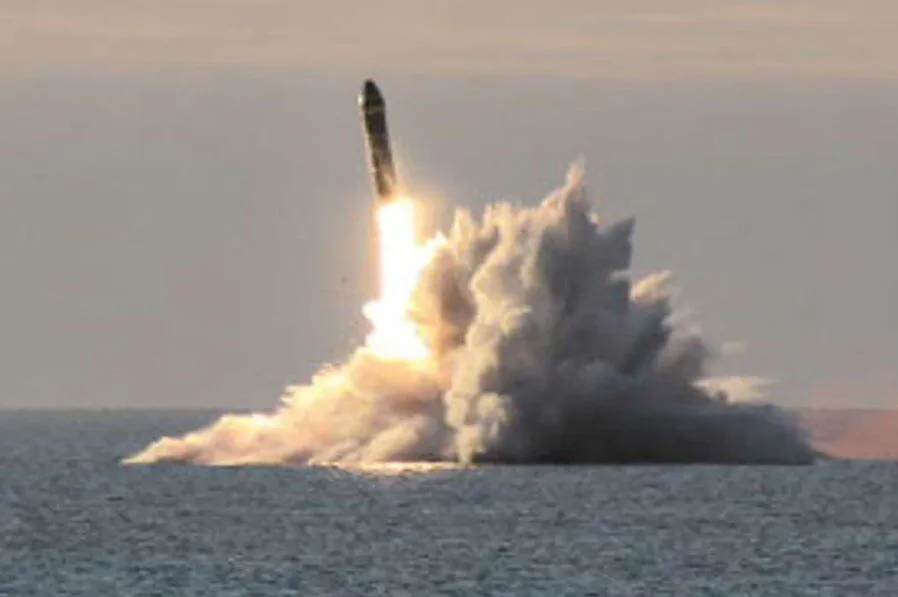
WHAT IT IS
The RSM-56 Bulava (РСМ-56 «Булава»; also R-30 / Р-30; GRAU and industrial index 3M30 / 3М30; the submarine missile complex is D-30 / Д-30; NATO SS-N-32) is a three-stage, submarine-launched ballistic missile. It was designed by the Moscow Institute of Thermal Technology (MIT / MITT / Московский институт теплотехники) under general designer Yuri Semenovich Solomonov, and it is built at the Votkinsk plant in Udmurtia. It is the sea-based counterpart of the Institute’s land-based solid ICBM family — the RT-2PM2 Topol-M and the RS-24 Yars — not a silo or road-mobile land missile, and not a Makeyev liquid SLBM. It is carried in 16 launch tubes on the Project 955 Borei and Project 955A Borei-A nuclear-powered ballistic-missile submarines built at Sevmash to a Rubin design. [DOCUMENTED]
Bulava is the Russian word for a mace. In the treaty record the missile is RSM-56. The missile index 3M30 is the usual GRAU / industrial designation in serious sources; 3K30 appears in some cards as a complex index and should not be treated as a second missile. Older Western and specialist cards also used the provisional NATO names SS-NX-30 or SS-N-30; SS-N-32 is the name used in current CSIS, Bulletin, and most specialist writing. [DOCUMENTED; 3K30 pairing and the older NATO names CONTESTED as current usage]
It is a solid-fuel SLBM with a post-boost bus, ejected “dry” from the tube by a gas generator and lit after it broaches the surface. The START memorandum declared a throw-weight of 1,150 kg and a load of six warheads. Open cards otherwise disagree on almost every soft figure that matters: range, CEP, whether the third stage is solid or liquid, and whether the bus can be loaded with as many as ten reentry vehicles. Those conflicts are kept in the open below, not averaged. [DOCUMENTED for the treaty throw-weight and six-warhead declaration; the rest CONTESTED]
QUICK FACTS
PURPOSE AND PLACE IN THE STRATEGIC FORCE
Bulava is the missile of the new Russian SSBN force. The land leg of the triad is the mobile and silo Yars force, the residual silo Topol-M force, a small Avangard load, and the still-unsettled replacement of the heavy R-36M2 Voevoda by RS-28 Sarmat. The sea leg, once a mix of Typhoon, Delta III and Delta IV boats, is being rebuilt around Borei and Borei-A, each with sixteen Bulavas. The remaining Project 667BDRM Delta IV boats still fire the liquid-fuel Makeyev R-29RMU2 Sineva and R-29RMU2.1 Liner, and will until they are retired. [DOCUMENTED]
The operational idea is second strike. A Borei is meant to be harder to find than a silo, and to be able to fire from a submerged, moving boat in northern or Pacific waters. Russian officials describe the reentry vehicles as able to overcome missile defenses; Western and specialist cards repeat claims of a short boost, a depressed trajectory, maneuvering RVs, and a penetration-aid suite. Those claims are discussed in the warhead section and are not all on the same footing. What is not in dispute is the role: this is the standard load of the boats that are replacing the Soviet SSBN force, not a heavy counterforce silo missile in the Voevoda class, and not a land-mobile ICBM that happens to have been given a naval name. [DOCUMENTED for the force role; defense-evasion details ESTIMATE / UNVERIFIED]
Bulava also sits in a political and industrial argument that never quite went away. Giving a solid SLBM to a land-ICBM bureau, after Makeyev’s Bark failed, was sold as unification and cost-saving — one solid-fuel family, one plant at Votkinsk, common combat equipment with Topol-M and later Yars. The first decade of flight tests was public and ugly. The missile was at sea for years before the formal adoption decree of May 2024. That history is part of what the missile is, not a side note. [DOCUMENTED]
HISTORY AND LINEAGE
The previous attempt at a new solid Russian SLBM was Makeyev’s R-39UTTKh Bark (Р-39УТТХ «Барк»; GRAU 3M91 in the usual specialist pairing). Bark was meant to succeed the liquid and solid SLBMs of the late Soviet force and to arm both the Project 941 Typhoon boats and the new Project 955 design, then planned around a heavier missile and a 12-tube load. After three unsuccessful flight tests the program was cancelled in 1998. Official explanations pointed at the failed shots. Specialist reconstructions also point at size and weight, at a first stage with Ukrainian industrial roots, and at a late-1990s preference for a “cross-service” solid missile that could share an industrial base with the land ICBM force. [DOCUMENTED for the cancellation year and the three failures; the mix of motives is specialist reconstruction]
The next missile was not kept at the Makeyev State Rocket Center in Miass, the bureau that had designed almost every Soviet SLBM. In 1997 a competition was announced; the work went to the Moscow Institute of Thermal Technology, a land-based solid ICBM house whose recent product was Topol-M. The general designer was Yuri Solomonov. The shift was controversial at the time and has been controversial since, because MIT had no record of underwater ejection, tube launch, or a missile that had to live in a salt-water tube on a moving hull. The advertised payoff was a lighter, smaller solid SLBM, built at Votkinsk alongside the land missiles, that would let Borei be redesigned around it. [DOCUMENTED]
That relationship to Topol-M and Yars is real, and it is also easy to overstate. What is documented is the same design bureau, the same production plant, a common solid-fuel philosophy, and repeated official and specialist language about unified or related combat equipment. What is not documented is a shared airframe. Podvig noted as early as 2005 that Bulava is shorter and stockier than Topol-M — about a third shorter, in his side-by-side — and is not a Topol-M simply stood on end and pushed out a tube. Identical stages, an identical physics package, and a shared fuze remain unverified. [DOCUMENTED for bureau, plant and the size difference; common warhead internals UNVERIFIED]
WHO BUILDS WHAT
MIT in Moscow is the prime designer. Serial production is at the Votkinsk plant (Votkinsk Machine-Building Plant), the same factory that builds Topol-M and Yars. Rudolf Kuzin, then the plant’s chief engineer, told reporters in Votkinsk on 27 September 2012 that the factory had already been producing Bulava in series for “three years, even four,” which lines up with a 2008–2009 start, before formal adoption. Some compiled histories also use 2008 as the serial-production year; others treat mid-2011, after the first successful shots from Yuri Dolgoruky, as the point when production in the tested configuration was announced. Those are not the same claim, and they are not averaged here. [DOCUMENTED; the exact start year CONTESTED]
Quality control at Votkinsk and among subcontractors was a public issue during the test failures. A solid-motor test explosion at the plant on 24 May 2004 is recorded in Russian summaries. After a failed launch on 6 September 2013, reports said a batch of missiles was sent back to Votkinsk for inspection; the plant publicly denied that it was responsible for that failure. Admiral Vladimir Vysotsky, as Navy commander, blamed production-technology violations for unsuccessful shots. Those statements are part of the record; they are not a complete failure-cause tree. [DOCUMENTED as reports and denials]
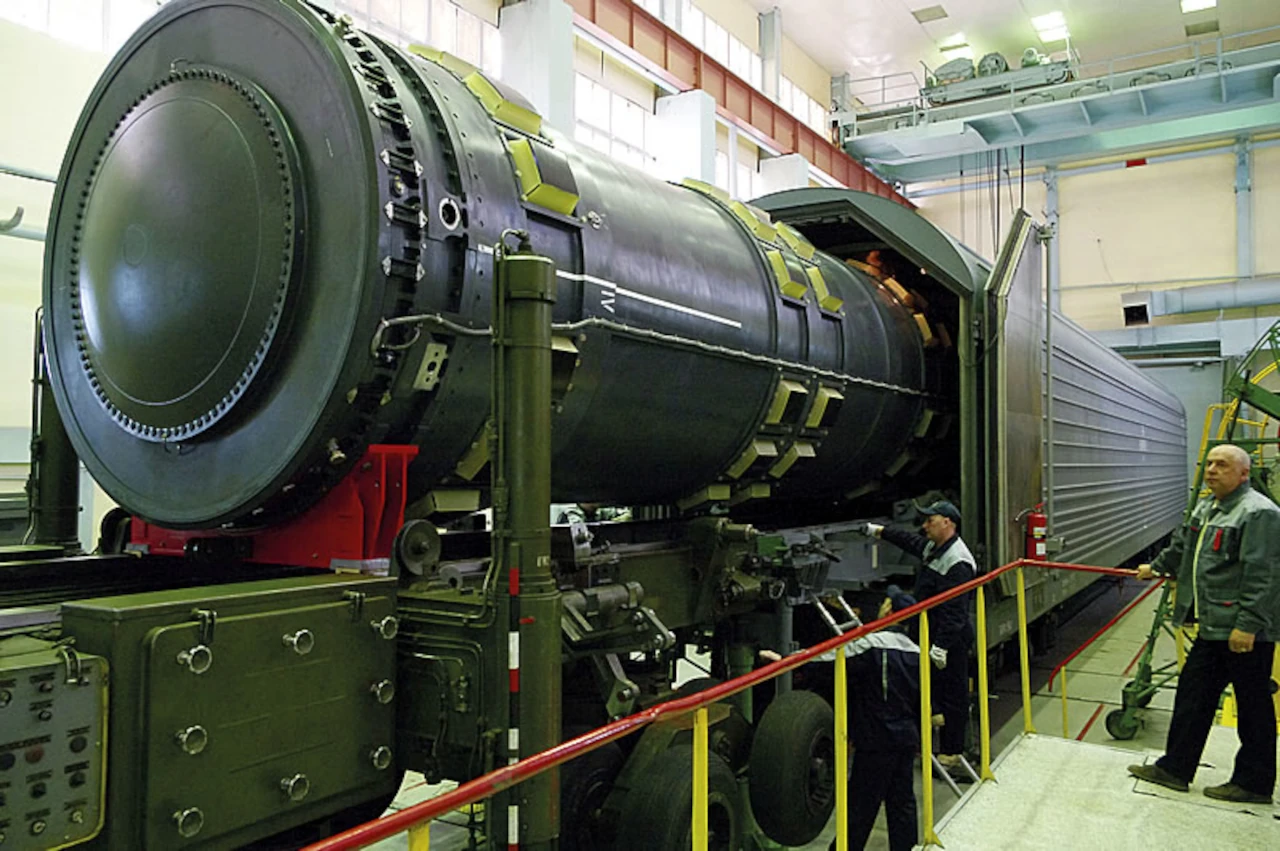
On Zak’s industrial card, NPO Iskra in Perm is the prime developer of the first stage and of the movable nozzle extensions on the second and third stages. Rubin Central Design Bureau is the designer of the boats; Sevmash in Severodvinsk builds them. The lead boat, K-535 Yuri Dolgoruky, was laid down to the older Bark-era design and had to be reprofiled around Bulava, which is one reason her construction ran so long. [DOCUMENTED for Rubin, Sevmash and the redesign; the Iskra credit is from Zak]
Project 955 was originally designed for the D-19UTTKh complex and twelve Bark missiles. When Bark died, the boat was redesigned for the smaller Bulava and the tube count went up, to sixteen, not down. That is the opposite of the casual story that a smaller missile simply shrank the ship. Early press, including Zak’s older running text, still mentions twelve-tube Borei plans; those are superseded. A later rumor that Borei-A would go to twenty tubes is dealt with in the platform section. [DOCUMENTED]
DESIGN OVERVIEW
In outline the missile is a short, thick, three-stage solid SLBM in a transport-launch canister about 12.1 m long and 2.1 m across. The airframe diameter is 2.0 m. The first stage is 3.8 m long and 18.6 t loaded in the START figures. A post-boost vehicle sits on top and dispenses independently targetable reentry vehicles and, in specialist descriptions, decoys. The missile is mortar-ejected from a dry tube and the first-stage motor lights after the nose breaks the surface. [DOCUMENTED]
What the open literature does not settle is the third stage. RIA Novosti and other official Russian wording repeatedly call Bulava a three-stage solid-fuel missile. CSIS Missile Threat does the same on its glance card: “Three-stage solid propellant.” Zak, by contrast, writes “two solid boosters and a liquid upper stage,” and a Missilery.info news card from 2012 describes solid first and second stages with a liquid third stage “to provide the necessary maneuvering speed at the stage of dispensing the warhead blocks.” Some Western encyclopedia cards blur the third stage with a “liquid head stage” or post-boost bus. These may be three different things — a solid third stage plus a liquid bus, a liquid third stage that also dispenses, or sloppy wording — and the public record does not let a reader choose. This article keeps the conflict in view and does not pick a winner. [CONTESTED]
Other design claims should be read with the same caution. Zak reports that the missile was promised an accelerated first-stage ascent against anti-missile systems, and that it was “reportedly capable of withstanding a nuclear explosion as close as 500 meters away.” Russian officials have said the reentry vehicles can overcome existing defenses and can maneuver. Early reports said the tubes on Borei were tilted from the vertical so the boat could fire while moving. None of those last items is a factory data plate, and the tilt claim in particular sits poorly against later descriptions of ordinary vertical tubes and a broach-then-ignite sequence. [UNVERIFIED / early press]
SPECIFICATIONS (PUBLISHED FIGURES)
The cleanest dimensional set in the open literature is the January 2006 START memorandum figures published by Pavel Podvig, which later specialist cards repeat. Conflicting figures are listed beside them, not averaged. Yield, CEP, range, and the ten-warhead load are estimates or contested cards, not treaty facts.
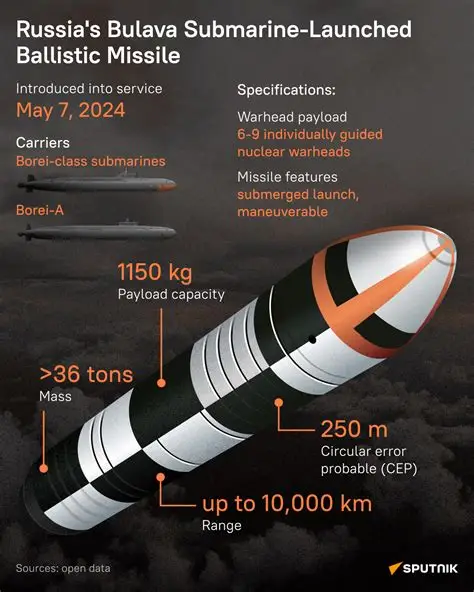
The graphic above is a Sputnik open-data card, not a factory datasheet. It is useful as a specimen of what Russian state media printed after the May 2024 adoption announcement — including a 7 May 2024 date, a 1,150 kg payload, a mass “greater than 36 tons,” a 250 m CEP, a range “up to 10,000 km,” and a “6–9 individually guided nuclear warheads” line that does not match the treaty six or the usual 6–10 specialist band. Those figures are not adopted as official below.
| Item | Published figure | Notes | Tag |
| Launch mass | 36.8 t (START memorandum via Podvig, 2006; Missilery.info news card; CSIS glance card 36,800 kg; Zak). Zak also prints a second line, “Total mass 36 tons.” CSIS body text: 36,000–39,000 kg. | 36.8 t is the usual open working figure and the treaty number. The 36 t line and the 36–39 t band are not treated as a second official mass. | [DOCUMENTED; minority figures CONTESTED] |
| Length | 11.5 m assembled, without the front section; 12.1 m as a unit with the launch canister, which is itself listed at 12.1 m (START / Podvig, Zak, Missilery.info news). CSIS glance card: 12.1 m. CSIS body text: 12–13.5 m. | The 11.5 / 12.1 m pair is a canister-versus-bare-missile distinction, not two missiles. The 12–13.5 m band is a looser Jane’s-derived estimate and is not averaged in. | [DOCUMENTED; 12–13.5 m CONTESTED] |
| Diameter | 2.0 m airframe (without stabilizers, raceways or protruding elements); 2.1 m launch-canister body (START / Podvig, Zak, Missilery.info news, CSIS glance card). | The two figures are missile and canister, not a conflict. | [DOCUMENTED] |
| Stages / propellant | Three stages plus a post-boost bus. Official Russian wording and the CSIS glance card: three-stage solid. Zak: two solid boosters and a liquid upper stage. Missilery.info 2012 news card: solid first and second, liquid third for dispensation maneuvering. | A real conflict, possibly worsened by some cards treating a liquid bus as a “third stage.” Not resolved here. | [CONTESTED] |
| First stage (START figures) | Length 3.8 m; diameter 2.0 m; fully loaded mass 18.6 t. | Second- and third-stage masses are not in the published START extract. | [DOCUMENTED] |
| Throw-weight | 1,150 kg (START memorandum; CSIS; Zak 1.15 t; Missilery.info news). | In the January 2006 memorandum the value was still marked as to be confirmed by flight-test results. It has been the standard open figure ever since. | [DOCUMENTED] |
| Range | 8,000 km (Zak; many Russian summaries). 8,300 km (CSIS glance card). 9,300 km (compiled Russian tables). “Up to 10,000 km” (Sputnik open-data graphic). Some Western text also uses 9,500 km in a throw-weight/range sentence. | 8,000–8,300 km is the usual working band. Higher figures are not averaged in and are not official range plates. | [CONTESTED] |
| Warhead load | Six, in the January 2006 START declaration (Podvig). Specialist cards: 6, or 6–10, or “up to 10” (CSIS glance card; Missilery.info news; Zak). Sputnik graphic: 6–9. Bulletin 2026 table: 6 × 100 kt, with a download assumption of four for counting. | Six is the treaty number. Ten is a recurring maximum in open cards and is tight against a 1,150 kg throw-weight if the RVs are in the Topol-M / Yars class. See the warhead section. | [DOCUMENTED for six; 10 CONTESTED] |
| Yield | Official Russian sources do not publish a yield. Common specialist band: 100–150 kt per RV. Bulletin 2026 table uses 100 kt. CSIS glance card 100–150 kT; CSIS body text 100–160 kT. Zak’s table prints “1–1.5 megaton each,” which is an order of magnitude above the specialist band and is not treated as a second official yield. | 100 and 150 are not averaged to 125. The megaton-class line is discussed as a likely unit-scale error in the warhead section. | [ESTIMATE / CONTESTED] |
| CEP | Not officially published. Zak: 350 m. CSIS / Jane’s: about 250–300 m. Compiled Russian tables sometimes give 120–350 m. Sputnik graphic: 250 m. | A spread, not a measurement. It matters for any hard-target claim and is not averaged. | [ESTIMATE / CONTESTED] |
| Guidance | Autonomous inertial, in official and specialist wording. Astro-inertial (star-sight) correction and GLONASS updates are widely claimed in compiled cards. | The satellite and star-sight additions are not in an official public specification. | [DOCUMENTED for INS; astro / GLONASS UNVERIFIED as official detail] |
| Launch method | Dry / cold ejection from the tube by a gas generator (powder / steam-gas), first-stage ignition after broach. Designed for submerged launch, including from a moving boat in specialist descriptions. | Open sources do not publish a official depth or speed envelope. | [DOCUMENTED for dry/submerged launch; envelopes UNVERIFIED] |
| Platforms | 16 tubes on Project 955 / 955A. Project 941 TK-208 Dmitry Donskoy as a converted testbed, withdrawn from the combat force in February 2023. | Not carried on Delta IV / Sineva-Liner boats. | [DOCUMENTED] |
AIRFRAME AND THE THREE STAGES
Compared with the liquid Makeyev SLBMs, Bulava is short and fat: 11.5 m of missile, 2.0 m of airframe, 36.8 t on the pad of a treaty table. The first stage alone is half the launch mass, 18.6 t, in a 3.8 m section. Second- and third-stage masses were not in the published START extract. Composite cases, specific motor names, and plant-level nozzle drawings are not in the public official record; Zak’s credit to NPO Iskra for the first stage and for movable nozzle extensions is the most specific industrial note in the open specialist cards. [DOCUMENTED for the START dimensions; motor-plant detail SINGLE-SOURCE]
The propellant argument is the one that will not close. A solid first and second stage is not in dispute. RIA Novosti, in multiple reports, called the missile a “three-stage solid-fuel missile” (трехступенчатая твердотопливная ракета), and Rossiyskaya Gazeta repeated the all-solid wording when it covered the May 2024 adoption. CSIS, on the glance card that most Western readers see first, also says three-stage solid. Against that, Zak’s specification table says two solid boosters and a liquid upper stage, and the Missilery.info news item that quoted Votkinsk in 2012 said the third stage was liquid so the missile could maneuver while the warhead blocks were dispensed. Encyclopedia cards that talk about a “liquid head stage” may be pointing at the post-boost vehicle rather than a third sustainer. Until a primary official diagram is published, a careful reading is that stages one and two are solid, that the missile is officially described as solid overall, and that a liquid third stage or a liquid bus is a live specialist claim, not a settled fact. [CONTESTED]
A short boost and a depressed trajectory, if they are real, belong as much to this section as to the warhead section. A solid first stage can be burned out quickly; a depressed path trades range and heating for less warning time and a harder intercept geometry. Russian officials have talked about an accelerated ascent and about overcoming defenses. Those are claims, not flight-test telemetry in the public domain. [ESTIMATE]
DRY LAUNCH FROM THE TUBE
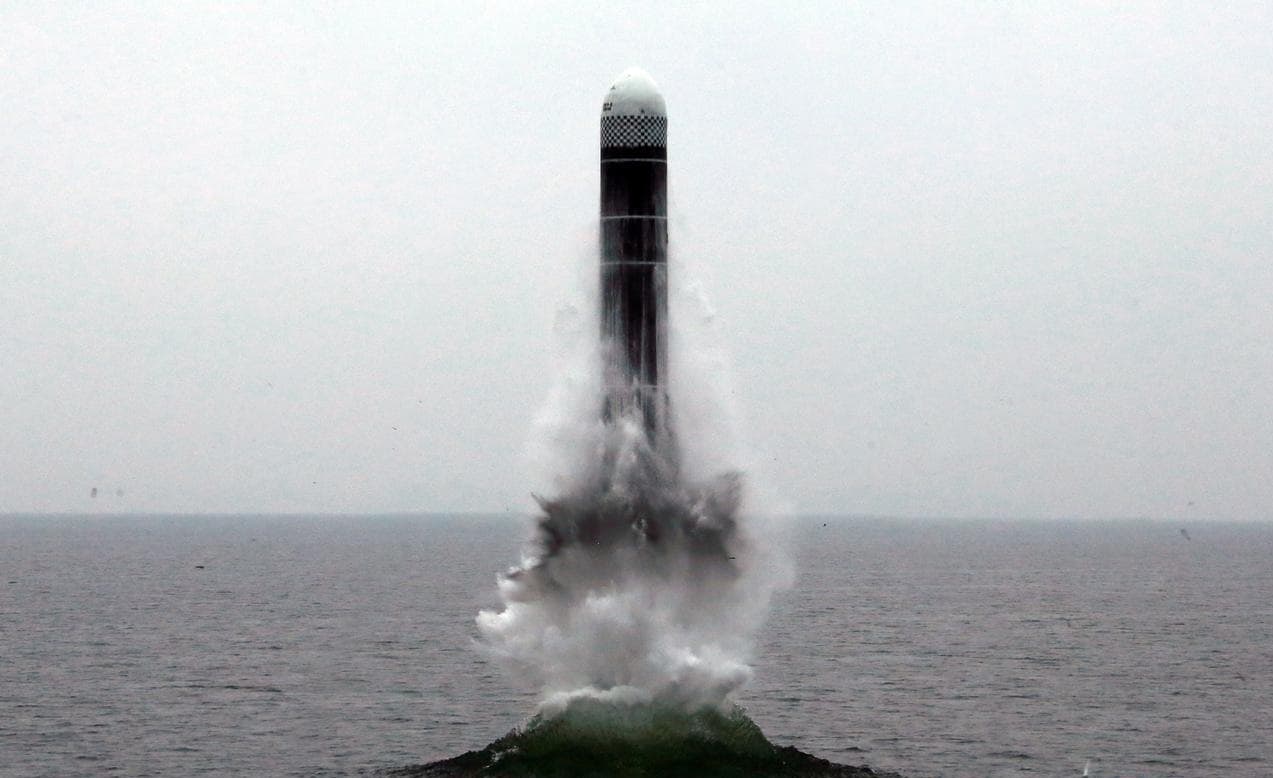
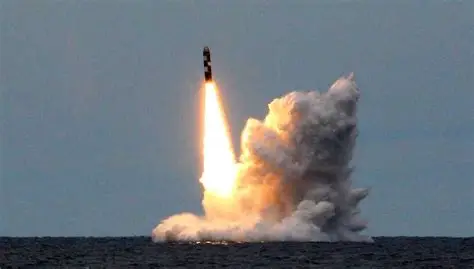
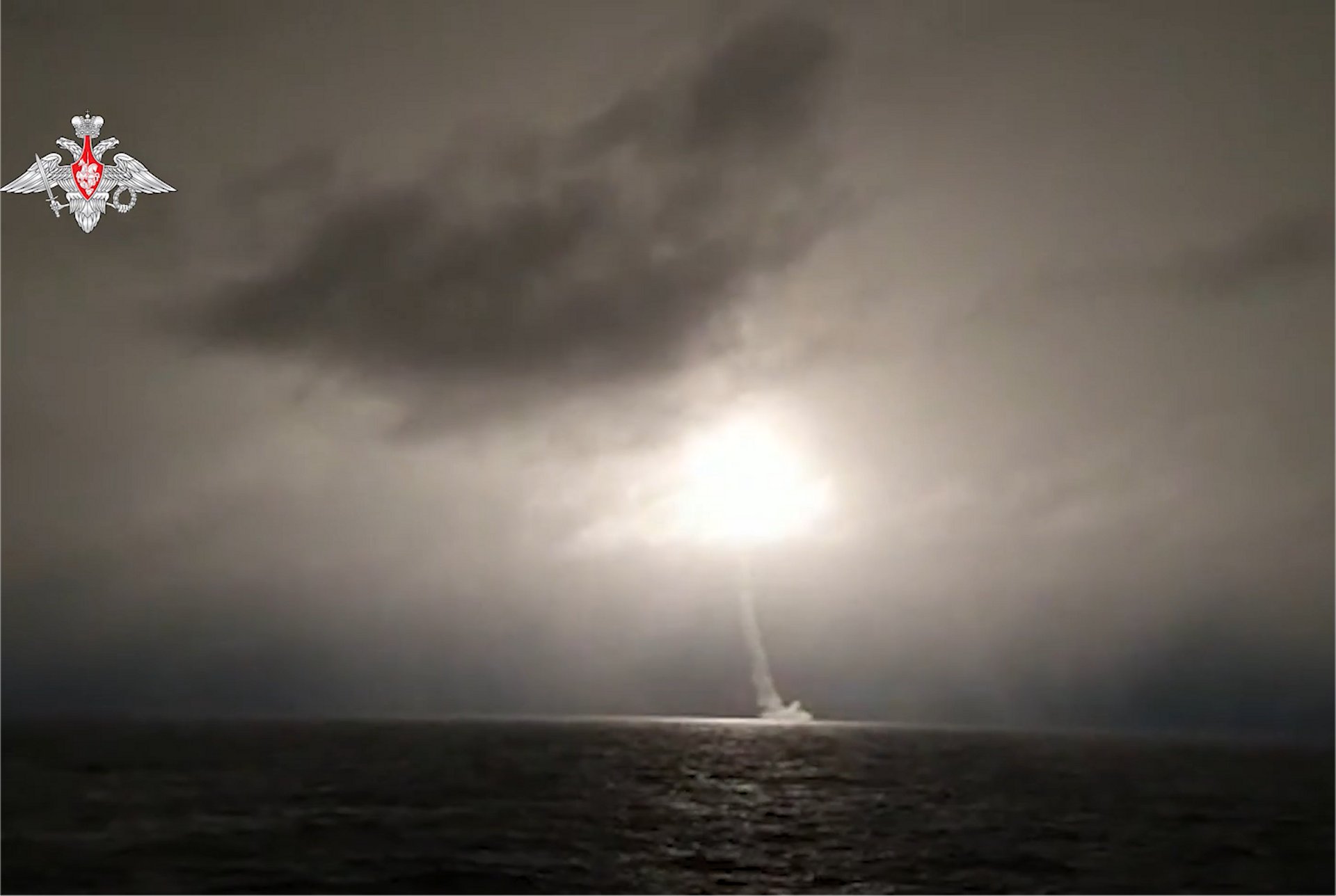
The photograph above is the moment the method is built around: the missile is already out of the water, the white nose cap and the checkered band are visible, and the first-stage motor has not yet lit. That is a dry, or cold, launch. A gas generator in the tube — a powder pressure accumulator or steam-gas ejector, in the language used for other Russian cold-launch missiles — pushes the canistered missile out. The first-stage solid motor ignites only after the missile has broached. The tube itself is not a combustion chamber. Zak records a September 2004 submerged mockup ejection from Dmitry Donskoy in which the PAD pressure generator threw the mockup to about 30–40 m. [DOCUMENTED]
This is the marine version of the mortar ejection used on the land Topol-M / Yars force, not a “wet” launch in which the motor lights in a flooded tube. Earlier Soviet SLBM families used more than one method, including gas-steam systems that created a cavity at the muzzle; those histories are not retold here. What matters for Bulava is that the design is built for a submerged shot, and that specialist descriptions also say the boat can be moving. Early press added that the tubes were installed at an angle so the missile could be fired from a moving or even a turning boat. Later public description is of a vertical ejection and ignition above the water. The tilt is left as early reporting, not as a settled feature of the 16-tube Borei. [DOCUMENTED for dry/submerged launch; moving-boat and tilted-tube details UNVERIFIED / early press]
Open official sources do not publish a launch-depth window, a speed envelope, or a sea-state limit, and this article does not invent one. The RIA Novosti Sineva graphic later in this page gives 55 m for that older liquid missile; that figure is not a Bulava number. Under-ice launch is a claimed Borei capability, in the same family of Arctic claims long made for Project 941. No documented under-ice Bulava flight test turned up in the sources used for this article. A Pacific submerged shot in open water is a different thing, and is documented: on 28 October 2026, Generalissimus Suvorov fired from the Sea of Okhotsk toward the Chizha range on the Kanin Peninsula. [DOCUMENTED for that test; under-ice launch UNVERIFIED]
A FLIGHT, STEP BY STEP
A combat shot, in the open description, looks like this. The boat is at launch depth, on a firing course. The tube is prepared and the gas generator fires. The canistered missile leaves the hull, punches through the surface, and sheds or leaves the launch hardware as the first-stage motor lights in air. The first stage burns and separates. The second stage burns and separates. The third stage, whatever its propellant, puts the post-boost vehicle onto the desired trajectory. The bus then dispenses reentry vehicles and, in specialist descriptions, decoys, on independent paths. The RVs reenter and fuze. Test shots from the Barents or White Sea have usually been aimed at the Kura impact range on Kamchatka; Pacific shots have been aimed west, at Chizha on the Kanin Peninsula. [DOCUMENTED as the standard sequence; decoy load and third-stage type CONTESTED]
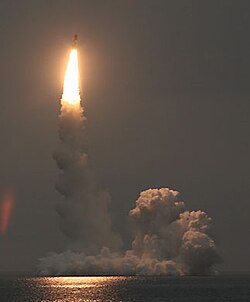
A salvo is the same sequence, more than once, on a short interval. Yuri Dolgoruky fired two missiles from a submerged position in the White Sea on 23 December 2011, toward Kura, and four from a submerged position in the White Sea on 22 May 2018. A four-missile Pacific salvo was fired on 12 December 2020. Those shots are the public proof that the tube farm and the fire-control system will support more than a single trial round. [DOCUMENTED]
GUIDANCE, NAVIGATION AND CONTROL
The published guidance description is an autonomous inertial system. Compiled cards add astro-inertial (star-sight) correction and GLONASS updates, the same pairing long claimed for the land solid ICBMs from the same bureau. No official public CEP is attached to those claims. The open numbers run from about 120 m on the optimistic end of compiled Russian tables, through 250–300 m on the CSIS / Jane’s card and 250 m on the Sputnik graphic, to 350 m on Zak. That is a spread of more than a factor of two, and it is not a measurement. It is wide enough that a hard-silo mission and a city or soft-military mission are different conversations, which is why the figure is not averaged and why it comes back in the warhead section. [DOCUMENTED for INS; astro / GLONASS UNVERIFIED as official detail; CEP ESTIMATE / CONTESTED]
In-flight retargeting and maneuver at the boost or bus stage are claimed in some Western and official wording. They are not demonstrated in a public test record that names those modes. The fire-control side on the boat is the D-30 complex, managing the 16 tubes. Named interior fire-control boxes beyond that designation were not found in the sources used here. [UNVERIFIED for retargeting modes; D-30 as the complex name DOCUMENTED]
THE WARHEAD AND THE REENTRY VEHICLE
This is the part of the missile that the open literature is least willing, or least able, to pin down, and it is the part that decides what Bulava is actually for. The official Russian public record does not publish a yield, a fuze type, a hardening specification, or a factory description of the reentry vehicle. Almost everything that follows is a specialist card, a treaty number, or an official phrase that stops short of a drawing. The conflicts are kept un-averaged.
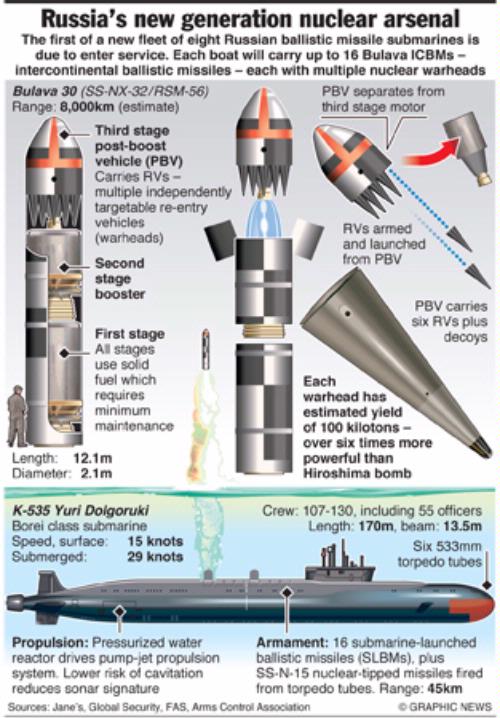
The diagram above is a Graphic News card that cites Jane’s, FAS and the Arms Control Association. It is not a plant plate. It is useful because it makes the usual open story visible in one picture: a three-stage missile, a post-boost vehicle, six reentry vehicles plus decoys, and an estimated 100 kt class yield. It also uses the older “Bulava 30” / SS-NX-32 wording, prints an 8,000 km estimate and a 12.1 m / 2.1 m pair, and says all stages are solid. Like the Sputnik graphic, it is evidence of what was being printed, not of what was stamped on a warhead.
Lineage with Topol-M and Yars. MIT designed all three. Votkinsk builds all three. Missilery.info, in its Topol-M material, has long written that a prospective small-class warhead of about 150 kt for a MIRV Topol-M / Yars-type missile would be unified with the combat equipment of the D-30 / R-30 Bulava complex, and that the land and sea programs were, in official language, substantially unified in design nodes and in the production cooperative. That is the strongest documentary hook for a family relationship at the warhead end. What it does not say, and what no public technical manual in the sources used here says, is that the physics package, the fuze, and the RV body are identical. Early reports that Bulava had a “completely different layout” from the land missiles should be read against Podvig’s 2005 size comparison: the sea missile is a different airframe. Unification of combat equipment is a live, sourced claim. Identity of the warhead is not demonstrated. [DOCUMENTED for bureau, plant, and the unification language; identical RV / package / fuze UNVERIFIED]
The reentry vehicle itself. Open descriptions call the vehicles independently targetable, and often maneuverable — a MaRV rather than a simple ballistic RV — with the ability to maneuver in yaw and pitch, in the wording of compiled Russian tables. Defense-Update and some official phrases go further and talk about in-flight retargeting and about evading interceptors. Rossiyskaya Gazeta, covering the 2024 adoption, wrote that the missile carries six “hypersonic” individually targeted blocks, which is official-language use of a word that Russian press applies loosely to any high-speed RV. There is no public photograph of a Bulava RV that can be used as a design document, no official statement of whether the vehicle is a new shape or a member of the land-missile RV family, and no public ablative-nosetip or radar-cross-section figure. Maneuvering RVs, if they are real, would be a penetration feature as much as a guidance feature. They remain a claim. [ESTIMATE / UNVERIFIED]
Yield, un-averaged. The working specialist band is 100–150 kt per RV. Podvig has used that class for years. CSIS prints 100–150 kT on the glance card and 100–160 kT in the body text, which is the same band with a slightly higher ceiling, not a different weapon. Bulletin 2026’s force table uses 6 × 100 kt, a single-point card inside that band, not a measurement. Official Russian sources do not publish a number. Two much higher figures appear in the wider literature and should be handled carefully. Some secondary cards, including older GlobalSecurity-style entries, have printed a 550 kt yield; that number sits on the R-29RM family (Zak’s R-29RM line is 4 × 0.55 Mt) and is not adopted here as a Bulava figure. Zak’s own Bulava table prints “Warhead yield 1–1.5 megaton each,” and his SLBM summary table repeats “6–10 × 1–1.5.” That is an order of magnitude above 100–150 kt (which is 0.10–0.15 Mt). It is kept in this article as a published-card conflict, and it is not treated as a serious alternative official yield; a unit-scale slip in a compiled table is the more likely reading, but the page does not silently correct it. One hundred and 150 are not averaged to 125. [ESTIMATE / CONTESTED]
Six versus ten, and the 1,150 kg throw-weight. The January 2006 START memorandum declared six warheads, and Podvig wrote at the time that the number appeared final: Russia intended to deploy the missile with six. That is the hardest number in the payload file. Almost every later open card, including CSIS (“up to 10 MIRVs, 1,150 kg”), Missilery.info’s 2012 news item (ten blocks of 100–150 kt), and Zak (6–10), keeps a ten-warhead maximum in play. The Sputnik graphic splits the difference at 6–9. A 1,150 kg throw-weight is not generous. Ten RVs in the 100–150 kt class, plus a bus, plus a penetration-aid suite, would require lighter vehicles than a six-vehicle load, or a thinner decoy set, or both. Analysts who take the treaty six as the operational load treat ten as a paper maximum or a counting hedge. Analysts who take “up to 10” at face value have to assume a smaller RV or a reduced aid package. This article does not invent a per-RV mass to close that gap. It is a MIRV system — independently targeted vehicles, not a simple MRV cluster. A single-warhead or variable-load option is sometimes inferred from the existence of a download under New START accounting, but a formal official monoblock variant is not documented. [DOCUMENTED for the six-warhead declaration and the 1,150 kg throw-weight; ten-warhead load CONTESTED]
Bulletin 2026 and Podvig both think the at-sea load is already lower than six, for counting reasons, not because the bus cannot hold six. Bulletin assumes one Borei in maintenance, warheads assigned to the other seven, and a download to four RVs per missile to stay near the New START deployed-warhead ceiling, which gives about 448 deployed Bulava warheads against a 672-warhead stockpile card (8 boats × 16 missiles × 6). Podvig, in January 2026, assumes a download to three, as part of a force-wide arithmetic that also downloads silo Yars and R-29RM and comes out at about 544 SLBM warheads and 1,531 deployed strategic warheads. Those are accounting hypotheses, clearly labeled as such by their authors, and they are not a third physical warhead count. [ESTIMATE]
Hardening. Russian wording talks about a “complex to overcome missile defenses” and about a missile that can complete its mission after a nearby nuclear burst. Zak’s 500 m nuclear-environment claim is the most specific number attached to that language, and it is not a cited test report. Open cards do not publish an EMP hardness, an X-ray fluence, a laser or directed-energy coating, or an ABM-defeat hardness figure. Brochure language about laser-hardened or directed-energy-resistant RVs appears in secondary descriptions and is unverified. A marine second-strike warhead would, as a design matter, be expected to have nuclear-environment hardening; expectation is not a specification. [UNVERIFIED]
Penetration aids and trajectory. Specialist descriptions of the post-boost vehicle include decoys — inflatable decoys and chaff are the usual Western inference — and sometimes active jammers or other electronic countermeasures on the bus or the RVs. Missilery.info and official phrasing stay at the level of a defense-penetration complex, without a parts list. The Graphic News card drawn above is unusually explicit in saying the bus carries six RVs plus decoys; that is a journalist’s diagram, not a sale document. A depressed trajectory, a short boost, and a lower apogee are the other half of the penetration story: less warning time, a flatter intercept geometry, more heating on the RV. Russian officials emphasize the ability to overcome “any existing” missile defense and do not itemize ECM or radar-cross-section work. Reduced-signature RV claims are unverified. [ESTIMATE / UNVERIFIED]
Fuzing and the targeting role. Airburst versus contact or lay-down fuzing is not described in the official public record. The force role is clearer than the fuze. Bulava is the standard weapon of a survivable SSBN, which is a second-strike assignment: to be able to answer, not to open a silo field in the first fifteen minutes of a war. That does not make every target a city. A 100–150 kt RV with a CEP in the 250–350 m band is in a gray zone for hard, buried silos and command bunkers, and is more than enough for area, port, base, and countervalue targets. If the vehicles really are maneuvering MaRVs, some of that CEP discussion is beside the point, because the miss distance is then a guidance-and-maneuver problem, not a pure ballistic one. If they are not, then Bulava is a poorer hard-target tool than a heavy liquid silo missile such as Voevoda or a hoped-for Sarmat, and a different tool from a land-mobile Yars that can be flushed and still aimed at military targets. Bulletin and Podvig both treat the naval warhead, including on Liner, as the same general small-class vehicle, which would be consistent with a shared second-strike / general-purpose RV rather than a specialized silo-buster. That is inference from force structure, not a targeting order. [ESTIMATE]
THE BOREI AND BOREI-A SUBMARINES
The carrier is the point of the missile. Project 955 Borei (Борей) and Project 955A Borei-A (Борей-А) were designed by Rubin and are built at Sevmash. Each boat has 16 launch tubes for Bulava. That figure is no longer in serious dispute. It is the number used by the Ministry of Defence, TASS, Bulletin 2026, Podvig, and the boats’ commissioning coverage. [DOCUMENTED]
Two earlier numbers have to be retired in public. The original Project 955 design was for twelve Bark missiles; that plan died with Bark, and the redesigned boat went to sixteen smaller tubes. Separately, in March 2012, Podvig recorded plans that the main difference of Borei-A would be an increase from 16 to 20 missiles. On 20 February 2013, a Navy-source report carried by Sputnik said the later boats would carry only 16, “rather than the 20.” The rumor is part of the record; the settled load is 16. CSIS still has a stale “12–16” clause on a page last updated in 2024; it should not be preferred to the later official and specialist count. [DOCUMENTED; the 20-tube plan retracted]
This is not a full class article, and boat-level quieting, displacement, and reactor type are not all on the same footing in open sources. Pump-jet propulsors, new anechoic coatings, and a quieter machinery fit are repeatedly attributed to the class, more strongly to the 955A boats. Specific OK-650-family reactor designations and a definitive submerged-speed or displacement card were not locked down in the primary sources used here, and popular figures are not repeated as fact. What matters for Bulava is the 16-tube farm, the boats’ assignment to the two SSBN fleets, and the fact that the missile and the hull were redesigned around each other. [DOCUMENTED for tubes and builders; detailed boat specs ESTIMATE / UNVERIFIED]
FLEETS: GADZHIYEVO AND VILYUCHINSK
The Northern Fleet boats are based at Gadzhiyevo (Yagelnaya Bay) on the Kola Peninsula, with the 31st Submarine Division. The Pacific Fleet boats are based at Vilyuchinsk (Rybachiy) on Kamchatka, with the 25th Submarine Division. As of Podvig’s January 2026 count, the split is three Borei / Borei-A boats in the Northern Fleet and five in the Pacific Fleet, with a long-term plan, also reported by TASS and used in Bulletin 2026, of six and six once the class reaches twelve hulls and the remaining Delta IVs go away. [DOCUMENTED]
The eight boats in service by late 2026, with the usual pennant numbers, are:
The Pozharsky date is a small conflict worth keeping. Podvig wrote that the boat was accepted into service in June 2025. Izvestia, in a January 2026 review of the year’s naval deliveries, describes a flag-raising at Severodvinsk on 24 July 2025, with President Putin present, as the boat entered the Northern Fleet. Those can both be true — a navy acceptance and a later ceremonial commissioning — but they are not the same day, and they are not merged here. [CONTESTED as to the exact service-entry day]
Two further Project 955A boats, a new Dmitry Donskoy (the name reused after the Typhoon testbed was withdrawn) and Knyaz Potemkin, were under construction at Sevmash in 2026; TASS in March 2026 said the new Dmitry Donskoy would eventually enter the fleet, and Izvestia expected a 2026 launch. Bulletin 2026 counted four boats in various stages of construction toward a planned twelve. [DOCUMENTED as construction status, not as commissioning]
DMITRY DONSKOY, THE TESTBED
Before any Borei was ready, the missile needed a tube at sea. The Project 941 Typhoon TK-208 Dmitry Donskoy (Дмитрий Донской) was converted as a testbed. A new launch cup was inserted into one of the existing R-39 tubes so the smaller Bulava could be ejected from a Typhoon-class hull. The first throw tests, the first powered flight, the first submerged flight, and most of the painful 2006–2009 shots were fired from that boat. She was withdrawn from the Navy’s combat composition in February 2023; later reporting has mentioned disposal, with occasional museum proposals. She should not be confused with the new Project 955A boat that has been given the same name. [DOCUMENTED]
THE TROUBLED FLIGHT-TEST PROGRAM
The public test record is long, and it is not a straight line. A first surface throw of a mockup from Dmitry Donskoy is dated 11 December 2003 by Zak and 10 December 2003 by Izvestia; the day is contested, the event is not. A submerged mockup ejection followed on 23 September 2004. The first powered flight was on 27 September 2005, from Dmitry Donskoy on the surface in the White Sea, at 17:22 Moscow time, under Captain Arkady Romanov, to the Kura range — a shot delayed from at least May. The first submerged powered flight was on 21 December 2005, again from Dmitry Donskoy. [DOCUMENTED; 10 versus 11 December 2003 CONTESTED]
Then the program became famous for the wrong reasons. A 7 September 2006 shot from Dmitry Donskoy failed after several minutes with a flight-control problem and fell into the sea. A 21 December 2006 shot failed about three minutes after liftoff, attributed to third-stage flight control, with the self-destruct apparently used. An 11 November 2007 shot destroyed itself about 23 seconds after liftoff. A 18 September 2008 failure, in Podvig’s contemporaneous account drawing on Kommersant, came after all three stages had worked, when the warhead bus did not separate or operate. A successful multiple-target shot from a submerged Dmitry Donskoy in the White Sea to Kura was reported on 28 November 2008. Failures continued into 2009. Solomonov told Interfax that failures were the price of new physical phenomena. He left the general-designer post in July 2009 in widely reported accounts. A December 2009 failure led to a suspension of about nine months while a commission looked at causes; nozzle defects and substandard components, including assembly quality at Votkinsk or among subcontractors, were among the explanations placed on the record. A single official failure-cause tree for every shot was never published. Compiled counts of “six failures in thirteen tests” or “about half of fifteen” should be treated as tallies, not as a plant statistic. [DOCUMENTED for the dated shots and the public explanations; aggregate failure-rate figures CONTESTED]
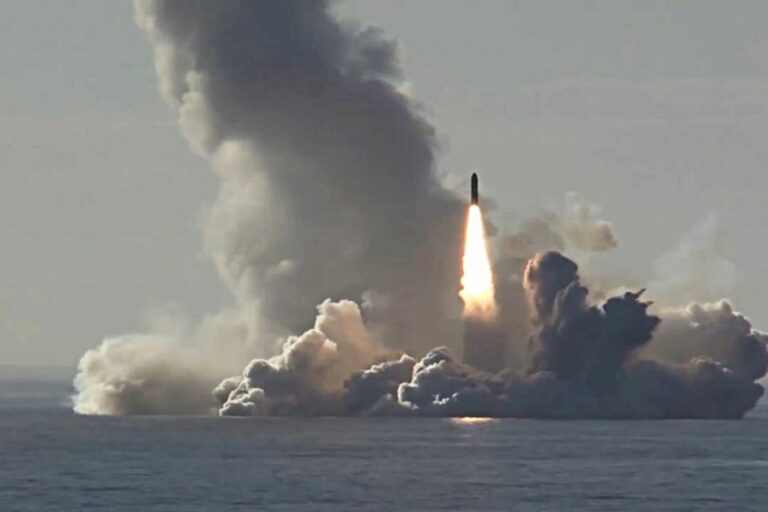
The turnaround is dated to 2010–2011. Yuri Dolgoruky fired successfully from a submerged position in the White Sea to Kura on 28 June 2011 and again on 28 October 2011, and on 23 December 2011 she fired the first two-missile salvo, also submerged, also to Kura. Those shots were used in official language as the path to state acceptance. A four-missile salvo from the same boat, submerged in the White Sea, was fired on 22 May 2018, with impacts reported at the Chizha / Kanin area in contemporary coverage. Later single shots and acceptance shots from the newer boats — including Knyaz Oleg on 21 October 2021 from the White Sea to Kura, a four-missile Pacific salvo on 12 December 2020, Knyaz Oleg again toward Chizha on 29 October 2024 during a strategic exercise, and Generalissimus Suvorov from the Sea of Okhotsk toward Chizha on 28 October 2026 — are the public evidence that the missile was no longer a test article looking for a first success. An official reliability percentage after the fixes was not found in the primary sources used here. [DOCUMENTED]
EXPERIMENTAL DUTY AND THE MAY 2024 ADOPTION
The dates people use for “in service” are not one date. Yuri Dolgoruky entered experimental combat duty (опытная боевая эксплуатация) on 10 January 2013. Alexander Nevsky and Vladimir Monomakh followed her into the force, and the Pacific transfer of the second and third boats gave Bulava its second ocean. In 2012, Admiral Viktor Chirkov, then Navy commander, told Rossiyskaya Gazeta that Bulava had been “de facto adopted,” with the paperwork still being completed. In 2018, TASS, citing a source, wrote that formal adoption would come by the end of that year; the report was not officially confirmed, though some compiled English cards, including Wikipedia’s English page, still treat June 2018 as an acceptance date after successful firings. CSIS, on a page updated in 2024, still prints “In service: 2013.” Bulletin 2026’s table uses 2014 as the year deployed. [DOCUMENTED as a set of conflicting service-entry markers]
The formal legal end of that story is later, and it is on the record as a statement by the designer, not as a published decree text. On 14 May 2024, Yuri Solomonov told TASS: “On 7 May of this year a decree was signed on the adoption into service of the Bulava missile complex.” Kommersant, Rossiyskaya Gazeta, Izvestia, RBC, and Missilery.info all carried the line the same day. The missile had by then been at sea on experimental or operational duty for more than a decade, and seven Borei-class cruisers were already in the Northern and Pacific Fleets, each with 16 tubes, in the TASS wording of that week. The delay is not fully explained in public. The long test failures, the lingering paperwork Chirkov had pointed at in 2012, and a drawn-out formal close-out of state tests are the usual explanations; they are inferences from the timeline, not a published ministry account of why a 2013 duty missile waited until 2024 for an ukaz. [DOCUMENTED as Solomonov’s statement of a 7 May 2024 decree; the decree text itself was not independently published in the sources used here]
COMPARED WITH OTHER SLBMS
A like-for-like table is harder than it looks, because the four missiles do not come with one official card. Sineva and Liner are liquid Makeyev missiles on the remaining Delta IVs. Trident II D5 is the US (and UK) solid SLBM. M51 is the French solid SLBM. Figures below are attributed; conflicts are not averaged. Liner can, in specialist accounts, carry the same warhead class as Bulava, which is why the Russian sea-leg comparison is not only solid versus liquid, but also two buses that may throw related vehicles.
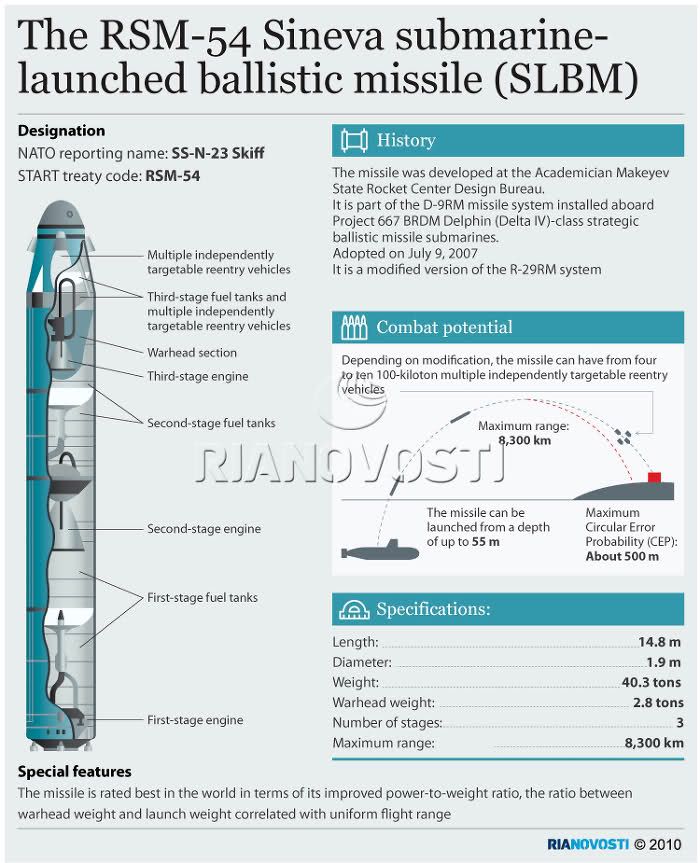
The graphic above is a 2010 RIA Novosti card on RSM-54 Sineva, not on Bulava. It is placed here because it is a contemporaneous official-media specification sheet for the liquid missile still sharing the sea leg: 14.8 m, 1.9 m, 40.3 t, 2.8 t warhead weight, three stages, 8,300 km, launch depth up to 55 m, CEP “about 500 m,” and four to ten 100 kt-class MIRVs “depending on modification.” Other cards give Sineva four 500 kt-class vehicles as the standard load. Both are kept in the table.
| Item | RSM-56 Bulava (3M30, SS-N-32) | R-29RMU2 Sineva / R-29RMU2.1 Liner (SS-N-23) | UGM-133A Trident II D5 | M51 |
| Status (late 2026) | In service on 8 Borei / Borei-A boats; formal adoption decree reported 7 May 2024; at sea since 2013 experimental duty | Sineva adopted 9 July 2007 (RIA card); Liner adopted 2014 in specialist accounts; still on 5 operational Delta IVs, plus one boat in overhaul (Podvig, Jan 2026) | IOC 1990; in service on US Ohio and UK Vanguard boats, with D5LE life-extension loads | First deployed 2010; M51.2 in service; M51.3 in introduction in specialist reporting; M51.4 development ordered by DGA in September 2025 |
| Launch mass | 36.8 t (START / Podvig, CSIS, Zak) | 40.3 t (RIA 2010 Sineva card; widely repeated). Zak: “more than 40 t” for Sineva / Liner | About 59,000 kg (130,000 lb) on US Navy / standard fact-sheet cards | 53,000 kg (CSIS) |
| Length / diameter | 11.5 m bare / 12.1 m with canister; 2.0 m airframe, 2.1 m canister | 14.8 m / 1.9 m (RIA 2010 Sineva card) | About 13.42 m (44 ft) / about 2.11 m on standard US cards | 13.0 m / 2.35 m (CSIS) |
| Stages / propellant | 3 + bus; first two stages solid; third stage solid-versus-liquid CONTESTED | 3 liquid (UDMH / N2O4 family); Liner is a combat-equipment evolution of Sineva | 3 solid stages + bus | 3 solid stages + bus |
| Throw-weight | 1,150 kg (START) | Up to 2.8 t on the RIA Sineva card (“warhead weight”) | About 2,800 kg on standard specialist cards | Not published on the CSIS card used here |
| Published range | 8,000 km (Zak) to 8,300 km (CSIS); higher compiled figures 9,300–10,000 km not averaged | 8,300 km with full payload on the RIA card; longer reduced-load flights have been claimed in secondary cards | US Navy fact-sheet figure is more than 4,000 nautical miles (about 7,360 km) at full payload; reduced-payload figures in specialist cards run much higher, often to about 12,000 km | CSIS: “considerably greater than M45,” commonly cited around 8,000 km in secondary cards |
| Warhead load | Treaty: 6. Cards: 6 or up to 10, usually 100–150 kt class. Bulletin 2026 table: 6 × 100 kt, with a 4-warhead download assumption | Sineva: 4 × 100 kt on the RIA card, or 4 × 500 kt in other specialist cards (CONTESTED). Liner: up to 10 in some accounts, often treated as 4 in service; Podvig notes Liner can take the same warhead as Bulava | Designed for up to 8 W88 (about 475 kt) or a larger number of W76-class (about 90–100 kt) vehicles; operational loads are downloaded and are a policy number, not a bus limit | Open cards typically give 6 to 10 TN-75 or TNO-class vehicles; official yields are not published |
| Platform / tubes | Project 955 / 955A; 16 tubes | Project 667BDRM Delta IV; 16 tubes; complex D-9RMU2 | Ohio: 24 tubes, four converted out under New START, 20 missiles carried; UK Vanguard: 16 tubes | Le Triomphant class; 16 tubes; four boats |
| Launch method | Dry / cold gas-generator ejection; ignition after broach | Cold launch with a gas generator and a cavity-creating system; RIA card: up to 55 m depth | Steam-gas ejection from a dry tube; ignition after broach | Cold / underwater ejection from a submerged SSBN, in standard descriptions |
| Guidance / CEP (open cards) | INS; astro / GLONASS claimed. CEP 120–350 m in compiled cards, 250–300 m CSIS, 350 m Zak — not official | Astro-inertial plus GLONASS on the RIA / specialist cards. CEP about 500 m on the RIA card | Astro-inertial, with GPS updates in standard descriptions. CEP estimates in secondary cards are tighter than the Russian open figures and are not an official US number | Astro-inertial, with satellite updates claimed in secondary cards. No official CEP on the CSIS card used here |
The comparison that matters for Russian force planning is not only Bulava versus Trident. It is Bulava versus Sineva / Liner on the boats that still exist. Liner throws more mass; Bulava is the missile the new hulls were built around, and it is the one the Navy will be living with into mid-century. Trident II remains heavier, longer-ranged on reduced-load cards, and more thoroughly tested in public. M51 is the closest Western peer in the solid, roughly 12–13 m, 50-tonne-class category, and even there the throw-weight and yield cards are not equally public. [ESTIMATE]
COMMAND, READINESS, AND SURVIVABILITY
A Borei does not have to surface to receive a nuclear release order, but it does have to listen. Strategic traffic to a submerged SSBN travels on very low frequency and extremely low frequency broadcast: the ZEVS (ЗЕВС) 82 Hz ELF transmitter on the Kola Peninsula, and VLF stations such as Goliath (Голиаф) and Antey (Антей) at Vileyka. Those systems, and the wider Russian strategic C3 architecture, are described on their own pages. The boat uses a buoyant wire, a towed or floating antenna buoy, or a period at antenna depth to copy the broadcast. Exact Borei-class antenna fits are not in the public official record used here, and are not invented. [DOCUMENTED for the named transmitters and the general method; boat-specific antenna fits UNVERIFIED]
Authorization itself is a Kazbek problem: the nuclear command system that carries a validated launch order from the political leadership and the General Staff to the platform. What the captain of a Borei then does with a D-30 fire-control solution is a Navy procedure, not a public manual. Integration of the SSBN force with Perimeter (Периметр, “Dead Hand”) is widely assumed in Western and some Russian writing about automated or assured retaliation. Official documentation of a Perimeter trigger that would fire a specific Borei, or of an automated Bulava launch without a human in the boat, was not found. That link is left unverified. [DOCUMENTED for Kazbek as the strategic C2 system; Perimeter-to-Bulava trigger UNVERIFIED]
Survivability, for this missile, is mostly the boat: quieting, patrol discipline, ice cover as a claimed Arctic option, and the ability to fire while submerged and, in specialist descriptions, while moving. The missile’s own contribution is a short boost, a possible depressed path, and whatever penetration aids the bus actually carries. Patrol endurance and at-sea rates for the eight-boat force are not published as a reliable official statistic. Bulletin 2026 assumes that one or two Borei boats are in maintenance or overhaul at any given time. [ESTIMATE]
ARMS CONTROL, LIMITS, AND COUNTS
Under START, Bulava was declared as RSM-56, with a 1,150 kg throw-weight and six warheads, in the January 2006 memorandum. New START counted deployed missiles, deployed launchers, and deployed warheads, with a 1,550 deployed-warhead ceiling. Russia suspended implementation of New START in February 2023; the last data exchange, as Podvig notes, reflected the force on 1 September 2022 (1,549 deployed warheads, 540 deployed launchers, 759 total launchers). Russia has said it will continue to abide by the treaty’s central limits in the near term, language Bulletin 2026 also records. [DOCUMENTED]
Whether the eight Borei boats, at 16 missiles each, carry six, four, or three warheads is therefore an accounting argument, not a public load-out photograph. At six each, 128 missiles would be 768 warheads, already a large fraction of a 1,550 ceiling once ICBMs and bombers are added, which is why both Bulletin and Podvig assume a download. Bulletin 2026 (as of March) prints 8 launchers / 128 missiles, a 6 × 100 kt card, a 672-warhead stockpile estimate, and about 448 deployed (seven boats, four warheads each). Podvig in January 2026 agrees on 8 boats and 128 missiles, three of them Northern and five Pacific, and assumes three warheads on each Bulava as part of a 544-warhead SLBM total and about 1,531 deployed strategic warheads. Those two downloaded numbers should not be averaged, and neither should be treated as a discovered onboard count. [ESTIMATE / CONTESTED as to the download]
STATUS AND OUTLOOK (LATE NOVEMBER 2026)
As of late November 2026, Bulava is the standard missile of an eight-boat Borei / Borei-A force: three Project 955 and five Project 955A, 128 tubes, split three and five between the Northern and Pacific Fleets on Podvig’s January count, with a planned twelve-boat, six-and-six end state still ahead. Knyaz Pozharsky is the newest boat in service. A new Dmitry Donskoy and Knyaz Potemkin are among the hulls still at Sevmash. The formal adoption decree of 7 May 2024 closed a paperwork lag that had outlived more than a decade of experimental and operational duty. [DOCUMENTED]
The most recent public flight in the sources used here is the 28 October 2026 shot. The Ministry of Defence reported a successful launch from the submerged Pacific-Fleet Borei-A Generalissimus Suvorov in the Sea of Okhotsk, with the warheads reaching the designated area at the estimated time. Podvig identifies that area as almost certainly the Chizha range on the Kanin Peninsula, and notes that this was the boat’s second Bulava shot (the first was a November 2022 acceptance-trial firing from the White Sea to Kura). Russia issued NOTAMs for 25–31 October, and the United States deployed RC-135S aircraft to observe, in his account. Pacific Bulava shots remain less common than Northern ones; the first was the 12 December 2020 four-missile salvo, and Knyaz Oleg fired toward Chizha in the October 2024 strategic exercise. [DOCUMENTED]
What happens next is mostly boat-building. The missile is in serial production at Votkinsk and is no longer waiting on a first success. The Delta IV / Sineva-Liner force will shrink as more Borei-A hulls commission. Force-count arguments will continue for as long as New START data stays frozen and as long as Bulletin and Podvig use different download assumptions. Replacement talk exists in secondary commentary; no official successor SLBM was on a public adoption path in the sources used for this article. [ESTIMATE]
WHAT IS UNCERTAIN IN THIS ARTICLE
A short list, so it is not buried in the sections:
TIMELINE
1997–1998: Competition for a new SLBM; Bark cancelled after three failed tests; the work goes to MIT and Solomonov. [DOCUMENTED]
10 or 11 December 2003: First throw test of a mockup from Dmitry Donskoy, on the surface. Zak: 11 December; Izvestia: 10 December. [DOCUMENTED; day CONTESTED]
23 September 2004: Submerged mockup ejection from Dmitry Donskoy in the White Sea; PAD reported to have thrown the mockup 30–40 m. [DOCUMENTED]
24 May 2004: Solid-motor test explosion at Votkinsk, in Russian summaries. [DOCUMENTED as a reported plant incident]
27 September 2005: First powered flight, Dmitry Donskoy, surface, White Sea, 17:22 Moscow time, to Kura. [DOCUMENTED]
21 December 2005: First submerged powered flight, Dmitry Donskoy. [DOCUMENTED]
January 2006: START memorandum lists throw-weight 1,150 kg and six warheads. [DOCUMENTED]
7 September 2006, 21 December 2006, 11 November 2007, 18 September 2008, and further 2009 shots: The public failure string, with flight-control, third-stage, bus-separation, nozzle and production-quality explanations placed on the record. Solomonov leaves the general-designer post in July 2009 in widely reported accounts. Tests paused for about nine months after a December 2009 failure. [DOCUMENTED]
28 November 2008: Successful multiple-target shot from submerged Dmitry Donskoy to Kura, in Zak’s chronology. [DOCUMENTED]
2008–2009: Votkinsk serial production underway, in Kuzin’s later (2012) wording of “three years, even four.” [DOCUMENTED as his statement]
28 June 2011 and 28 October 2011: Successful shots from submerged Yuri Dolgoruky in the White Sea to Kura. [DOCUMENTED]
23 December 2011: First two-missile salvo, submerged Yuri Dolgoruky, White Sea to Kura. [DOCUMENTED]
2012: Admiral Chirkov says the missile is de facto adopted, with paperwork still in progress. Kuzin, 27 September, says Votkinsk has been building it in series for years, and that it is not yet formally adopted. [DOCUMENTED]
10 January 2013: Yuri Dolgoruky enters experimental combat duty with the Northern Fleet. [DOCUMENTED]
March 2012 / 20 February 2013: 20-tube Borei-A rumor recorded, then a Navy-source report that later boats will carry 16. [DOCUMENTED]
6 September 2013: A failed launch; reports of a batch returned to Votkinsk; the plant denies responsibility. [DOCUMENTED as reports and a denial]
29 October 2014: Yuri Dolgoruky fires from the Barents Sea to Kura, in Zak’s account, for the first time from a boat carrying all 16 missiles. [DOCUMENTED as Zak’s dating]
22 May 2018: Four-missile salvo from submerged Yuri Dolgoruky in the White Sea. Some English cards treat 2018 as formal adoption; that was not independently confirmed at the time. [DOCUMENTED for the salvo; 2018 adoption CONTESTED]
12 December 2020: Four-missile salvo from a Pacific-based boat, the first Pacific Bulava launch in Podvig’s account. [DOCUMENTED]
February 2023: Testbed Dmitry Donskoy (TK-208) withdrawn from the combat force. [DOCUMENTED]
7 May 2024: Solomonov tells TASS, on 14 May, that a decree adopting the Bulava complex was signed this day. [DOCUMENTED as his statement]
29 October 2024: Knyaz Oleg fires toward Chizha during a strategic exercise. [DOCUMENTED]
June / 24 July 2025: Knyaz Pozharsky enters service with the Northern Fleet. Podvig: accepted June 2025. Izvestia: flag-raising at Severodvinsk, 24 July 2025, President Putin present. The eighth Borei / Borei-A boat. [CONTESTED as to the exact day]
28 October 2026: Submerged launch from Pacific-Fleet Generalissimus Suvorov in the Sea of Okhotsk toward Chizha; MoD reports a success. [DOCUMENTED]
RUSSIAN TERMS USED IN THIS ARTICLE
IN ONE SENTENCE
Bulava is the solid-fuel SLBM of the Borei force: a short, thick, 36.8-tonne, 16-tube missile from the Topol-M bureau, declared at 1,150 kg and six warheads, bloodied in tests, at sea since 2013, formally adopted in May 2024, and now the standard load of eight Russian SSBNs.
SOURCES
Plain-text citations only. No outside hyperlinks. Four items were spot-checked for this article: the Missilery.info news cards and Anatoly Zak / Russianspaceweb specification and test chronology (including the 2003–2005 first flights, the solid-versus-liquid third stage, and the 36.8 t / 11.5–12.1 m / 1,150 kg set); Yuri Solomonov’s mid-May 2024 TASS statement of a 7 May 2024 adoption decree, together with the 2025 commissioning of Knyaz Pozharsky; Bulletin of the Atomic Scientists, “Russian nuclear weapons, 2026,” versus Pavel Podvig’s January 2026 force notes and his 28 October 2026 Pacific-launch post; and the warhead-yield / MIRV-count / third-stage spread across those specialist cards, CSIS Missile Threat, and the January 2006 START memorandum.
Project Orlan Data Base // public encyclopedia