WHAT IT IS
The S-300V (С-300В, GRAU 9K81, NATO SA-12 Gladiator / Giant; later versions SA-23) is the Soviet and Russian Ground Forces' long-range tracked surface-to-air and anti-ballistic missile system. Its descendants are the S-300VM Antey-2500 and the S-300V4 / S-300VMD, with the Antey-4000 for export. [DOCUMENTED]
A SEPARATE SYSTEM FROM THE S-300P
The shared "S-300" name hides two unrelated families. The P-line (С-300П) was designed by NPO Almaz for the national air-defence forces, with Fakel missiles. The V-line was designed by NIEMI (later Antey) for the Army, with Novator missiles. [DOCUMENTED]
| Item | S-300P line | S-300V line |
| Designer | NPO Almaz; missiles by MKB Fakel | NIEMI / Antey; missiles by NPO Novator |
| Customer | PVO Strany, now VKS | Ground Forces air defence |
| Chassis | Wheeled MAZ / BAZ trucks and towed | Tracked Ob’yekt 830 / 832 family |
| Missiles | 5V55 series, 48N6 series | 9M83 / 9M82 and their M and MD versions |
| Engagement radar | 30N6 / 92N6 "Flap Lid" / "Tomb Stone" at battery | 9S32 "Grill Pan" plus illumination radars on each 9A82 / 9A83 |
| Surveillance | 64N6 "Big Bird", 76N6 / 40V6 low-altitude | 9S15 "Bill Board", 9S19 "High Screen" |
| Main extra task | Area defence of cities and bases | Field army cover, including tactical and theatre ballistic missiles |
Missiles, launchers and radars cannot be swapped between the two lines. They only meet at the command level, where both feed the same air picture. [DOCUMENTED] For the P-line, naval Fort and the export history of both lines, see S-300.
The V-line is a different system from the P-line, despite the name. It was built by a different bureau for a different customer, and it does not share missiles, launchers or most radars with the P-line. Do not put a 48N6 on a 9A83. The P-line belongs to the air-defence forces that guard fixed territory; the V-line belongs to the Ground Forces air-defence branch (Войска ПВО Сухопутных войск) and is meant to move with an army, set up in the field and protect troops, depots, headquarters and rear areas from aircraft, cruise missiles and tactical and theatre ballistic missiles. [DOCUMENTED]
9K81 S-300V: DEVELOPMENT AND ORGANISATION
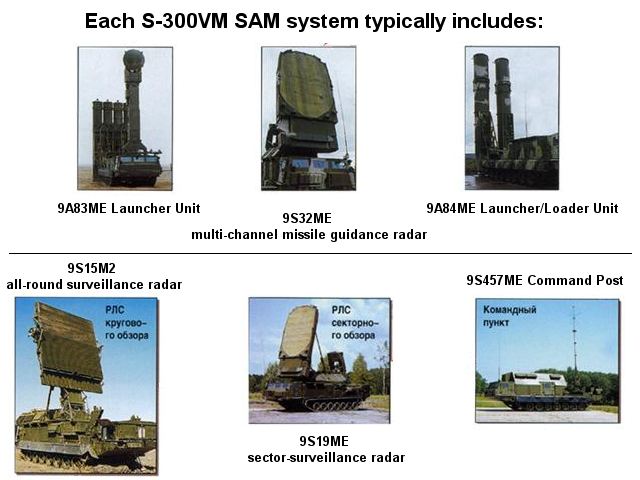
The requirement dates from the late 1960s, when the Soviet Army wanted a single mobile complex able to shoot down both aircraft and the new NATO tactical missiles, and it went through trials at the Emba range in Kazakhstan in the late 1970s and early 1980s. The system was accepted in two steps. In 1983 the first version entered service with the 9M83 missile only, a configuration often called S-300V1. In 1988 the complete 9K81 with the heavy 9M82 anti-ballistic round was accepted. [DOCUMENTED] The exact trial dates differ by a year or two between Russian references. [UNVERIFIED]
A complete S-300V air-defence missile brigade (зенитная ракетная бригада) has a brigade command post and usually three or four battalions (дивизионы). Each battalion has a command-and-designation group and up to four firing batteries. Brigade-level control over the whole army area came later through the Polyana-D4 automated post (see below). [DOCUMENTED] Exact establishment tables changed over time and are not public in full. [ESTIMATE]
| Vehicle | Index / NATO | Role |
| Command post | 9S457 (9С457) | Battalion command post. Takes the air picture from both battalion radars and higher command, assigns targets to batteries, and decides between the aircraft and ballistic channels. |
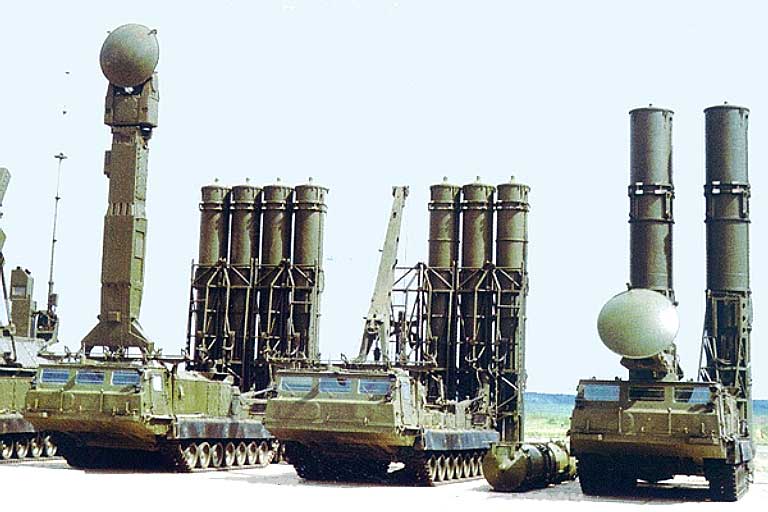
| All-round radar | 9S15 Obzor-3 / 9S15M, "Bill Board" | 3D surveillance radar for aircraft and cruise missiles, also used to cue the ballistic channel; reported detection of large aircraft out to about 250 km. |
| Sector radar | 9S19 Imbir / 9S19M2, "High Screen" | Programme-survey radar that scans a sector for ballistic missiles and stand-off aircraft, with a phased array on a tall lifting mast. |
| Guidance radar | 9S32 / 9S32M, "Grill Pan" | Battery multi-channel guidance radar. Tracks targets, hands them to launchers and relays commands to missiles in flight. |
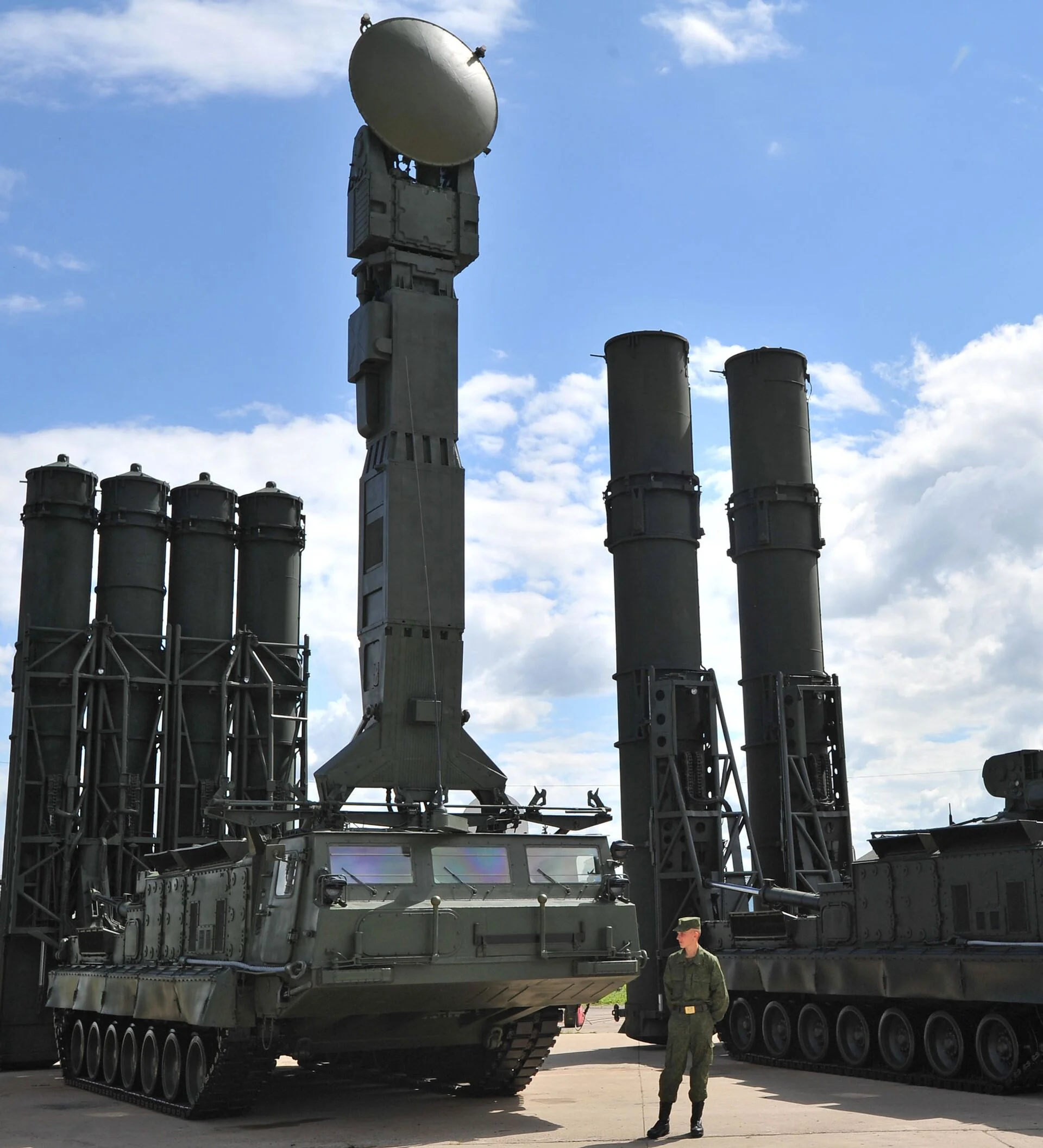
| Launcher-radar (TELAR) | 9A83 (four 9M83) | Launcher with its own illumination radar on a mast; can engage targets designated by the 9S32. |
| Launcher-radar (TELAR) | 9A82 (two 9M82) | Same concept for the heavier anti-ballistic missile, with a radar suited to high-elevation targets. |
| Launcher-loader | 9A85 (with 9A83) / 9A84 (with 9A82) | Carry extra missiles that can be fired under control of the paired TELAR, or reload it with its own crane. |
Brochure figures for the original complex give each battalion the ability to engage up to 24 aircraft or 16 ballistic missiles at once, with up to two missiles guided at each target. [SINGLE-SOURCE] (Russian manufacturer and reference-book figures, repeated widely.) The split between the long-range Bill Board and the high-elevation High Screen reflects the job: one radar looks out for aircraft, the other looks up for missiles coming down. [DOCUMENTED]
HOW THE SYSTEM WORKS: ELEMENT BY ELEMENT
This section goes through each vehicle of an S-300V battalion and, where the sources allow, its S-300VM (Antey-2500) successor. It covers what the vehicle does, how its radar or launcher works and how it talks to the rest of the system. The main source is the detailed 1999 article in Tekhnika i Vooruzhenie (Техника и вооружение, issues 5-6), reprinted on Vestnik PVO, which draws on developer material. Carlo Kopp's Air Power Australia report and Russian trade press add to it. [BACKGROUND] (Sources 19, 20.) Nearly all the numbers below are design or brochure figures for the original S-300V. The S-300V4 values are still classified, and only fragments have been published. [DOCUMENTED] (Sources 19, 20.)
Battalion and battery structure
A battalion (дивизион, called a "ZRK" in the source) has a detection and designation group and four fire batteries. The group is the 9S457 command post, the 9S15M Obzor-3 all-round radar and the 9S19M2 Imbir programmed-sector radar. Each battery has one 9S32 multichannel missile guidance station (MSNR), two 9A82 launchers, one 9A84 launcher-loader, four 9A83 launchers and two 9A85 launcher-loaders. [DOCUMENTED] (Sources 1, 19.) The pairing is fixed. The 9A85 serves the 9A83 and the 9M83 missile, and the 9A84 serves the 9A82 and the 9M82. [DOCUMENTED] (Source 19.)
In the Antey-2500 export layout the group is called the detection and target-designation node (узел обнаружения и целеуказания). It is made up of the 9S457ME, a 9S15M2, 9S15MT2E or 9S15MV2E all-round radar, and a 9S19ME sector radar. Each battery has a 9S32ME, up to six 9A83ME launchers with four 9M83ME each, and up to six 9A84ME launcher-loaders with two 9M82ME each. In that layout the 9M82ME is fired from the 9A84ME. That vehicle is "informationally linked" to a 9A83ME, whose illuminator guides both missile types. [SINGLE-SOURCE] (Source 21, Russian reference sites reproducing Antey brochure text.)
According to the 1999 article, a full battalion carries 96-192 ready missiles on its launchers and launcher-loaders. It can engage 24 targets and guide 24 missiles at once, fire at 1.5-second intervals, and go from standby to combat mode in 40 seconds. [DOCUMENTED] (Sources 19, 20.) A 1998 Russian summary credits the Antey-2500 with 24 aerodynamic or 16 ballistic targets at once, down to 0.02 m² radar cross-section and up to 4,500 m/s. [SINGLE-SOURCE] (Source 19, quoting Voenny Parad no. 2, 1998.)
| Vehicle | Chassis (1999 article) | Mass | Crew | Main job |
| 9S457 command post | "Ob'yekt 834" | 39 t | 7 | Track fusion, threat ranking, target distribution to 4 batteries |
| 9S15M Obzor-3 | "Ob'yekt 832" | 46 t | 4 | All-round 3D search, aircraft and Scud/Lance-class missiles |
| 9S19M2 Imbir | "Ob'yekt 832"-family (printed as "ob'yekt 32") | 44 t | 4 | Sector search for Pershing re-entry vehicles, SRAM, stand-off jammers |
| 9S32 guidance station | "Ob'yekt 833" | 44 t | 6 | Tracking and fire control of up to 12 targets and 12 missiles |
| 9A83 launcher | "Ob'yekt 830" | 47.5 t loaded | 3 | 4× 9M83, illuminator and command uplink |
| 9A82 launcher | "Ob'yekt 831" | n/a | 3 | 2× 9M82, illuminator and command uplink |
| 9A85 launcher-loader | "Ob'yekt 835" | 47 t loaded | 3 | 4× 9M83, crane, fires under a 9A83 |
| 9A84 launcher-loader | n/a | n/a | 3 | 2× 9M82, crane, fires under a 9A82 |
Chassis numbers: the table follows the 1999 article. Kopp's component table swaps some of them (for example, it lists the 9A82 as GM-830 and the 9A83 as GM-831), Sources conflict on the object numbers: the 1999 Tekhnika i Vooruzhenie article (Source 19) and Kopp (Source 20) give different assignments, and neither has been checked against factory documents. Treat the individual numbers as [UNVERIFIED]. All the hulls come from the Kirov Plant family that also carries the 2S7 Pion gun and shares some components with the T-80. [DOCUMENTED] (Sources 19, 20.) Every main vehicle carries its own navigation, survey and mutual-orientation equipment. Each also has its own gas-turbine generator, except the launcher-loaders, which use a diesel. So the battalion can deploy without cables to a power grid. [DOCUMENTED] (Source 19.) Kopp gives about 5 minutes to deploy or march order. [SINGLE-SOURCE] (Source 20.)
9S457 / 9S457ME command post
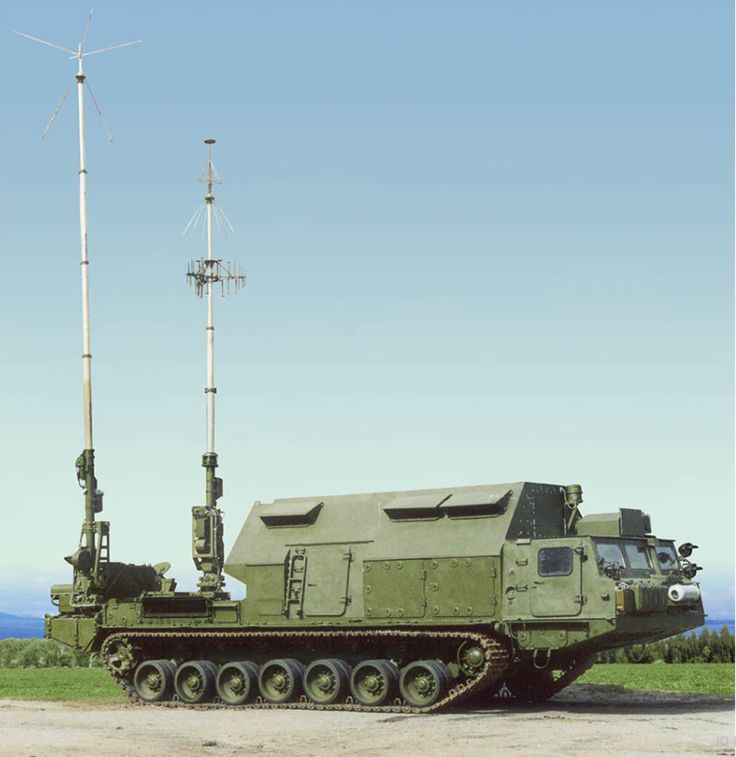
Role. The 9S457 runs the battalion's fight. It can work alone, with the battalion operating autonomously. It can also work under centralised control from the brigade command post, in both the anti-missile (PRO) and anti-aircraft modes. [DOCUMENTED] (Sources 19, 23.) It has no radar of its own. It is a computer and communications vehicle that merges the radar pictures, decides what to shoot and hands targets to the batteries.
Anti-aircraft mode. The CP handles up to four batteries, each with 6 target channels. It accepts up to 200 aerodynamic targets reported by the Obzor-3, including in jamming. It forms and holds up to 70 tracks, classifies them as aerodynamic or ballistic and picks the most dangerous for engagement. [DOCUMENTED] (Sources 19, 22, 23.) In each 3-second distribution cycle it can issue up to 24 target designations. With the Obzor-3 on its 6-second scan, the average time from the first radar plot to a designation is 17 seconds. Against Lance-type missiles, designations are issued at 80-90 km. [DOCUMENTED] (Sources 19, 23.)
Anti-missile mode. The CP takes the Imbir's tracks, sets the Imbir's search sectors and jamming directions, and controls the modes of the Imbir and the 9S32s. It separates real warheads from decoys by trajectory features and assigns targets automatically. Average working time in this mode is no more than 3 seconds. [DOCUMENTED] (Source 19.) When it picks a battery for a ballistic target, it weighs three things: the predicted warhead impact point relative to that battery, the battery's current mode, and whether it has ready 9M82 channels. Every 9S32 reports its position and status to the CP so that it can make this choice. [DOCUMENTED] (Source 19.)
Equipment. The CP carries special-purpose computers and telecode and voice communications equipment for every vehicle it works with. It has a combat-control post with three operator workstations and recording equipment that documents the work of the CP and the firing units. It also has navigation and orientation gear, a gas-turbine power unit and life support. [DOCUMENTED] (Source 19.) Russian descriptions of the 9S457M/ME say the modernised CP runs the whole battalion automatically and that its data exchange with the radars, the guidance stations and the higher CP is "in telecode mode". [SINGLE-SOURCE] (Source 21.) A drawing of the proposed wheeled S-300VMK shows a large elevating antenna mast on the 9S457MK. [SINGLE-SOURCE] (Source 20.)
9S15M / 9S15M2 Obzor-3 all-round radar ("Bill Board")
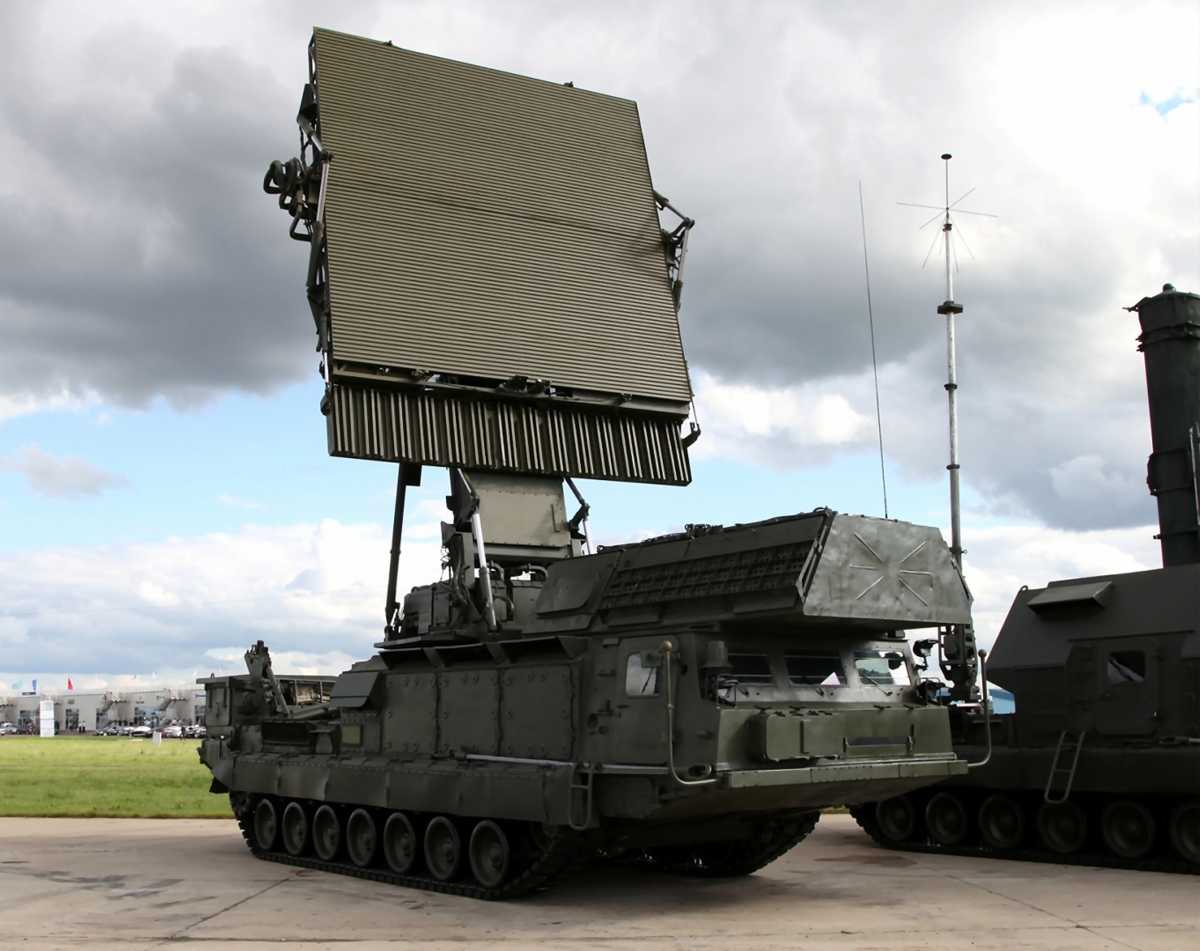
Role. This is the battalion's main search radar. It looks all around for aircraft, cruise missiles and slower ballistic missiles (Scud and Lance class) and sends plots to the 9S457. It was developed by NIIIP (НИИИП, later Tikhomirov NIIP) under Yu. A. Kuznetsov and then G. N. Golubev, and built at the Murom radio-measuring instruments plant. About half of it, at the level of functional units, is shared with the S-300P's search radar. [DOCUMENTED] (Source 19.)
Type and band. It is a three-dimensional coherent-pulse radar in the centimetre band. Radartutorial and Western references put it in IEEE S-band (NATO F-band). [DOCUMENTED] (Sources 19, 24.) The antenna is a flat one-dimensional waveguide array. It is rotated in azimuth by electro-hydraulic drive and scanned electronically in elevation, with a 1.5° × 1.5° beam. The radar can retune its frequency instantly from pulse to pulse. [DOCUMENTED] (Source 19.)
Transmitter and receiver. The transmitter is a travelling-wave tube driving two amplitrons, giving about 8 kW average power. The receiver has a TWT RF amplifier with sensitivity of the order of 10-13 W. Data are handled by two special-purpose computers. The radar also carries Parol IFF and telecode and voice links to the CP. [DOCUMENTED] (Source 19.)
Scan modes. The radar has two regular all-round modes. [DOCUMENTED] (Source 19.)
Capacity and accuracy. In automatic plot-extraction mode the radar outputs up to 250 plots per scan, of which up to 200 can be targets. RMS errors are no more than 250 m in range, 35′ in elevation and 30′ in azimuth. Resolution is better than 400 m in range and 1.5° in angle. [DOCUMENTED] (Source 19.)
ECCM. The 1999 article is unusually detailed here. Measures include: [DOCUMENTED] (Source 19; Kopp calls the Russian ECCM description "unusually detailed", source 20.)
It measures bearings to barrage-noise jammers and passes them to the CP. That is the first step of the passive anti-jammer engagement described below. [DOCUMENTED] (Source 19.)
Variants. The Obzor-3 was modernised in the 1990s as the 9S15MT, 9S15MV3 and 9S15MT3. [DOCUMENTED] (Source 22.) The Antey-2500 offers the 9S15M2, 9S15MT2E or 9S15MV2E. Russian brochure-derived text gives about 250 km against aerodynamic targets and 110-115 km for ballistic missiles in the anti-missile mode. [SINGLE-SOURCE] (Source 21.) Kopp cites "320+ km" for the 9S15M2. [SINGLE-SOURCE] (Source 20.) Kopp notes that the slow mechanical scan limits it against fast medium-range missiles, which is why the Imbir exists. Its low-level coverage is also limited by antenna height, which is why brigades often add a 1L13 Nebo-SV. [SINGLE-SOURCE] (Source 20.)
9S19M2 / 9S19ME Imbir sector radar ("High Screen")
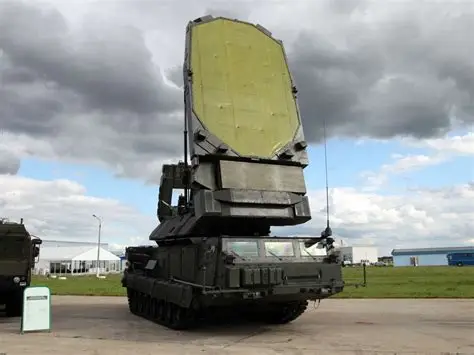
Role. This is the anti-missile acquisition radar. It searches a programmed sector, set by the CP toward the most likely missile threat, for Pershing-type re-entry vehicles, air-launched SRAM-type missiles and stand-off jammers out to 100 km, and sends tracks to the 9S457 by radio link. It was developed by NIEMI under V. P. Efremov, the system's chief designer, and built at the Mari machine-building plant. [DOCUMENTED] (Sources 19, 22.)
Type and band. It is a three-dimensional, high-power coherent-pulse radar in the centimetre band. It steers its beam electronically in both planes with a phased array, giving a pencil beam of about 0.5°. Kopp places it in X-band and describes a large passive phase-shifter array fed through free space, similar in concept to the US MPQ-53 and the Russian 30N6. [DOCUMENTED] (Sources 19, 20.) Sources conflict on the transmitter: the 1999 Tekhnika i Vooruzhenie article says a high-power amplifying klystron (Source 19), and Kopp says a travelling-wave tube (Source 20). [UNVERIFIED] on which is correct.
Waveforms and ECCM. The narrow beam and linear-FM pulses with high compression give a very small pulse volume. Combined with digital inter-period clutter cancellation, automatic wind compensation against chaff and electronic scanning, this resists passive (chaff) jamming. High power, electronic scanning and digital processing give resistance to noise jamming. [DOCUMENTED] (Source 19.) Kopp adds frequency hopping and very low sidelobes. [SINGLE-SOURCE] (Source 20.)
Electronic scan in practice. Because the beam can jump anywhere in the sector, the radar can do three things during its normal search. It can quickly examine a sector the CP points it to. It can return to each new plot every 1-2 seconds to build a track. It can keep tracking fast targets between search frames. [DOCUMENTED] (Sources 19, 22.)
| Mode | Azimuth | Elevation | Range window | Output |
| 1: Pershing RV | ±45° | 26°-75° (array tilted 35°) | 75-175 km | up to 16 tracks; data to CP every second; search frame 12.5-14 s with 2 tracks held |
| 2: SRAM / aeroballistic | ±30° | 9°-50° | 20-175 km | target parameters to the 9S457 at 0.5 Hz |
| 3: aircraft / jammers | ±30° | 0°-50° (array tilted 15°) | 20-175 km | plots to CP; bearings (and range where possible) on jammers to 100 km; update 0.3-16 s |
Sources for the table: the 1999 article. [DOCUMENTED] (Source 19.) In mode 2 the radar sends the CP only targets moving faster than 300 m/s, which filters out ordinary aircraft. [DOCUMENTED] (Source 19.) The search direction is set over the telecode link from the CP or by the radar's own operator. A designation from the CP interrupts the regular search automatically, and the search resumes once the designation has been worked. [DOCUMENTED] (Source 19.) RMS errors are no more than 70 m in range, 15′ in azimuth and 12′ in elevation. [DOCUMENTED] (Source 19.)
Variants. The Antey-2500 uses the 9S19ME. Russian text gives up to 175 km and 16 tracks. Kopp quotes 250 km for the improved version. [SINGLE-SOURCE] (Sources 20, 21.) Kopp also describes an "S-300V2" block upgrade using paired 9S19M2s linked by fibre-optic cable in place of the 9S15M. No Russian source checked here confirms it. [UNVERIFIED] (Source 20.)
9S32 / 9S32ME multichannel guidance station ("Grill Pan")
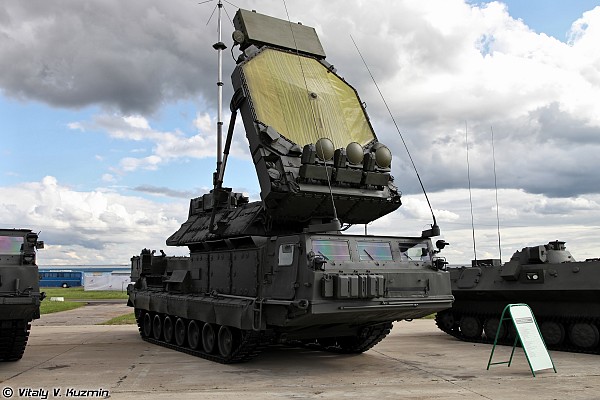
Role. Each battery has one 9S32. It searches for, acquires and auto-tracks the targets the CP assigns, and can also search on its own. Ballistic missiles it engages only on CP designation. It computes target coordinates and their rates and sends them to its launchers, which point their illuminators and work out the missile flight task. It controls all the battery's launchers and launcher-loaders, either under the CP or autonomously. [DOCUMENTED] (Source 19.) It can track up to 12 targets while guiding 12 missiles at 6 of them. At the same time it keeps scanning the horizon edge for low fliers. [DOCUMENTED] (Sources 19, 20.)
Antenna. This was the key design decision of the 1960s "Prizma" and "Binom" studies. It is a coherent-pulse centimetre-band radar with a passive phased array that works "through transmission": a horn feed behind the array lights it up, and on receive the same horn is switched to the receiver. A digital beam-control system sets a phase shifter in each element to steer a beam of about 1°. Coverage is ±45° in azimuth and elevation around the array normal, and the array is tilted 45° to the ground. [DOCUMENTED] (Source 19.) The whole array turret rotates through ±340° to point the battery's sector of responsibility. [DOCUMENTED] (Sources 19, 20.) Kopp places it in X-band. [DOCUMENTED] (Source 20.)
Transmitter and receiver. A transmitter chain gives 10-13 kW average and 150 kW peak power. [DOCUMENTED] (Source 19.) Sources conflict on the tube type: a klystron chain in Source 19 versus a TWT in Source 20. [UNVERIFIED] The receivers have RF preamplifiers with sensitivity down to 10-17 W. [DOCUMENTED] (Sources 19, 20.) The radar uses monopulse angle and range measurement and digital signal processing in all modes. Separate antennas feed quadrature jamming auto-cancellers. Kopp describes three auxiliary channels for sidelobe jamming and frequency hopping in all modes. [DOCUMENTED] / [SINGLE-SOURCE] (Sources 19, 20.)
Waveforms. Two kinds are used. [DOCUMENTED] (Source 19.)
Modes and performance. On CP designation the radar searches a 5° × 6° window. In autonomous mode it scans ±30° in azimuth about the sector bisector and 0-18° in elevation. The CP can also order an autonomous low-level search over 60° × 1.4°. [DOCUMENTED] (Source 19.) On designation it detects fighters above 5 km at 150 km, Scud at 90 km, Lance at 60 km, a Pershing warhead at 140 km and SRAM at 80 km. In autonomous mode it detects fighters at up to 140 km. Going from detection to an unambiguous track takes 5 seconds for Pershing or SRAM and 11 seconds for a fighter. [DOCUMENTED] (Source 19.) Tracking errors for a fighter are 5-25 m in range and 0.3-1.5 m/s in velocity. Resolution is 100 m, 1° and 5 m/s. [DOCUMENTED] (Source 19.)
9S32ME. Kopp, working from manufacturer brochure images, says the VM radar was substantially redesigned. It uses the larger Imbir-type space-fed aperture, with new IFF and interferometer / sidelobe-blanker arrays below it, which gives almost twice the gain of the Grill Pan, and probably higher peak power. He calls it "Grill Screen". [SINGLE-SOURCE] (Source 20.) Russian texts quote precise tracking of up to 12 targets and detection at 140-150 km, or about 80 km for aeroballistic targets. Some Antey material claims more than 200 km against a fighter. [SINGLE-SOURCE] (Sources 20, 21.)
9A83 / 9A82 launchers and the 9A85 / 9A84 launcher-loaders
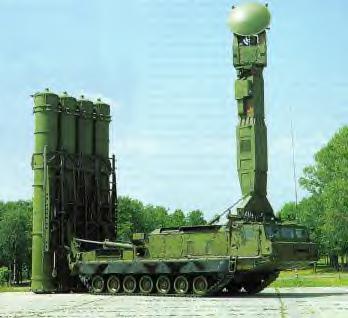
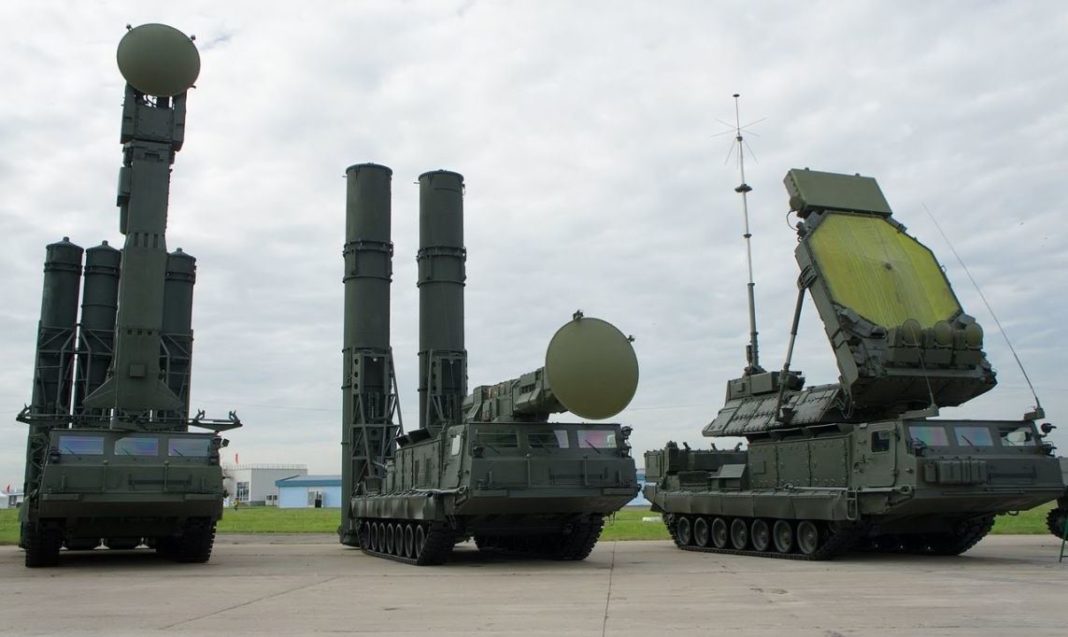
9A83 launcher (TELAR). It carries four ready 9M83 missiles in 9Ya240 containers. It runs automatic pre-launch preparation and launch, both for its own rounds and for those on its paired 9A85. It also carries its own target-illumination station (СПЦ). That station sends radio-correction commands to 9M83s in flight and then lights the target with continuous-wave energy for the missile's semi-active Doppler seeker. [DOCUMENTED] (Source 19.) It can prepare and launch two missiles at once, 1-2 seconds apart. Missile preparation takes no more than 15 seconds. With the cables already connected, it can switch from its own rounds to the launcher-loader's in 15 seconds or less. [DOCUMENTED] (Source 19.) Its equipment includes a hydraulic container-raising gear, a special-purpose computer, pre-launch equipment for the seeker and the inertial system, launch automation, the illuminator, navigation and orientation gear, telecode equipment and a gas-turbine generator. The loaded mass is 47.5 t and the crew is 3. [DOCUMENTED] (Source 19.) The illuminator antenna sits on an elevating, telescoping mast that covers the whole upper hemisphere and is meant to extend coverage against low fliers. Kopp gives about 10-12 kW CW. [SINGLE-SOURCE] (Source 20.)
9A82 launcher. It carries two 9M82 missiles in 9Ya238 containers and does the same job as the 9A83. It differs only in the container-raising gear and the mechanical part of the illuminator. [DOCUMENTED] (Sources 1, 19.) Kopp says its antenna slews 180° in azimuth and 110° in elevation but does not rise on a mast, because the long-range 9M82 does not need low-altitude reach. [SINGLE-SOURCE] (Source 20.)
9A85 and 9A84 launcher-loaders. The 9A85 carries four 9M83s. It can fire them together with the electronics of a 9A83, reload the 9A83 (from itself, from a 9T83 transporter, from civilian trucks, from the ground or from an MS-160.01 pack) and reload itself. Reloading a 9A83 completely takes 50-60 minutes, and the crane lifts 6,350 kg. It has a crane where the launcher has electronics and an illuminator, cables linking its rounds to the launcher's equipment, and a diesel generator. Loaded mass is 47 t, crew 3. The 9A84 is the same vehicle for two 9M82s, with a different raising gear. [DOCUMENTED] (Source 19.) In effect these are "dumb" launchers that need a nearby TELAR's guidance and illumination. [DOCUMENTED] (Source 20.)
Launch sequence (from the 1999 article). [DOCUMENTED] (Source 19.)
For a ballistic target the 9S32 automatically assigns two 9A82s, each preparing two 9M82s on itself or on its 9A84. [DOCUMENTED] (Source 19.) Against a stand-off jammer, the launcher receives a "jammer" flag in the flight task. The missile is then aimed at the current rather than the predicted position, and its on-board computer switches to an algorithm that lets the 9M82 home from long distance, out to about 100 km. [DOCUMENTED] (Source 19.)
Support vehicles
The battery and battalion depend on a tail of wheeled support equipment. Reload transporters are the 9T82 (for 9M82) and the 9T83 (for 9M83), and the 9T447-1 carries spares. The 9T325 is a rigging kit. Repair and test vehicles include the 9V868-1, 1R15, 9V879-1, 9V898-1 and 1R16, mostly on Ural-43203 trucks. The 9V91 is the automated test station (AKIPS), on a ZiL-131. There is also a PES-100 power station, a UKS-400V compressor, an AGZ-M1 workshop and the 9F88 training simulator. [DOCUMENTED] (Sources 1, 20.) The S-300V shares some items with the S-300P, including the STS-1 and STS-2 telecode link equipment, the FD-91 recording gear and the GAP-65 gas-turbine power units. [SINGLE-SOURCE] (Source 1.) Kopp also lists a 9T31M1 crane on Ural-375. [SINGLE-SOURCE] (Source 20.)
HOW THE 9S457 COMMUNICATES
Inside the battalion. The 1999 article describes telecode (digital data) and voice links between the CP and every vehicle it works with. Each radar and each 9S32 lists "telecode and voice communication equipment with the CP" among its own fit. [DOCUMENTED] (Source 19.) The 1998 FBIS translation says the Imbir passes radar data "over a radio link" to the CP. [DOCUMENTED] (Source 22.) Russian descriptions of the modernised 9S457ME call the exchange with radars, guidance stations and the higher CP telecode. [SINGLE-SOURCE] (Source 21.) The STS-1 and STS-2 telecode sets shared with the S-300P are the likely hardware. The sources do not publish frequencies, data rates or crypto. [UNVERIFIED] (Source 1.)
The links form a star centred on the CP. [DOCUMENTED] (Source 19.)
Inside the battery. The 9S32 talks to its launchers over a telecode radio link. The 9A83 equipment list includes telecode gear, and launcher commands and designations are described as passed "over the telecode radio link from the guidance station". [DOCUMENTED] (Source 19.) Kopp says the TELARs can be controlled "using either cables or a bidirectional radio datalink", which lets them send status back, and notes a telescoping datalink mast aft of the 9S32 array. [SINGLE-SOURCE] (Source 20.) Launcher-loaders are tied to their TELAR by cable. [DOCUMENTED] (Source 19.) Uplink to the missile in flight goes from the launcher's illuminator, not the 9S32. The tail-fin antennas on the 9M82/9M83 receive it. [DOCUMENTED] (Sources 19, 20.)
Passive anti-jammer chain. This shows how the links work together. The 9S15, 9S19 and 9S32 each measure bearings to an airborne jammer through their cancellation channels. The 9S32 tracks the jammer in angle and reports it, and the CP supplies range from whichever of its own tracks lies closest on that bearing. The 9S32 then extrapolates range itself, and a 9M82 is launched with the jammer flag. [DOCUMENTED] (Sources 19, 20.) A designation can also come from the brigade CP. [DOCUMENTED] (Source 19.)
Upward: brigade and Polyana-D4. In centralised mode the battalion works to commands, target distribution and designations from the brigade CP. That CP is part of the Polyana-D4 automated control system (АСУ «Поляна-Д4»). The brigade was to have its own radar post with another 9S15M, a 9S19M2, a 1L13 standby-mode radar (the Nebo-SV metre-band 2D radar) and a POORI-P1 radar data processing point, controlling three or four battalions. [DOCUMENTED] (Sources 19, 25.) Kopp describes "datalink tie-ins" with 9S52/9S52M Polyana command posts, use of the PORI-P1 fusion centre and frequent addition of a 1L13-3 Nebo-SV. [SINGLE-SOURCE] (Source 20.) The 9S52 Polyana-D4 later became the brigade standard across Ground Forces air defence and was modernised as Polyana-D4M1. It receives secondary radar data from the 9S15, 9S19, 9S18 and 1L13 over telecode channels. [DOCUMENTED] (Sources 3, 25.)
Higher echelons, A-50 and wider networks. No open source checked here gives technical details of the S-300V brigade's link to army or front air-defence command, or to A-50 or Nebo-M track feeds. That Polyana-D4 accepts higher-level and neighbouring data is general Russian doctrine, but specifics for the V-line are [UNVERIFIED]. Claims that the S-300V4 engaged targets at very long range using external cueing (see the Ukraine section) are [SPECULATION] as far as the data path is concerned.
Voice and other radios. Every main vehicle has voice links alongside telecode. [DOCUMENTED] (Source 19.) Which radio sets are fitted (for example the R-168 family that replaced older R-123/R-173 sets in Russian ground forces) is not stated in the sources found. [UNVERIFIED]
Timing. The CP's 17-second plot-to-designation time with the Obzor-3, its 3-second time in anti-missile mode, the Imbir's 1-second track updates and the 9S32's 5-11 seconds to track all indicate a mostly automatic data network. In the 1970s design, humans mainly authorised fire rather than handled data. [DOCUMENTED] (Source 19.) At the 1992 "Oborona-92" exercise the system reportedly killed aircraft with its first missile and ballistic missiles with no more than two. [SINGLE-SOURCE] (Source 19.)
9M82 AND 9M83 MISSILES
Both missiles were designed by Novator and share a common upper stage. The 9M83 is a single-booster missile; the 9M82 adds a larger first stage, so it is longer, heavier and faster, and carries more energy into the high-altitude ballistic intercept. Both use inertial guidance with radio-command correction in the middle of the flight and semi-active radar homing at the end, with illumination from the TELAR. Both are cold-launched upright from their tubes and turned by gas jets before the motor ignites. A directional high-explosive fragmentation warhead of about 150 kg is commonly quoted. [DOCUMENTED] for the guidance type; warhead weight [SINGLE-SOURCE].
| Missile | NATO | Launch weight (approx.) | Aircraft range (approx.) | Ballistic targets |
| 9M83 | SA-12A Gladiator | about 2,300-3,500 kg (sources differ) | about 75 km | up to about 40 km range of intercept |
| 9M82 | SA-12B Giant | about 4,600-5,800 kg (sources differ) | about 100 km | tactical and theatre ballistic missiles, warheads up to about 1,000 km class |
The weight spread in the table is real disagreement between references, not rounding. Treat every number in it as [ESTIMATE]. Maximum altitudes of about 25-30 km and target speeds up to about 3,000 m/s for the original complex are commonly quoted. [SINGLE-SOURCE]
MISSILE DESIGN DETAILS
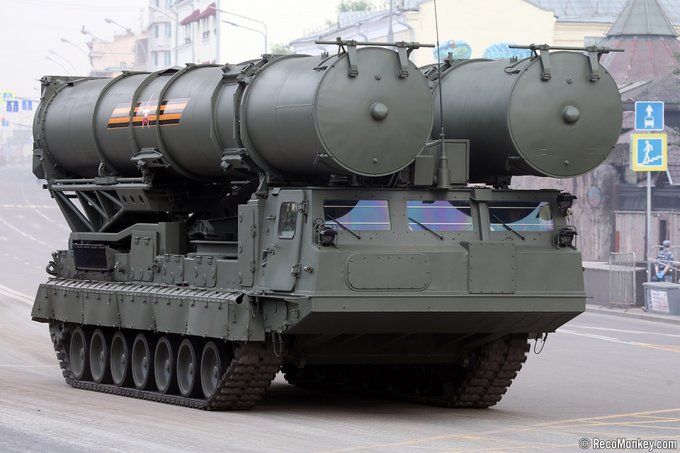
Both rounds are two-stage solid-fuel missiles that differ mainly in the first stage; the 9M82 has the much more powerful booster, a design that the long-range MD version later exploited. Russian accounts compare the 9M82 with the American Sprint interceptor: it is said to reach about 2.6 km/s within about 4.5 seconds, while the 9M83 reaches about 1.2 km/s in 5 seconds and then about 1.7 km/s with its second stage. [SINGLE-SOURCE] (Russian popular-reference figures; no official test data published.)
The 9M82 / 9M83 family is credited in Russian sources with the world's first directional fragmentation warhead on a SAM. Before detonation the missile rolls so that a narrow cone of heavy fragments points at the target, which allows fewer but heavier fragments with enough energy to pierce a re-entry vehicle's heat shield. In the later versions the warhead has two fractions, "light" fragments for aircraft and "heavy" fragments for ballistic warheads; Almaz-Antey said in 2016 that this made it more than five to six times as effective as a classic warhead. [SINGLE-SOURCE] (Almaz-Antey via Interfax/TASS, Sept 2016.) The fragment cone is given as about 60 degrees. [SINGLE-SOURCE]
The upper stages use gas-dynamic (jet) control at high altitude, where fins have little air to bite. A 2019 Russian trade article claimed that only Russia (S-300V4) and the USA (Aegis SM-3 and THAAD) field hypersonic interceptors with gas-dynamic control. That is a promotional comparison, not an independent assessment. [SINGLE-SOURCE]
S-300VM ANTEY-2500
S-300V4 / S-300VMD AND ANTEY-4000
S-300V4 IN DETAIL
Contract and first delivery. A three-year contract for the S-300V4 was signed in 2012. On 17 December 2014, during a "single day of military acceptance", Almaz-Antey director general Yan Novikov and Ground Forces commander Colonel General Oleg Salyukov signed over the first brigade set. Novikov said the V4 protects an area two to three times larger than its predecessor and "guarantees" interception of medium-range ballistic missile warheads. [DOCUMENTED] (Interfax, 17 Dec 2014.) The Russian MoD described the V4 as a deep modernisation of the S-300V3 (as it called the VM stage) with performance 1.5 to 2.3 times higher, able to hit ballistic missiles with launch ranges up to 2,500 km. [DOCUMENTED] (MoD via AEX.RU, 23 Dec 2014.)
Three missiles. In September 2016 Almaz-Antey described a three-round mix: the "small" 9M83M for aircraft, cruise missiles and tactical ballistic missiles; the "intermediate" 9M82M with a maximum range of about 200 km; and the "large, high-potential" 9M82MD to intercept the main types of ballistic targets, including medium-range warheads at up to 4,500 m/s, and aerodynamic targets out to 400 km. All three are described as two-stage, solid-fuel, hypersonic and highly unified. [DOCUMENTED] (Interfax-AVN / Lenta.ru, 9 Sept 2016, quoting the manufacturer.)
Claimed V4 improvements (Russian trade press, 2019): 9M83M aircraft range raised from 130 to 150 km; 9M82MD from 350 to almost 400 km; 9M82MD maximum altitude from 30 to 33 km; maximum ballistic-target speed from 4,500 to 4,800 m/s; range against operational-tactical missiles from 30 to 45 km and altitude from 25 to 27 km. The same source says that for the longest shots the sustainer is fired after a programmed delay so that the missile accelerates again in the stratosphere and is still near its top speed at 350-380 km. [SINGLE-SOURCE] (oborona.ru.) The two 2016 and 2019 descriptions disagree on the 4,500 vs 4,800 m/s figure, so quote both as claims.
| Missile | Role (manufacturer) | Claimed max range vs aircraft | Claimed top speed |
| 9M83M | aircraft, cruise missiles, tactical BMs | about 150 km (V4) | about 1,700 m/s |
| 9M82M | intermediate | about 200 km | about 2,400-2,600 m/s [ESTIMATE] |
| 9M82MD | BMs incl. IRBM warheads; AWACS, jammers | about 400 km | about 2,600 m/s |
Why so far? The 400 km shot is aimed at the support aircraft that make an air campaign work: AWACS, airborne command posts and orbiting jammers. A V4 brigade is meant to push those aircraft back from the front line, not to shoot fighters at 400 km. [DOCUMENTED] for the stated purpose (Almaz-Antey); [ESTIMATE] for practical effect.
S-300V4 UNITS
SYRIA 2016
In early October 2016, amid tension with the US over Aleppo, the Russian MoD confirmed it had sent an S-300 system to Tartus to protect the naval facility. Western reporting identified it as an S-300V4. Russian accounts later said one V4 battalion was deployed to watch eastern Syrian airspace and cover Hmeimim and Tartus, and that it repeatedly tracked US strategic bombers and reconnaissance aircraft at 200-300 km. [DOCUMENTED] for the deployment; [SINGLE-SOURCE] for the tracking claims (Russian accounts reported by Army Recognition). No V4 engagement in Syria has been documented. [DOCUMENTED]
POLYANA-D4 AND THE ARMY AIR-DEFENCE BRIGADE
The 9S52 Polyana-D4 (Поляна-Д4) and its successor 9S52M1 Polyana-D4M1 are brigade-level automated control posts for Ground Forces air defence. One post takes the picture from its own battalions, neighbours, higher command and airborne radars, and gives targets to mixed groups of S-300V and Buk battalions. In practice this lets a commander hand the long-range or ballistic targets to the S-300V4 and the mid-range aircraft, helicopter and cruise-missile targets to Buk-M2 or Buk-M3, without the two systems competing for the same target. [DOCUMENTED] (see Buk-M3).
Below that sits the point-defence layer: Tor and Pantsir to protect the long-range radars and launchers, and short-range missiles and guns with the troops. The army brigades are tied into the Aerospace Forces (VKS) air picture, which runs the P-line, the S-400 and the S-350, so a V4 battery can fire on targets it does not yet see itself. How tightly the Army and VKS networks are actually joined in combat is not public. [ESTIMATE]
WHERE THE V-LINE SITS IN RUSSIAN LAYERED AIR DEFENCE
USE AND LOSSES IN THE UKRAINE WAR
Both sides started the 2022 war with V-line systems. Ukraine inherited a small number of original S-300V (9K81-1, the V1 configuration) battalions in 1991, while Russia fielded S-300V4 brigades. [DOCUMENTED]
Claims of long-range kills
In October 2022 the outlet Military Watch Magazine, often pro-Russian, said an S-300V4 shot down a Ukrainian Su-27 and a Su-24 at about 217 km after a raid on Belgorod region, possibly with a 40N6 missile. That claim is internally confused: the 40N6 and 48N6DM are S-400 missiles, not V-line rounds. A few days later the same outlet ran reports that a Su-57 with an R-37M made the kill instead. A Ukrinform fact-check in June 2023 said the original report attributed the 217 km event to an S-400, and that the Russian MoD report of 13 October 2022 mentioned a Su-27 shot down by air defence without giving the system. [DOCUMENTED] that the claims exist; the system, range and kill itself are [UNVERIFIED].
Russian sources also credit V4 batteries with intercepts of HIMARS/GMLRS rockets, ATACMS, Storm Shadow and drones. No individual claim has been independently confirmed, and the Russian MoD rarely names the system that made an intercept. [UNVERIFIED]
Deployment pattern
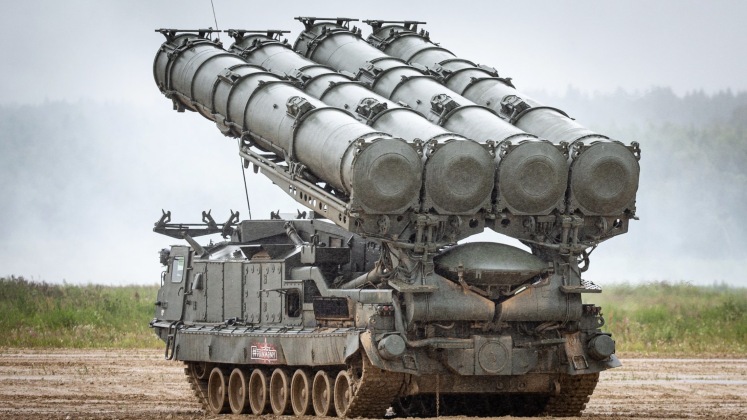
V4 batteries have been placed in the occupied south (Zaporizhzhia region), in Crimea, in Luhansk region and in Russian border regions to cover troop groups and push Ukrainian aircraft back from the front. The location of documented losses (below) maps that pattern. [ESTIMATE] based on loss geolocations.
Visually confirmed losses
Oryx, which lists only losses with photo or video evidence, showed the following Russian V-line items when checked on 26 October 2026. [DOCUMENTED] (Oryx; counts are minimums and change often.)
| Item | Oryx count (as of 26 Oct 2026) |
| 9A83M2 TELAR (S-300V4) | 9 destroyed |
| 9A84-2 launcher-loader (S-300V4) | 2 destroyed |
| 9A85-2 transloader (S-300V4) | 1 destroyed |
| 9S32M1 guidance radar (S-300V) | 2 damaged |
| 9S19M2 High Screen radar (S-300V) | 1 destroyed, 1 damaged |
Oryx's Ukrainian list showed one 9S32-1 radar of a 9K81-1 S-300V1 destroyed. [DOCUMENTED]
Dated examples from news and the WarSpotting database:
What the losses show. Most confirmed V4 losses since 2025 are launchers caught by drones on roads or in field positions in the occupied territories, tens of kilometres behind the line. The S-300V4 was built to protect a field army from aircraft and ballistic missiles, and it has ended up being hunted by cheap drones it was not designed to stop. That is why its batteries are increasingly guarded by Tor, Pantsir, guns and electronic warfare. [ESTIMATE]
Ukrainian S-300V. Ukraine's few V1 units were used against Russian aircraft and missiles early in the war. Their missiles are not produced outside Russia, so stocks are limited and the confirmed radar loss above is the only documented V-line loss on the Ukrainian side. [ESTIMATE]
SOURCES
Related on this site: S-300 (P-line and overview), Buk-M3, Tor, Tunguska, Strela-10, MT-LB, Sozvezdie / YeSU TZ.
Related on this site: Russian Unified Air Defense (how the layers fit together).
Project Orlan // Underground Information Database