WHAT IT IS
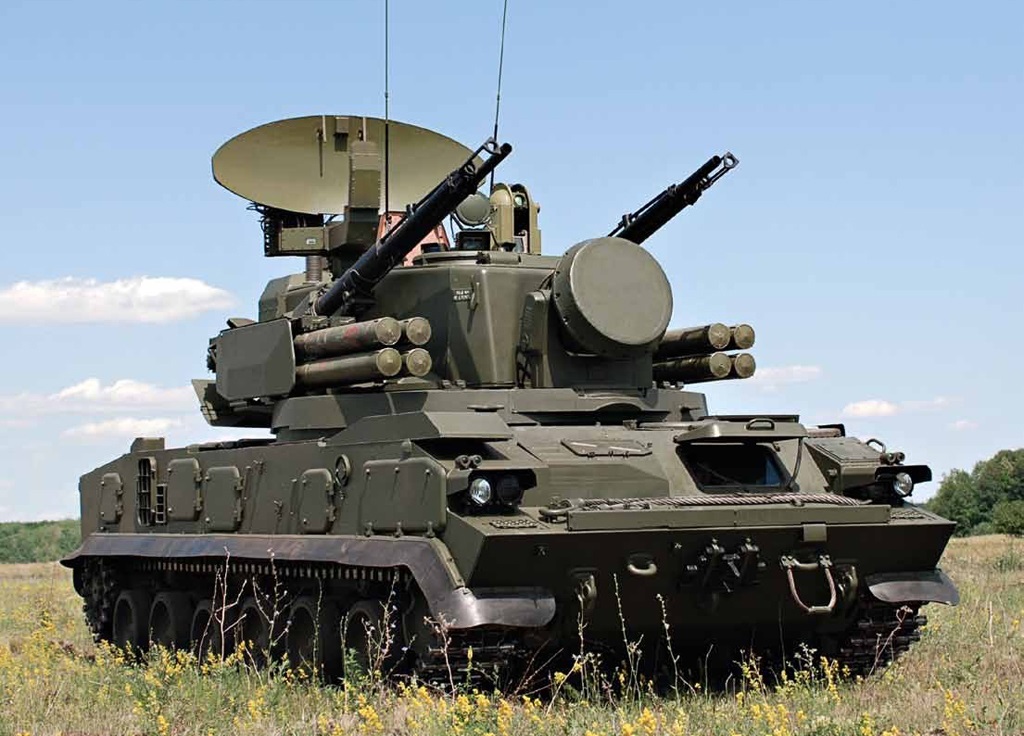
The 2K22 Tunguska (2К22 «Тунгуска», NATO SA-19 Grison) is a Soviet and Russian tracked gun-missile air-defence system built by KBP Tula. It carries two twin 2A38 30 mm cannons and eight 9M311 radio-command missiles on one GM-352 chassis, with a surveillance radar, a tracking radar and an optical sight. It entered service in 1982 as the regimental successor to the Shilka, and its gun-plus-missile layout was carried over into the Pantsir. [DOCUMENTED]
VERSIONS
| Version | Service | Notes |
| 2K22 Tunguska | 1982 | 9M311 missile, about 8 km class |
| 2K22M Tunguska-M | about 1990 | better radio link with battery command post; new power unit |
| 2K22M1 Tunguska-M1 | 2003 | 9M311-M1 missile with radar proximity fuze, better resistance to IR countermeasures, automated fire control |
The 9M311-M1 has an engagement range of 2.5-10 km, and the 30 mm guns cover close-in low-altitude targets out to about 4 km. [SINGLE-SOURCE] (Armeysky Standart, May 2025.) Earlier versions are commonly given as about 8 km for the missile. [ESTIMATE]
UKRAINE WAR
DEVELOPMENT
Development started on 8 June 1970, when the Soviet MoD asked KBP Tula, under chief designer A. G. Shipunov, for a 30 mm system to replace the Shilka. The Shilka's weaknesses were short range and no search radar, and new ground-attack aircraft (the A-10) and helicopters (the AH-64) were being designed to survive 23 mm hits. KBP studies found that a 30 mm gun needed a third to a half as many shells as the 23 mm to kill a target, and that the same mass of 30 mm shells against a MiG-17-class target at 300 m/s gave 1.5 times the kill probability. The requirement was to double the Shilka's range, altitude and effectiveness, with a reaction time under 10 seconds. [DOCUMENTED] (en.wikipedia.)
Because the fire control for guns and missiles was similar, KBP made it a combined system. The partners were the Minsk Tractor Plant (chassis), Ulyanovsk Mechanical Plant (radio equipment and production), NIEMI/Antey (central computer), VNII Signal (guidance and navigation) and LOMO (optics). [DOCUMENTED]
Work slowed in 1975-1977 after the 9K33 Osa entered service and seemed to meet the need with better missile performance. It restarted because a missile-only system reacted too slowly to helicopters that popped up at short range without warning, as in the 1973 war: about 8-10 seconds for a gun against about 30 seconds for a missile system. Trials ran from September 1980 to December 1981 at the Donguz range. The system was accepted on 8 September 1982, and the first batteries reached the army in 1984. [DOCUMENTED] (en.wikipedia.)
DESIGN AND SUBSYSTEMS
GUNS
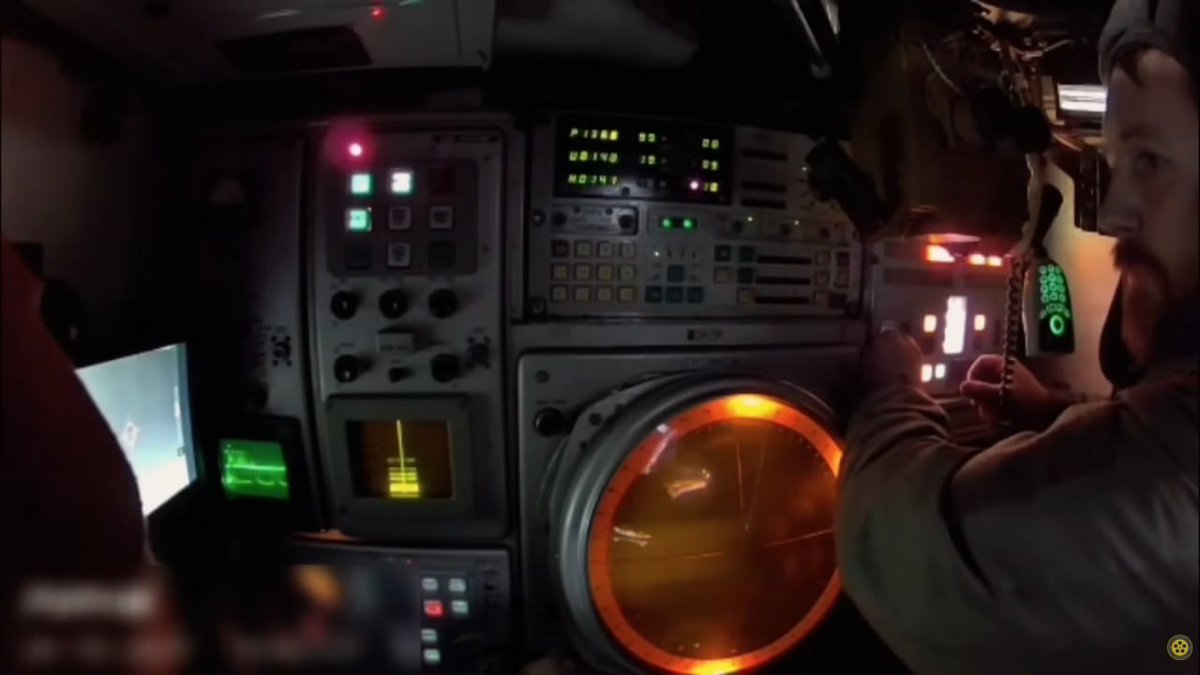
Two twin-barrel 2A38 (later 2A38M) 30 mm cannons from KBP, built by Tulamashzavod, fire alternately for a combined 3,900-5,000 rounds a minute, with a muzzle velocity of about 960 m/s. The vehicle carries 1,904 rounds, a mix of high-explosive incendiary and fragmentation-tracer shells with A-670 time and impact fuzes, which include an arming delay and self-destruct. Bursts are 83-250 rounds depending on target type, at 0.2-4 km. In radar mode the guns are laid automatically; in optical mode the gunner tracks and the radar gives range. [DOCUMENTED] (en.wikipedia.)
THE 9M311 MISSILE FAMILY
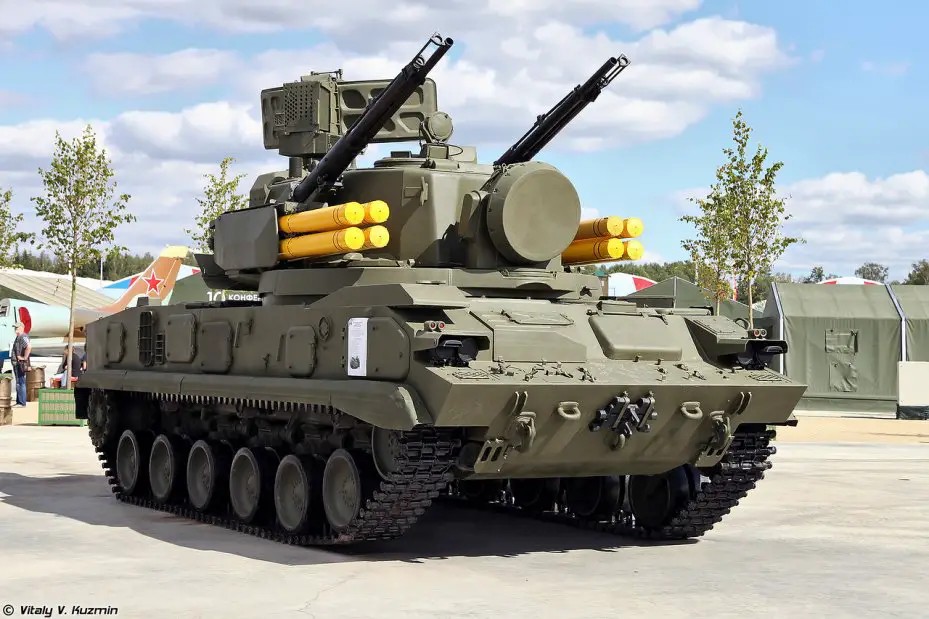
The 9M311 is a two-stage radio-command missile. A large booster with folding fins accelerates it to about 900 m/s and drops away; the slim sustainer section then coasts with four fixed fins and four control surfaces. The missile is about 2.56 m long and weighs about 57 kg. The tracking radar (or the gunner's sight) tracks the target, the computer generates corrections, and a radio link steers the missile, which carries a tracking flare (pulsed IR beacon on the M1) so the system can see it. Within about 5 m of the target a laser proximity fuze (radio fuze on 9M311-M1) fires a 9 kg continuous-rod warhead: 60 cm rods, 6-9 mm thick, which form a ring about 5 m across and break into 2-3 g fragments. [DOCUMENTED] (en.wikipedia.)
| Missile | Notes |
| 9M311 | original; laser proximity fuze; 1.5-8 km, 5-3,500 m |
| 9M311K (3M87) | naval version for Kortik/Kashtan; export 9M311-1E |
| 9M311-1 | export version |
| 9M311M (3M88) | improved missile for Tunguska-M |
| 9M311-M1 | Tunguska-M1: radio proximity fuze for small targets such as cruise missiles; pulsed IR beacon instead of constant flare; 2.5-10 km, 15-3,500 m |
VARIANTS
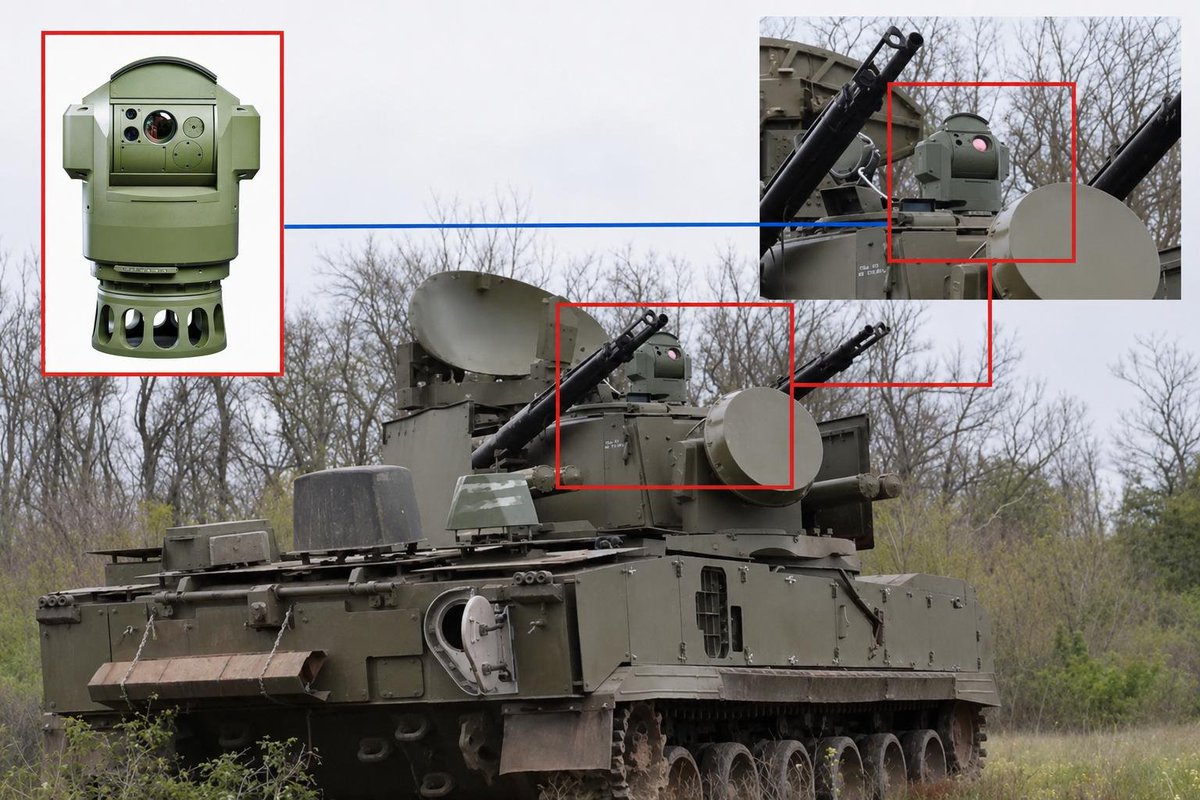
2K22 / 2S6 (1982): four ready missiles. 2K22M / 2S6M (1990): the main production version, eight ready missiles, 2A38M guns, better fire-control software and reliability, 2F77M transloader. 2K22M1 / 2S6M1 (2003): accepted on 31 July 2003, on the GM-5975 chassis with the 9M311-M1, better optical tracking and battery coordination, claimed 1.3-1.5 times the combat effectiveness of Tunguska-M. Russia received 21 Tunguska-M1s in 2012-2017. [DOCUMENTED] (en.wikipedia.)
Chinese relatives: 9M311 missiles were exported to China from 2005. The CASIC FK-1000 shown at Zhuhai in 2012 has a very similar layout on an 8x8 truck, with phased-array radars, 25 mm guns and 12 KS-1000 missiles, and NORINCO's Sky Dragon 12 uses the same missile family. [DOCUMENTED] for the systems; their link to Tunguska is [ESTIMATE]. The naval Kashtan and Kortik systems share the 9M311 and the 30 mm gun philosophy, and the Pantsir-S1 is its direct descendant. [DOCUMENTED]
BATTERY AND DOCTRINE
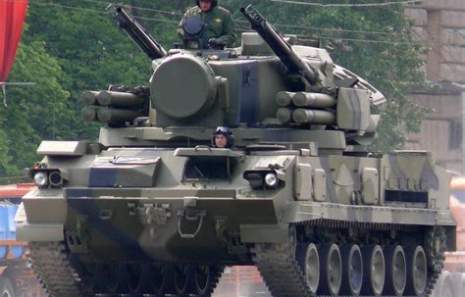
A battery has six 2S6 vehicles and up to three 2F77 transloader trucks, supported by 2F55, 1R10 and 2V110 repair and maintenance vehicles, an MTO-AGZ workshop and a 9V921 test vehicle. Each vehicle engages one target at a time. The battery is linked by an encrypted radio net to a Ranzhir or PPRU battery command post, which can distribute targets using data from early-warning radars, AWACS or (on PPRU) its own radar. [DOCUMENTED] (en.wikipedia.) In the regimental air-defence battalion, Tunguska replaced the Shilka battery, alongside Strela-10 and Igla batteries. [DOCUMENTED]
COMBAT HISTORY BEFORE 2022
Tunguska saw little combat before 2022. Russian forces used it in the 2008 war with Georgia. It was not used in Afghanistan in significant numbers, and the Chechen wars made more use of Shilkas for ground fire. [DOCUMENTED] (en.wikipedia.) [ESTIMATE] for Afghanistan and Chechnya.
UKRAINE WAR: DRONE KILLS AND CREW CLAIMS
LOSSES (ORYX)
As checked on 26 October 2026, Oryx lists 18 Russian Tunguskas (under "2K22M1 Tunguska") and one 2F77M transloader captured, against 13 at 9 March 2024 (Newsweek). Oryx lists 7 Ukrainian 2K22M Tunguska-M losses, including one captured and later destroyed. The broader Oryx category of self-propelled anti-aircraft guns totals 30 Russian (18 destroyed, 3 damaged, 2 abandoned, 7 captured) and 51 Ukrainian (41 destroyed, 5 damaged, 1 abandoned, 4 captured). [DOCUMENTED] (Oryx.) Oryx counts only photo- or video-confirmed losses, so these are minimums. [DOCUMENTED]
EXPORTS AND OPERATORS
Military Balance 2024 lists Russia with at least 240 2S6, Ukraine 75 (before war losses), Belarus an unknown number, India up to 80 (SIPRI: at least 66 received 1997-2009), Morocco 12 2S6M and Myanmar 38 bought in 2004-2007. India placed a further order for Tunguska worth INR 445 crore (about USD 46 million) on 27 March 2026. [DOCUMENTED] (en.wikipedia citing IISS, SIPRI and Indian press.)
PLACE IN THE LAYERED DEFENCE
In Russia's layered air defence this system sits in the lowest tier, under Tor, Pantsir, Buk-M3 and the S-300 / S-400 long-range layer. Beside it are the MANPADS (Verba, Igla), guns and electronic warfare. Its main job in 2024-2026 is to stop Ukrainian reconnaissance, strike and long-range drones, the mirror image of Ukraine's fight against the Geran-2. [ESTIMATE]
Tunguska is in many ways a Pantsir on tracks with older electronics. Its mix of cheap gun rounds for close drones and missiles for helicopters and larger drones is exactly what the drone war rewards, which explains why both armies keep it running. [ESTIMATE]
Related on this site: Shilka, Gibka-S, 1L122 Garmon, Strela-10, Sosna, Igla, Verba, MT-LB, S-300V, Pantsir, Tor.
Related on this site: Russian Unified Air Defense (how the layers fit together).
SOURCES