WHAT IT IS
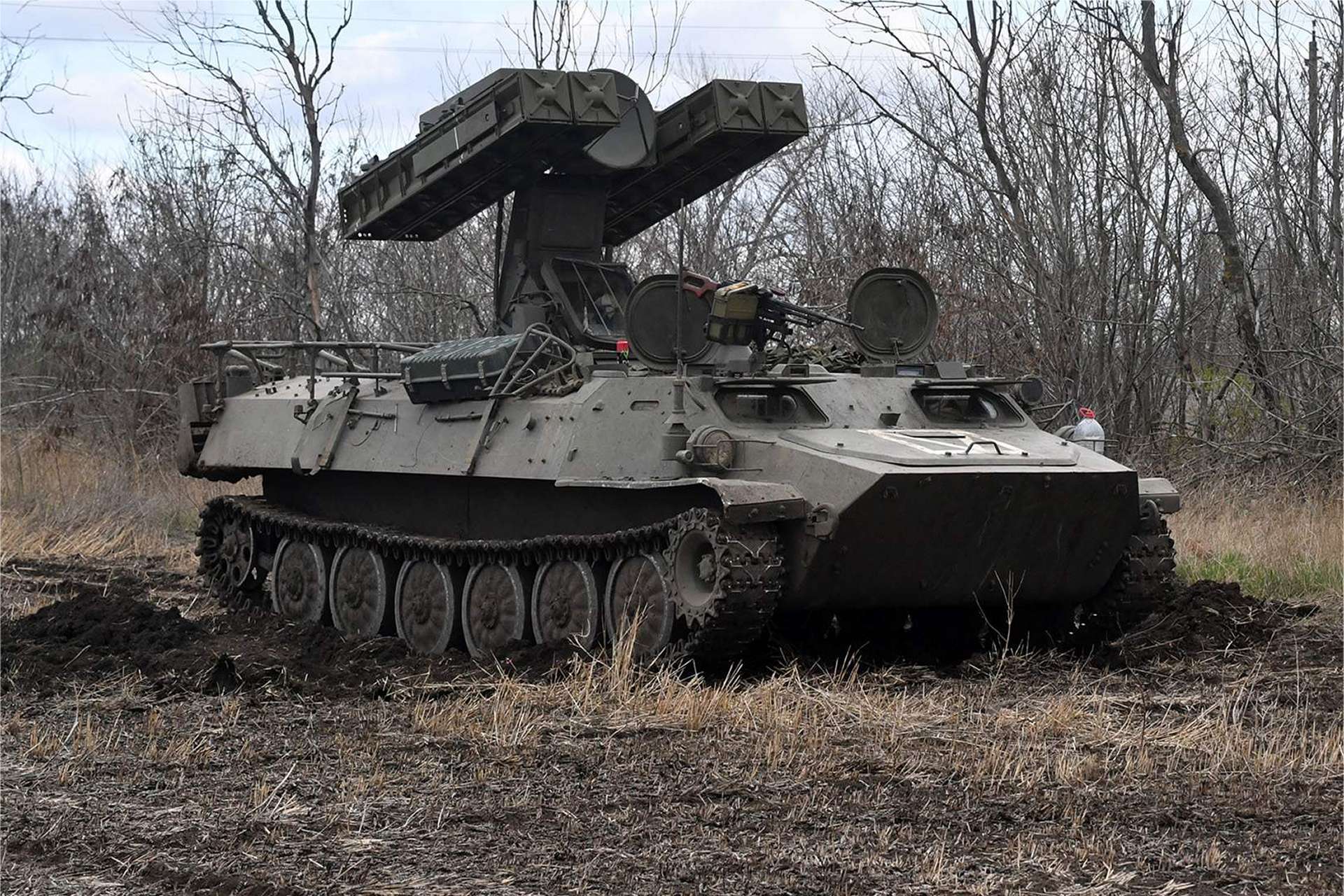
The 9K35 Strela-10 (Стрела-10, NATO SA-13 Gopher) is a Soviet and Russian short-range infrared-guided surface-to-air missile system on the MT-LB tracked carrier. It was developed by KB Tochmash (Конструкторское бюро точного машиностроения) in Moscow as the regimental replacement for the wheeled 9K31 Strela-1, and it entered service in 1976. Four missiles sit in boxes on a turret over the rear hull, with an optical sight and, on later versions, a passive radio direction-finder and thermal sight. [DOCUMENTED]
Half a century later it is still one of the most numerous Russian short-range air-defence vehicles at the front. Its missile, the 9M333, is still being produced, now by Kalashnikov. [DOCUMENTED]
VERSIONS
| Version | Service | Notes |
| 9K35 Strela-10 (SA-13) | 1976 | 9M37 missile, two-band seeker |
| 9K35M Strela-10M | about 1979 | improved launcher and electronics |
| 9K35M2 Strela-10M2 | about 1981 | 9M37M missile; automation and link to battery command post |
| 9K35M3 Strela-10M3 | about 1989 | 9M333 missile with three-channel seeker; improved sight |
| 9K35M4 Strela-10M4 | 2010s | thermal imaging sight for night use, modern electronics |
Service years are those common in reference books and differ by one or two years between sources. [ESTIMATE]
THE 9M333 MISSILE
The 9M333 has a multispectral seeker with three modes, intended to pick a real target out of flares, and a 2.6 kg warhead. It engages targets from 10 to 3,500 m in altitude. [DOCUMENTED] (Rostec / Kalashnikov via Army Recognition.) Typical range figures are about 0.8-5 km. [ESTIMATE] (reference-book figures.) The missile is fired from the vehicle without a radar emission. Where the vehicle carries a range-only radar or radio direction-finder, those help aim it, and the newest M4 adds a thermal sight so it can fight at night. [DOCUMENTED]
Kalashnikov delivered new batches of 9M333 missiles under the 2023 and 2024 state orders, announced by Rostec in October 2023 and May 2025. Russian sources claimed an 80% effectiveness rate in Ukraine, mostly against Ukrainian Su-25s and helicopters. [SINGLE-SOURCE] (Rostec via Army Recognition; a manufacturer claim.)
UKRAINE WAR
DEVELOPMENT HISTORY
The Strela-10SV (9K35) programme was started by a decree of the CPSU Central Committee and the Council of Ministers on 24 July 1969. At the same time the much more expensive all-weather 2K22 Tunguska gun-missile system was being developed. The simpler fair-weather missile system was approved anyway, for reasons of cost. Its intended role was to complement Tunguska against low fliers that appear suddenly, especially in heavy radio-electronic jamming, against which an optical system is immune. [DOCUMENTED] (Sources 7, 8.) Parallel work on a naval version and on a "Strela-11" for the VDV on the BMD-1 chassis was not completed. [DOCUMENTED] (Source 7.)
The requirement set several targets. The system was to hit targets flying at up to 415 m/s head-on and 310 m/s going away, at 25 m to 3-3.5 km altitude and 0.8-1.2 to 5 km range, with a crossing parameter (lateral offset) of up to 3 km. Against a single target manoeuvring at 3-5 g, with no flares, it was to reach a single-shot kill probability of 0.5-0.6. The vehicle was to weigh no more than 12.5 t, be air-portable in Mi-6 and An-12B aircraft, and swim. [DOCUMENTED] (Source 7.) The lead developer was KBTochmash under A. E. Nudelman, which had also built the Strela-1. TsKB Geofizika (D. M. Khorol) did the seeker and proximity fuze. NIIEP, LOMO (optics) and the Kharkiv Tractor Plant (chassis) were among the other partners. [DOCUMENTED] (Sources 7, 8.)
Joint trials at the Donguz range ran from January 1973 to May 1974 and went badly. The GRAU and 3rd NII representatives wanted to accept the system, but the commission chairman, L. A. Podkopaev, objected, as did the air-defence troops and the range staff. They cited low kill probability (IR channel throughout the zone; photocontrast channel head-on, going away, below 100 m and above 2,000 m), vehicle reliability, firing while afloat and crew ergonomics. [DOCUMENTED] (Sources 7, 8.) Once these issues were fixed, the system was accepted by decree in 1976. Russian sources give 16 March 1976, while en.wikipedia gives 16 May 1976. [UNVERIFIED] on the exact day. (Sources 6, 7.) Members of the design team (Nudelman, Moreino, Konyukhov, Terentyev and others) received the USSR State Prize. Vehicles were built at the Saratov Aggregate Plant and missiles at the Kovrov Mechanical Plant. [DOCUMENTED] (Source 7.)
THE 9K35 COMBAT VEHICLES
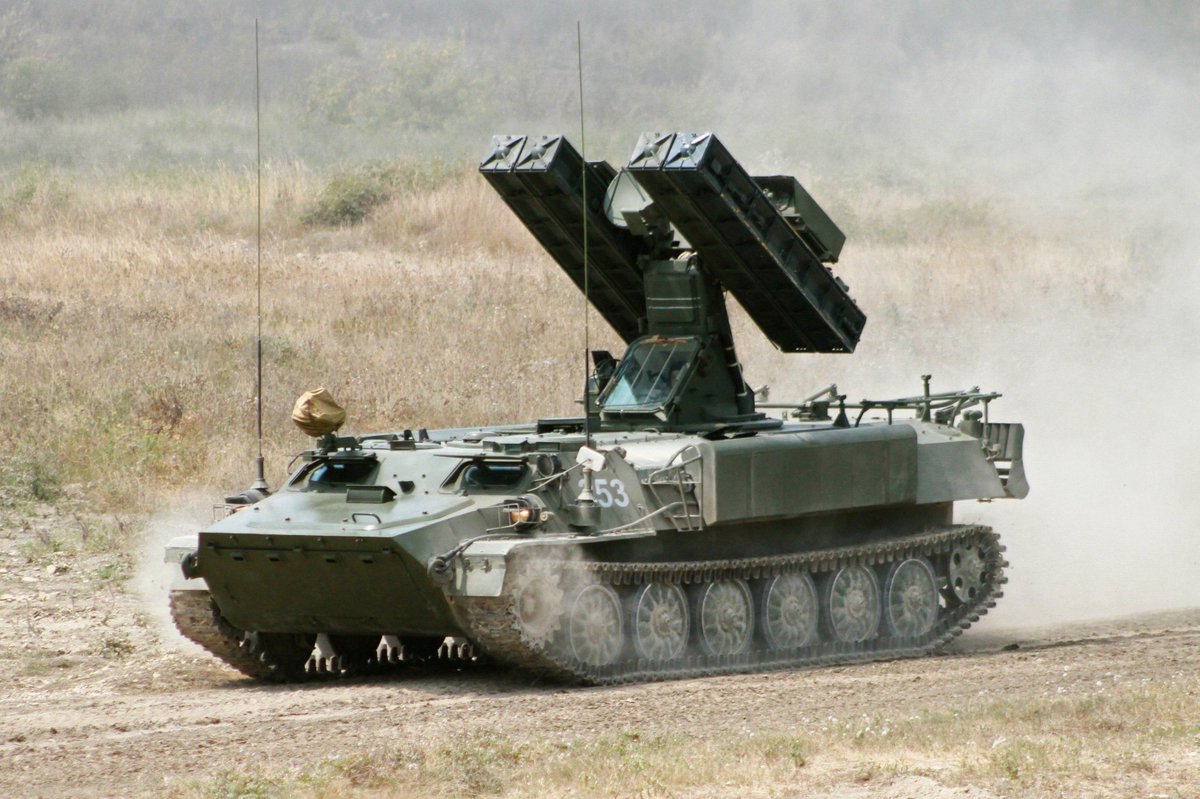
Chassis. The Strela-1 had been on the wheeled BRDM-2. The 9K35 instead uses the tracked MT-LB multipurpose tractor. Its extra payload allowed 8 missiles to be carried: 4 on the launcher and 4 inside the hull. [DOCUMENTED] (Source 7.) en.wikipedia gives 4 ready rounds plus 8 reloads; the Russian design-history sources give 4 + 4. [UNVERIFIED] for the larger figure. (Sources 6, 7.) The tracked chassis vibrated far more than the old wheeled vehicle, and this caused long problems with the instruments. [DOCUMENTED] (Source 7.) Russian reference data give a combat weight of about 12.3 t and a crew of 3. The MT-LB chassis has a 240 hp V8 diesel, 60 km/h on roads, 5-6 km/h afloat and about 500 km range, with bullet-proof armour of about 14 mm at the front. [DOCUMENTED] (Source 8.) Low ground pressure lets it cross swamp, snow and sand. [DOCUMENTED] (Sources 8, 13.)
Launcher. On the Strela-1 the operator traversed the launcher by muscle power; on the 9K35 it is electrically driven, 360° in azimuth and -5° to +80° in elevation. [DOCUMENTED] (Sources 7, 13.) The operator sits behind an armoured-glass front wall with a 60° field of view and aims through an optical sight. On the march the launcher folds onto the roof, and it deploys in about 20 seconds. [DOCUMENTED] (Source 13.) Power comes from a generator on the main engine or from an external source such as the trailer-mounted 9U111, which can feed up to four vehicles by cable. [DOCUMENTED] (Sources 6, 13.) Standard fit includes IFF, navigation equipment, an R-123M radio and an intercom, plus a 7.62 mm PKT machine gun for self-defence. [DOCUMENTED] (Sources 6, 13.)
9A35 and 9A34. A Strela-10 platoon has one 9A35 commander's vehicle and three 9A34s. The only difference is that the 9A35 also carries the 9S16 passive radar direction finder; the 9A34 does not. [DOCUMENTED] (Sources 7, 13, 14.) Both have the 9S86 launch-zone assessment set. [DOCUMENTED] (Sources 7, 13.) en.wikipedia's equipment list puts the 9S86 against the 9A34 and the 9S16 against the 9A35, which could be read as meaning the 9A35 lacks the rangefinder. The Russian sources make clear that it does not. [DOCUMENTED] (Sources 6, 7, 13.)
SENSORS: WHAT THE DISH IS AND IS NOT
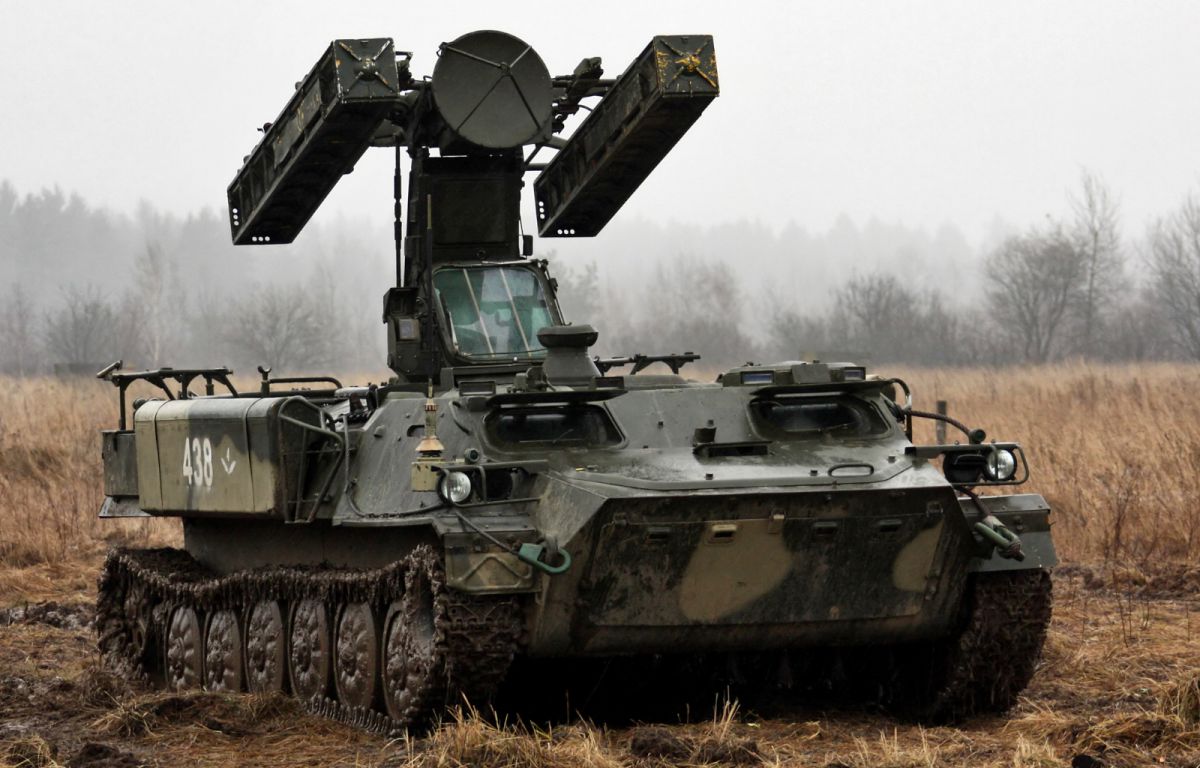
9S86 launch-zone assessment set (АОЗ, NATO "Snap Shot"). The small dish between the two pairs of launch boxes is a coherent-pulse radar rangefinder in the millimetre band, paired with an analogue-discrete computer. It measures range to the target from about 430 m to 10,300 m (maximum error about 100 m) and closing (radial) speed (error up to 30 m/s). The computer then works out the boundaries of the launch zone (error 300-600 m) and the lead angles for launch (mean error 0.1-0.2°). [DOCUMENTED] (Source 7.) Other descriptions say the set also helps lay the launcher and decide the moment of launch, with a working range of about 10 km. [DOCUMENTED] (Source 13.)
What the dish is not. The 9S86 does not guide the missile or illuminate the target. Nothing on the vehicle radiates toward the target once the missile is away. The 9M37 and 9M333 are passive homing missiles: the seeker locks onto the target's infrared or optical contrast before launch, and the missile then steers itself to the target ("fire and forget"). They are not beam-riders like the 9M337 Sosna-R (see Sosna), and not semi-active radar homers like Buk or S-300V missiles. [DOCUMENTED] (Sources 6, 7, 9.) The rangefinder emits only briefly, just before a shot, so it is a weak signature. It is not a search radar, and a Strela-10 can also fire without it. [ESTIMATE] (based on Sources 7, 13.)
9S16 passive radar direction finder (NATO "Flat Box-B"). This set is on the 9A35 only. It detects targets whose own radio-electronic equipment, such as bombing radars and airborne radars, is switched on, and takes their bearing in azimuth. [DOCUMENTED] (Sources 13, 14.) It gives 360° azimuth coverage and at least 40° in elevation. US Army ODIN describes four antenna units: one at each rear corner of the hull, one facing aft and one between the driver's vision ports. [DOCUMENTED] (Sources 6, 15.) The 9S16 is a cueing aid. It turns the launcher toward an emitter, and the operator still has to see and lock onto the target. Small drones carry no radar, so the 9S16 is of little use against them. [ESTIMATE]
Optics. The original vehicles had an optical sight. The Strela-10M3 added a two-channel sight with a wide field (35°, ×1.8) and a narrow field (15°, ×3.75), which increased detection range against small targets by 20-30%. [DOCUMENTED] (Source 7.)
External cueing. At regimental level the original system took target designations by voice radio from the PU-12(M) battery command post. Telecode data was to follow, once fitted. [DOCUMENTED] (Source 7.) The Strela-10M2 (1979-1981) added the 9V179-1 set, which receives designations automatically from the PU-12M, from the PPRU-1 "Ovod-M-SV" regimental CP, and from radars fitted with ASPD-U data links. It also slews the launcher onto the cued target automatically, and a second R-123M radio was added for the telecode. [DOCUMENTED] (Source 7.) Later references describe M3 platoons controlled by a PU-12M6 and batteries by a PPRU-M1, with the launcher slewing automatically on a designation. [DOCUMENTED] (Source 16.) The 9S80 "Dog Ear" radar on an MT-LBu and the Ranzhir-M 9S737M CP also feed mixed short-range groups. [DOCUMENTED] (Source 6.)
THE MISSILES: 9M37, 9M37M AND 9M333
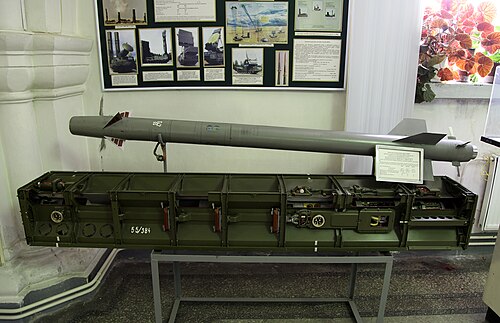
Compatibility. The launch equipment also accepts the old Strela-1 9M31M. Every Strela-10 version (SV, M, M2, M3) can fire every missile type: the 9M31M, 9M37, 9M37M and 9M333. [DOCUMENTED] (Sources 6, 7.) The missiles never leave their transport-launch containers in service. They are stored in wooden crates or on the vehicle. [DOCUMENTED] (Source 17.)
9M37. The 9M37 kept the Strela-1 wing span and body diameter but was lengthened to 2.19 m. It weighs about 40 kg. Its 3 kg high-explosive fragmentation warhead uses cutting rods instead of plain fragments; en.wikipedia gives 3.5 kg. [DOCUMENTED] (Sources 6, 7.) Separate rollerons behind the wings limit the roll rate. [DOCUMENTED] (Source 7.) The 9E47 seeker has two channels. It adds a cooled infrared channel to the Strela-1's photocontrast channel, which improved head-on and tail-chase shots and performance in clutter. The photocontrast channel needs no cooling and serves as a backup, since the IR detector can be cooled for only one pre-launch preparation. [DOCUMENTED] (Source 7.) Training-manual data for the 9E47: 1° field of view, 40° maximum gimbal angle, gyro speed 68 rev/s, 5 s to come up to speed, and a mass of 3.4 kg. The optics are a dual-band mirror-lens objective with separate focal planes and reticles for each channel, and most of the optics spin with the gyro rotor. [DOCUMENTED] (Source 17.) The same manual gives a mean speed of 550 m/s, a 20° no-fire cone around the sun, fuze arming 250 m from the vehicle and 5 s to readiness. [DOCUMENTED] (Source 17.) The design-history table gives 517 m/s. [DOCUMENTED] (Source 7.)
9M37M. It entered service with the Strela-10M in 1979 after trials in January-May 1978. Its seeker separates targets from deliberate optical decoys (flares) by their trajectory, which made flares less effective. The cost was about 3 seconds of extra reaction time when firing through countermeasures. [DOCUMENTED] (Source 7.) en.wikipedia describes the main change as a more efficient autopilot. [DOCUMENTED] (Source 6.) Later derivatives, the 9M37MD and 9M37M1, were meant to improve flare resistance further. [DOCUMENTED] (Sources 10, 16.)
9M333. It was developed in 1983-1986 under the code name "Kitoboy" (Whaler) and accepted with the Strela-10M3 in 1989. [DOCUMENTED] (Source 7.) Changes from the 9M37M: [DOCUMENTED] (Sources 6, 7.)
The trials found that the 9M333 still fell short of requirements against small targets on crossing courses and at high temperatures (up to +50 °C), so it was further refined before acceptance. [DOCUMENTED] (Source 7.) The M3 with the 9M333 is rated against drones flying at 20-300 m/s and cruise missiles at up to 250 m/s, at 10-2,500 m altitude (above 25 m in the photocontrast channel). It is rated against helicopters at up to 100 m/s and aircraft at 415/310 m/s, at 25-3,500 m. [DOCUMENTED] (Source 7.) In trials against F-15-type targets firing flares upward every 2.5 s, kill probability and range fell by up to 65% in the photocontrast channel and 30-50% in the IR channel. The requirement allowed only a 25% loss. [DOCUMENTED] (Source 7.) The 9M333 was still in production in 2026, and Russia was replenishing stocks in 2025. [DOCUMENTED] (Sources 3, 6.)
| Parameter | Strela-10SV | 10M | 10M2 | 10M3 |
| Range | 0.8-5 km | 0.8-5 km | 0.8-5 km | 0.8-5 km |
| Altitude | 25 m-3.5 km | 25 m-3.5 km | 25 m-3.5 km | 10 m-3.5 km |
| Pk vs fighter, one missile | 0.1-0.5 | 0.1-0.5 | 0.3-0.6 | 0.3-0.6 |
| Reaction time | 6.5 s | 8.5 s | 6.5 s | 7 s |
| Missile / warhead mass | 40 / 3 kg | 40 / 3 kg | 40 / 3 kg | 42 / 5 kg (9M333) |
Table source: the Russian design history. [DOCUMENTED] (Source 7.) Because the photocontrast channel allows head-on shots, the launch range against an approaching target can be much longer than the 5 km intercept limit. Against a receding target it is much shorter. [DOCUMENTED] (Source 6.)
PRE-LAUNCH SEQUENCE AND THE "WHIRR" IN COMBAT VIDEOS
In Strela-10 combat videos a rising spinning or whirring sound is often heard for several seconds before the motor ignites. The site owner points this out. [FIELD ACCOUNT, site owner] The documented sequence explains it.
The operator's mode sequence (Bogdan manual). The training manual gives the sequence step by step. The operator puts the target in the ring of the 9Sh127 sight and presses the left-handle button for "Bort" (on-board) mode. This powers the missile, spins up the seeker gyro and aligns it with the container axis, and switches on the 1RL246-10 IFF interrogator. "Bort" mode lasts at least 5 s. The first detent on the right handle selects "Tracking": the front cover opens, the seeker tracks in the photocontrast or thermal channel, the 9S86 switches to "Measure" mode, and the IFF interrogates. When the target enters the launch zone, the 9S86 sends a "Zone" signal that lights in the sight. If there is no friendly reply, the second detent fires. The on-board power source and gas generator start, and after 1.1 s the pyrotechnic igniters of the safety-arming mechanism and the motor fire. During that 1.1 s the lead in azimuth and elevation is applied and the launcher is braked. The fuze works on a hit or a miss of up to 4 m. After 16 s of flight it is blocked, so the warhead cannot detonate. [DOCUMENTED] (Source 17.) The KazNU course notes describe the same launch phase in the same terms. [DOCUMENTED] (Source 18.) The at-least-5-second "Bort" mode, in which the gyro runs up, matches the length of the rising whirr in videos. [SPECULATION, site owner]
What makes the sound. The most likely sources are the seeker gyro spinning up over about 5 seconds, which is the right length of time, the hiss of the nitrogen coolant, and in the last second the missile's gas generator and power unit starting. The electric traverse drives of the launcher also contribute. Which of these dominates in a given video cannot be confirmed from the sources. [SPECULATION, site owner] The owner confirms the gyro-and-cooling reading. A similar spin-up and cooling cycle happens in MANPADS: see Igla and Verba, where a one-shot battery-coolant unit does the same job by hand. [DOCUMENTED] (Source 19.)
VARIANTS IN DETAIL
ORGANISATION AND DOCTRINE
In Soviet service a Strela-10 platoon (one 9A35 and three 9A34s) and a Tunguska platoon together made up the missile-gun battery of a tank or motor-rifle regiment's air-defence battalion. The battery CP was a PU-12(M), which was to be replaced by Ranzhir. [DOCUMENTED] (Source 7.) It replaced the 9K31 Strela-1 one for one. [DOCUMENTED] (Source 15.) In the layered scheme it is the regiment's fair-weather, short-range, passive missile layer. It sits under Tor, Buk and S-300V and alongside Tunguska, guns and MANPADS. Its advantages are that it emits almost nothing and is immune to radio-frequency jamming. [DOCUMENTED] (Sources 6, 7.)
COMBAT HISTORY BEFORE UKRAINE
UKRAINE: THE STRELA-10 AS A DRONE KILLER
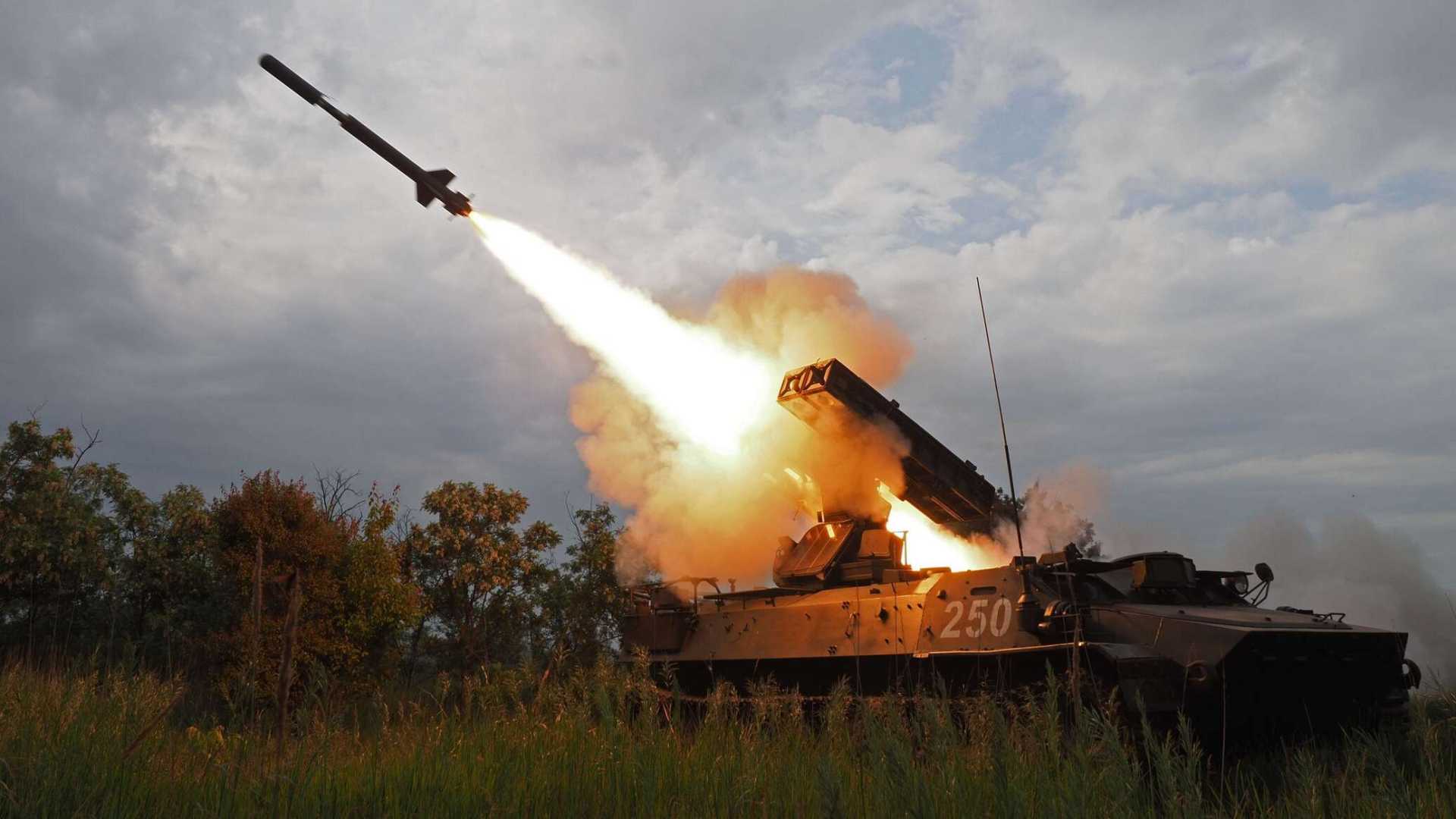
Few expected a 1970s fair-weather SAM to become one of the most useful counter-drone weapons of the war. Yet from 2024 Russian state media ran a steady stream of crew interviews and videos of Strela-10 kills against Ukrainian fixed-wing drones. [DOCUMENTED] (Sources 22-26.) Ukrainian Strela-10s were used the same way against Shaheds and reconnaissance drones. Individual kill counts on both sides are unit claims. [UNVERIFIED]
Why an old system works against drones. The site owner offers the core insight. [FIELD ACCOUNT, site owner] The sources support each part of it:
Limits. The ceiling is about 3.5 km and the range 5 km. In poor visibility older vehicles need external cueing, and there is no answer to fast FPV drones attacking the vehicle itself, hence the improvised armour. Several confirmed losses were to FPV and loitering munitions. [DOCUMENTED] (Sources 1, 2, 26.)
LOSSES (ORYX, AS OF 26 OCTOBER 2026)
| Side | Strela-10 (all versions) visually confirmed lost |
| Russia | 58 |
| Ukraine | 34 |
Counts are from Oryx's Russian and Ukrainian loss lists, checked on 26 October 2026. [DOCUMENTED] (Source 27.) Early-2025 reporting gave 51 for Russia, so losses have continued at a few a quarter. [DOCUMENTED] (Sources 4, 27.) Notable dated losses: a Russian Strela-10M on Snake Island destroyed by a TB2 on 30 April 2022, a Ukrainian Strela-10M near Lysychansk on 17 June 2022, and a Strela-10M3 hit by two FPV drones from the Requiem group in February 2025. A Strela-10M4 was destroyed by Ukrainian drone forces in February 2025. [DOCUMENTED] (Sources 1, 2, 6.)
EXPORTS AND OPERATORS
Current operators include Russia (about 350), Cuba (200), Jordan (92), Vietnam (20), Serbia (18), Turkmenistan (13), Croatia (3 M3 and 6 CRO), the Czech Republic (9) and North Macedonia (8). Angola, Armenia, Azerbaijan, Belarus, Georgia, India, Kazakhstan, Kyrgyzstan, Laos, Mongolia, Syria and Ukraine also operate it in unpublished numbers. [DOCUMENTED] (Source 6, citing IISS.) Former operators include Afghanistan, Bulgaria, East Germany, Hungary, Iraq, Libya, Poland and Slovakia. [DOCUMENTED] (Source 6.)
PLACE IN THE LAYERED DEFENCE
In Russia's layered air defence this system sits in the lowest tier, under Tor, Pantsir, Buk-M3 and the S-300 / S-400 long-range layer. Beside it are the MANPADS (Verba, Igla), guns and electronic warfare. Its main job in 2024-2026 is to stop Ukrainian reconnaissance, strike and long-range drones, the mirror image of Ukraine's fight against the Geran-2. [ESTIMATE]
Strela-10 suits small, cool drones poorly: the IR seeker needs a heat contrast, and the vehicle has no search radar of its own. It works best when a battery command post or a radar such as the one in Barnaul-T cues it, and against helicopters and attack aircraft. [ESTIMATE]
SOURCES
Related on this site: Gibka-S, 1L122 Garmon, Sosna, Tunguska, Tor, Pantsir, S-300V, MT-LB, Igla, Verba.
Related on this site: Russian Unified Air Defense (how the layers fit together).
Project Orlan // Underground Information Database