WHAT IT IS
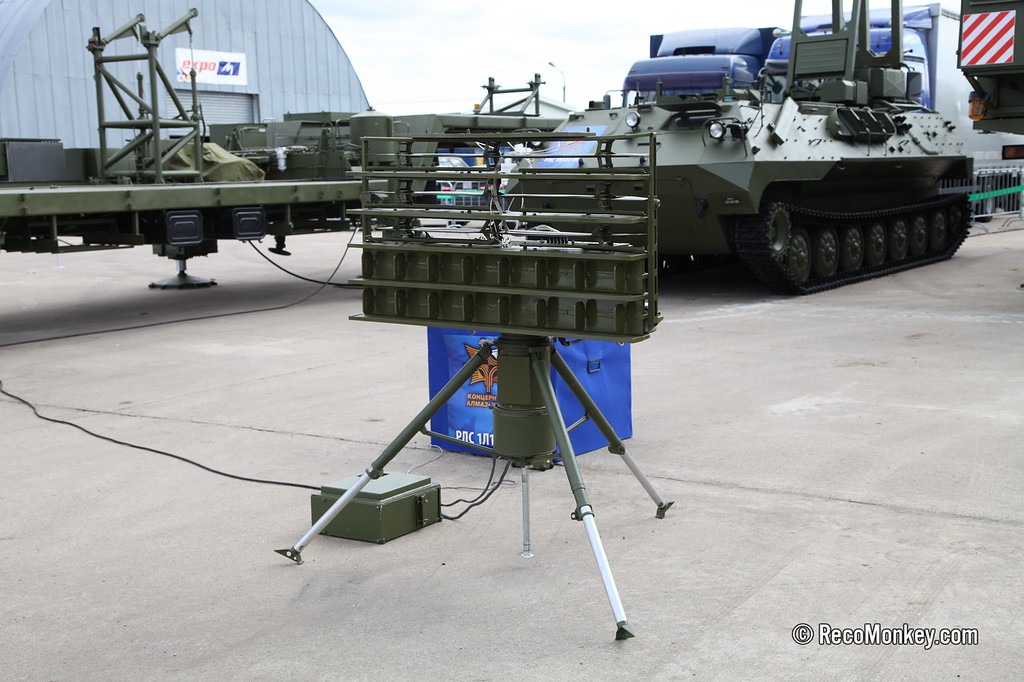
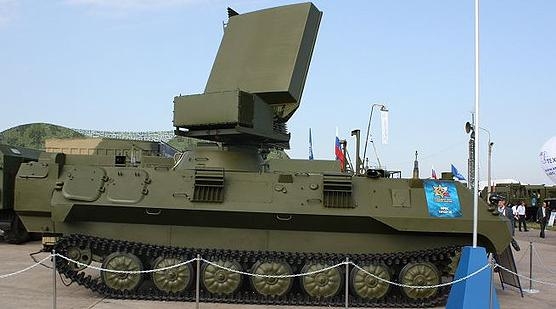
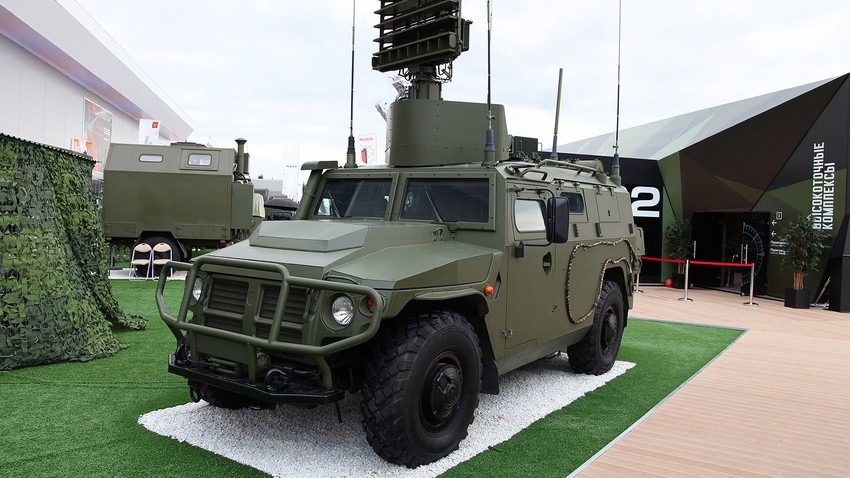
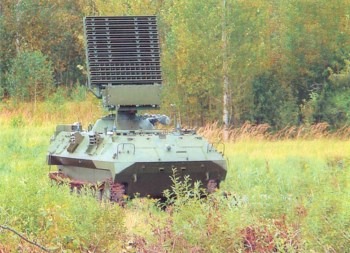
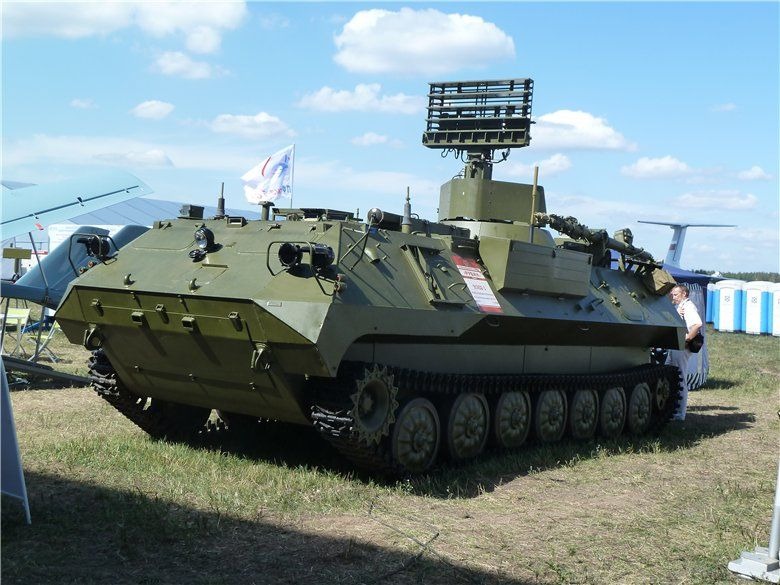
The 1L122 Garmon ("accordion") is a Russian small-size air-surveillance radar (малогабаритная радиолокационная станция, MRLS). Its job is to give short-range air-defence units a radar picture they would otherwise lack: MANPADS teams, short-range missile and gun systems, and their automated command posts. It detects, measures three coordinates for, and tracks fixed-wing aircraft, helicopters, cruise missiles and drones, identifies friend or foe, and sends track data automatically to its users by wire or radio. [DOCUMENTED] (manufacturer data sheet, source 3; Topwar, source 1.) The Garmon matters because the weapons it serves are short-sighted. An Igla or Verba gunner, or a Strela-10 crew, sees only what the eye or an optical sight can see. The two Garmon versions are different sets: the smaller 1L122-1E detects out to 40 km and up to 10 km altitude, while the 1L122-2E, with a much larger panel, reaches 80 km and 20 km altitude, both against a 1 m² target. [DOCUMENTED] (sources 1-5.) The 1E appears on tripods, on the Tigr (Gibka-S) and on MT-LB vehicles; the 2E is the much larger panel, seen on MT-LB. Panel size, not the chassis, is the way to tell them apart. [FIELD ACCOUNT, site owner] Either tells the gunners where to look and when, though against small drones the real range is far shorter (see Against drones). Topwar notes that before the Garmon, Russian troops had no small-size detection equipment built to work inside air-defence units. [SINGLE-SOURCE] (source 1.)
DESIGN
The data sheet describes the 1L122 as a coherent pulse-Doppler 3D radar working in the decimetre band, with a solid-state transmitter and a digital phased-array antenna. The array turns mechanically in azimuth for all-round search and scans electronically in elevation, which is how a single small antenna gives height as well as range and bearing. [DOCUMENTED] (source 3.) Export material gives the band as L. [DOCUMENTED] (sources 1, 2.) KRET-era data also says both versions work in band L. [DOCUMENTED] (source 5.) The decimetre band (дециметровый диапазон) covers wavelengths of 10 cm to 1 m, roughly 0.3-3 GHz, the upper UHF range. [BACKGROUND] L-band, which these sources name, is the 1-2 GHz part of it. [BACKGROUND] A 2025 Topwar analysis puts the 1L122-1E at a wavelength of about 22 cm, which works out to about 1.36 GHz. [SINGLE-SOURCE] (source 15; the frequency is calculated here from the stated wavelength.) No source found gives an exact operating frequency. [UNVERIFIED] A wavelength of roughly 15-30 cm explains the antenna's look. At these wavelengths an array is built from rows of stacked dipole or Yagi-type elements, not a slotted waveguide panel or a dish, which suit centimetre-band radars. [ESTIMATE] The site owner notes that the antenna construction itself suggests a UHF radar. [FIELD ACCOUNT, site owner] The longer wavelength is a trade. It gives good range and power efficiency from a light array, but a beam from a small aperture is wide, so angular resolution and accuracy are coarse (0.5° in azimuth and 1.5° in elevation for the 1E). [DOCUMENTED] for the accuracy figures (source 2); the trade-off reasoning is [ESTIMATE]. That fits the poor small-drone performance described under Against drones. It sets up its own position and north reference from GLONASS and GPS, so the crew does not need to survey the site by hand. The transmitted pulse power is low enough that the crew can work right next to the antenna safely, according to the export brochure. [DOCUMENTED] (sources 2, 3.) It can be dropped by parachute from an aircraft, and it can run from its own power unit or from the electrical system of any vehicle. [DOCUMENTED] (source 3.)
VERSIONS
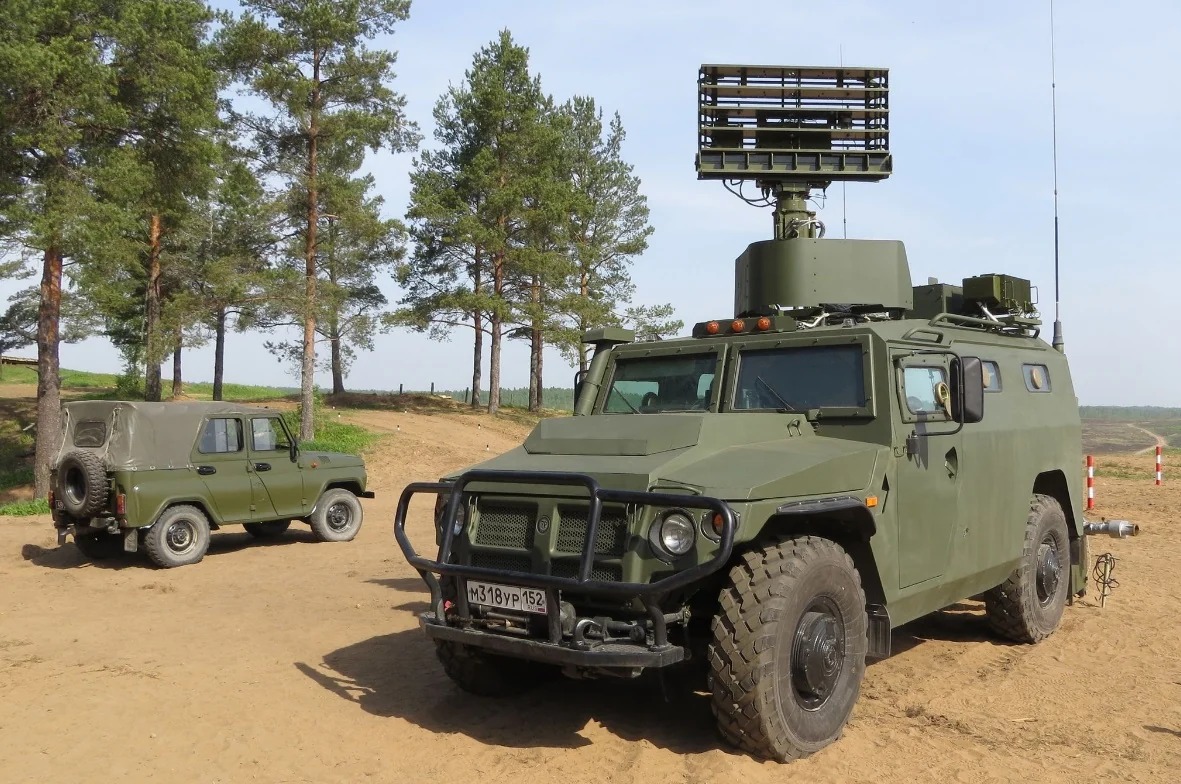
Two versions were first shown at the MAKS show in 2009: a portable set and a heavier vehicle-mounted set. [DOCUMENTED] (source 1.) The export names are 1L122-1E (portable) and 1L122-2E (vehicle). Topwar writes them both as "1L122-E1 / E2" and as "1L122E-1", so the spelling varies; this site uses 1L122-1E and 1L122-2E, as the export tables do. [DOCUMENTED] (sources 1, 2.) Russian service sets are referred to simply as 1L122, and the portable set as 1L122-1. [DOCUMENTED] that the names are used; the exact Russian sub-model designations are [UNVERIFIED].
SPECIFICATIONS
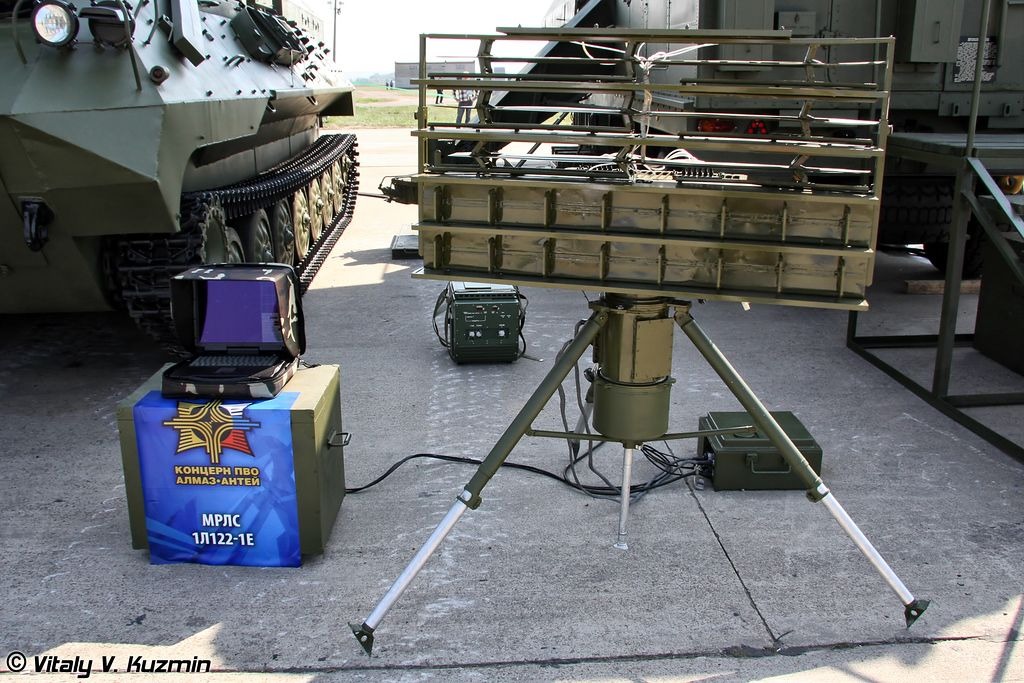
Export figures for a single 1 m² target in clear conditions. [DOCUMENTED] (Almaz-Antey export table, source 2; the portable figures match the data sheet, source 3, and Topwar, source 1.)
| Parameter | 1L122-1E portable | 1L122-2E vehicle |
| Band | L | L |
| Range | 1-40 km | 1-80 km |
| Azimuth | 360° | 360° |
| Elevation | -5° to +45° | 0° to +60° |
| Altitude | 10 km | 20 km |
| Max target speed | 700 m/s | 700 m/s |
| Range accuracy | 100 m | 100 m |
| Azimuth accuracy | 0.5° | 0.33° |
| Elevation accuracy | 1.5° | 1° |
| Ground clutter rejection | 55 dB | 55 dB |
| Noise jamming immunity | 18 dB | 18 dB |
| Other clutter | 40 dB | 40 dB |
| Data update | 2 or 4 s | 4 or 10 s |
| Power (max) | 800 W (22-30 V) | 5,000 W |
Topwar gives the portable elevation coverage as "from 5° to 45°"; the export table and the data sheet say -5°. The minus sign has probably been lost in translation. [ESTIMATE] Sources conflict on the vehicle version's antenna. KRET-era data quoted by Topwar gives the same 1,200 x 800 mm array for both versions (source 5), while a later Topwar analysis describes the 2E as having a larger array (source 15); some secondary summaries give 1.9 x 1.8 m. [UNVERIFIED] The site owner reports that the 2E uses the same array construction as the 1E but with more rows, and that it is often fitted with a cover over the array; the photos on this page show it both covered and uncovered. On his reading, the larger aperture is the main reason the 2E has roughly double the range, and it would draw more power. [FIELD ACCOUNT, site owner] This supports Topwar's larger-array view over the KRET-era 1,200 x 800 mm figure for both versions, which is kept here as published. The power point matches the export data: 5,000 W maximum for the 2E against 800 W for the 1E. [DOCUMENTED] (source 2.) The same KRET data says the 1E can be either carried or mounted on a vehicle, which fits the Tigr installation. [SINGLE-SOURCE] (source 5.)
WHO MAKES IT
Sources conflict. The export brochure carries the Almaz-Antey name. [DOCUMENTED] (source 2.) Russian reporting says KRET delivered Garmon radars to the MoD, and Roselektronika (Rostec) described the 1L122 on the Gibka-S. [DOCUMENTED] (sources 5, 7.) The technical data sheet is distributed in the name of NNPO Frunze of Nizhny Novgorod. [DOCUMENTED] (source 3.) Which firm designs it and which builds it is not settled by these sources; several holding-company reorganisations probably explain part of the mix. [ESTIMATE]
GROUND TRIPOD AND VEHICLE MOUNTS
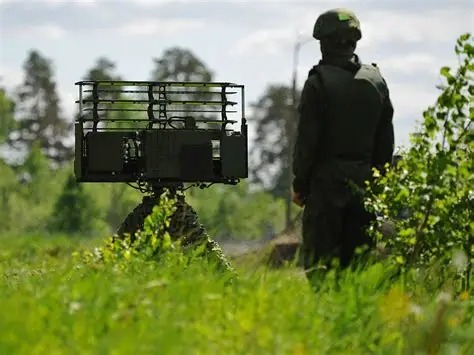
The portable set is meant to stand on the ground. Its tripod turntable, man-portable containers and five-minute setup let a crew put it on a hilltop or other high point that a vehicle cannot reach. The export brochure stresses delivery "to any station, including adverse terrain and mountainous areas". [DOCUMENTED] (sources 1, 2.) In practice the radar is commonly placed on the ground rather than on a vehicle, often right beside the MANPADS gunners it cues. [FIELD ACCOUNT, site owner] On vehicles, the radar appears in several forms:
HOW IT CUES SHORT-RANGE AIR DEFENCE
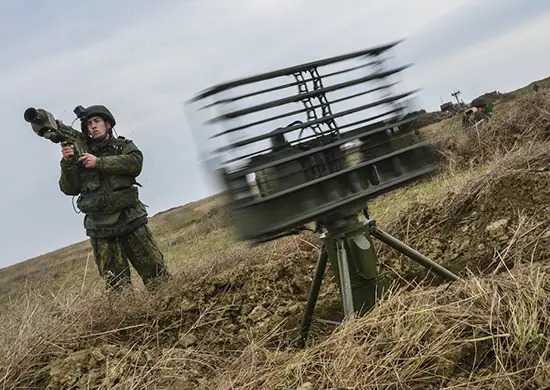
The data sheet lists the users the 1L122 is meant to feed: MANPADS gunners, the PU-12 battery command post, the Strela system, Tunguska, the 1L15 and 1L110 electronic plotting tablets, the Igla, and automated control systems at various levels. [DOCUMENTED] (source 3; the sheet calls Tunguska a "MANPADS", which is an error in the original.) Track data goes out automatically over wire or radio. [DOCUMENTED] (source 3.)
AGAINST DRONES
Drones are among the target types the radar is designed for. [DOCUMENTED] (sources 1, 3.) The sources found give no detection range for small drones: the published 40 km figure is for a 1 m² target, and a small quadcopter or FPV drone has a much smaller radar cross-section, so its detection range will be far shorter. [ESTIMATE] A 2-4 s update rate is slow for a fast FPV drone at close range but adequate for cueing against reconnaissance drones and Shahed-type attack drones flying a steady course. [ESTIMATE]
A 2025 Topwar analysis is blunt: at a wavelength of about 22 cm and with an antenna of about 0.96 m², the 1L122-1E has an antenna gain of only about 250, and the author judges Garmon "ineffective" for detecting small drones made of plastic and foam, whose radar cross-section is measured in square decimetres. [SINGLE-SOURCE] (source 15.) The same author estimates the antenna centre at about 4 m on the Tigr and about 5 m on the MT-LBu, which limits how far either can see a target flying very low. [ESTIMATE] (source 15.) No official small-drone detection range was found. [UNVERIFIED]
UKRAINE WAR
Most open reporting on Garmon in the war is of Ukrainian strikes on it, which also confirms it is deployed near the front.
These are Ukrainian claims; none of the sources found give an independent loss count. [SINGLE-SOURCE] for each strike. The pattern of repeated drone hits suggests the radar is used well forward, where its emissions and small crew make it a target worth an FPV or loitering munition. [ESTIMATE]
PLACE IN THE LAYERED DEFENCE
Garmon sits at the bottom of the radar ladder. It gives the shortest-range weapons (Igla, Verba, Gibka-S and Strela-10) early warning that their own optics cannot give. The larger systems above them, such as Tunguska, Tor and S-300V, carry their own radars. [BACKGROUND] See also Gibka-S, the main vehicle carrier of the 1E; see also Shilka and ZU-23-2.
IN ONE SENTENCE
The 1L122 Garmon is a small L-band 3D radar, carried in backpack-sized cases or mounted on vehicles such as the Gibka-S Tigr, that gives MANPADS and short-range air-defence crews a 40 km radar picture, and one that Ukrainian drones have hunted repeatedly.
Related on this site: ZU-23-2, Gibka-S, Igla, Verba, Strela-10, Sosna, Tunguska, MT-LB.
Related on this site: Russian Unified Air Defense (how the layers fit together).
SOURCES