Home |
Data Base |
Technical |
Radio |
Search
ZU-23-2 (ЗУ-23-2) AND MOBILE FIRE GROUPS
twin 23 mm AA gun | trucks, MT-LB, technicals | anti-drone gun layer
Project Orlan Data Base // public encyclopedia
WHAT IT IS
The ZU-23-2 (ЗУ-23-2) is a Soviet towed twin 23 mm anti-aircraft gun, accepted on 22 March 1960. Its two 2A14 autocannons fire 23x152 mm rounds at a combined rate of up to about 2,000 rounds a minute, from 50-round boxes, out to about 2.5 km against air targets and about 2 km in altitude. [DOCUMENTED] (Rossiyskaya Gazeta.) It was copied and built in many countries and is one of the most common guns in the world, often bolted onto trucks as a "technical". [DOCUMENTED]
In the Russo-Ukrainian war it has had an unexpected second career as a cheap drone killer on trucks, pickups and MT-LBs. That is why this article is mostly about how it is used now. [ESTIMATE]
MOUNTS
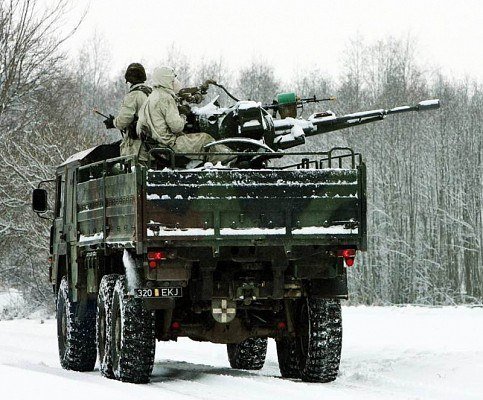
- Towed and static: the basic two-wheeled carriage, set up at fixed posts around infrastructure. [DOCUMENTED]
- Trucks and MT-LB: Ural and KamAZ trucks with the gun in the bed, and tracked MT-LBs, which give crews some armour. A Russian ZU crew commander said in 2025 that they moved from a Ural near Lysychansk to an MT-LB near Krasnoarmeysk because "there is at least some armour". [DOCUMENTED] (Uralsky Meridian, 21 Oct 2025.)
- Pickups: light pickups with heavy machine guns, and sometimes ZUs, in the mobile groups. [DOCUMENTED]
- ZU-23AE: an upgrade shown at Army-2023 with automatic target tracking, an electro-optical unit (TV, thermal, laser rangefinder) and a selectable rate of 500 or 1,000 rounds a minute per barrel. [DOCUMENTED] (Rossiyskaya Gazeta.)
RUSSIAN MOBILE FIRE GROUPS
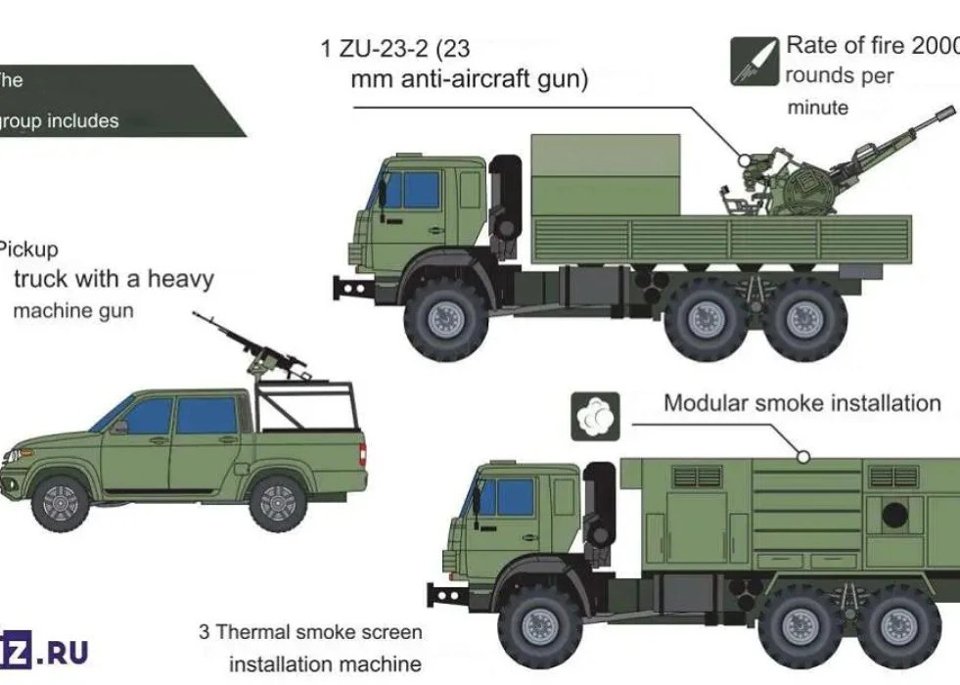
In March-April 2024 Izvestia reported that Russia was forming mobile anti-aircraft units in several combined-arms armies and the Aerospace Forces to protect troops and rear areas from drones. Each was to have a truck-mounted ZU-23-2, electronic warfare equipment and smoke vehicles, as a cheaper option than guided missiles. [DOCUMENTED] (The Defense Post, 2 Apr 2024, citing Izvestia; Militarnyi.)
The Izvestia diagram above (source: Izvestia, iz.ru) shows one such group: a KamAZ truck with a ZU-23-2, a pickup with a heavy machine gun, and a thermal smoke-screen truck. The site owner's view is that it is a small snapshot of these mobile groups: the gun trucks plus a smoke truck that hides them and creates problems for optically guided drones. [FIELD ACCOUNT, site owner] He also reports that crews mount Kord 12.7 mm heavy machine guns on pickup trucks, consistent with the heavy machine gun shown in Izvestia's diagram. [FIELD ACCOUNT, site owner]
- What they actually carry: Militarnyi noted that footage mostly showed teams with Kalashnikovs and Dragunov rifles with thermal sights, plus pickups with heavy machine guns. Later footage showed groups coordinated by vehicles carrying the AESA surveillance radar of the Pantsir-SMD-E family, and civilian radars and optics. Russian channels published a fairly intact Ukrainian Lyutyi long-range drone they said such a group had brought down. [DOCUMENTED] (Militarnyi.)
- Rosgvardia: in March 2025 Rossiyskaya Gazeta described Rosgvardia ZU-23-2 posts in occupied Zaporizhzhia region guarding infrastructure, including a gun captured from Ukraine in 2022 and refitted with a night sight and laser rangefinder. It also described mobile fire groups on trucks and pickups with heavy machine guns, shotguns and portable jammers. Rosgvardia claimed more than 250 drones downed in Kherson and Zaporizhzhia regions since the start of 2025. [SINGLE-SOURCE] (Russian state paper; claim.)
- Night hunts inside Russia: an AiF report from a "Kuban" volunteer brigade described a five-man "roaming" ZU-23 crew that changes position often and hunts aircraft-type Ukrainian drones at night at 200-300 m altitude, aiming by sound and by neighbours' tracers. Machine-gun teams nearer the front are the first echelon and the ZU is the second. The commander said "more than a hundred" drones crossed one night, with about forty over their position. [SINGLE-SOURCE] (AiF.)
- Crew claims: one ZU-23-2 crew commander claimed "hundreds" of drones downed and said the 23 mm high-explosive rounds self-destruct after 10-15 s, so a near miss can still kill. The same crew also fought in ground assaults. [SINGLE-SOURCE] (Uralsky Meridian, 21 Oct 2025.)
UKRAINE'S MIRROR
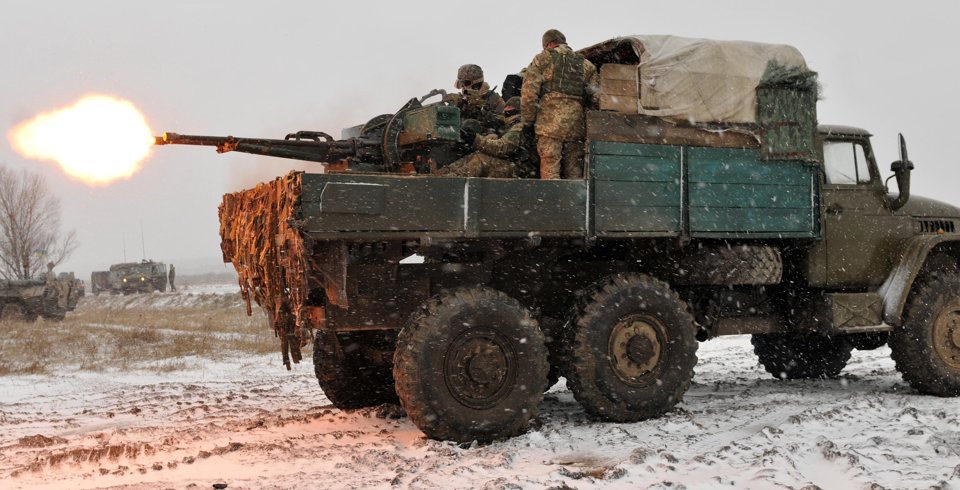
Ukraine built the same thing first, at scale: Air Force and Territorial Defence mobile fire groups with ZU-23-2s, heavy machine guns, searchlights and MANPADS on pickups hunting Shaheds at night. That is the main reason both sides converged on the method. [DOCUMENTED] (widely reported; see Geran-2).
STRENGTHS AND LIMITS
- Cost: a burst of 23 mm costs a tiny fraction of a missile. [ESTIMATE]
- Range: about 2.5 km means the gun needs early warning, so radar and acoustic networks matter more than the gun. [DOCUMENTED] (Leonkov in Izvestia.)
- Targets: good against low, slow, predictable drones; poor against small FPVs that dive in fast, or anything above about 2 km. [ESTIMATE]
- Vulnerability: crews say they are prime targets for mortars, FPVs and Ukrainian "Baba Yaga" bomber drones. [SINGLE-SOURCE]
TECHNICAL DESCRIPTION
| Parameter | ZU-23-2 (GRAU 2A13) |
| Guns | 2 × 2A14 23 mm, gas-operated |
| Ammunition | 23×152B, two 50-round belts in side boxes |
| Muzzle velocity | 970 m/s (BZT); 980 m/s (OFZ, OFZT) |
| Rate of fire | 2,000 rds/min cyclic, 400 practical |
| Effective range / altitude | 2-2.5 km / 1.5-2 km |
| Elevation / traverse | -10° to +90° / 360° |
| Mass / length / width / height | 0.95 t / 4.57 m / 2.88 m / 1.22 m |
| Barrel length | 2.008 m (87.3 calibres) |
| Crew | 6 (general characteristics) or 2, gunner and commander (infobox) |
| Built | about 140,000 in the USSR, plus licences in Bulgaria, Poland, Egypt, China |
Source: en.wikipedia. [DOCUMENTED] (Source 6.) Sources conflict on two points even within that page: whether the 2,000/400 rds/min rates are for the pair or per cannon, and whether the crew is 6 or 2. [UNVERIFIED] Two people can fire the gun, and the larger figure includes ammunition handlers and drivers. [ESTIMATE]
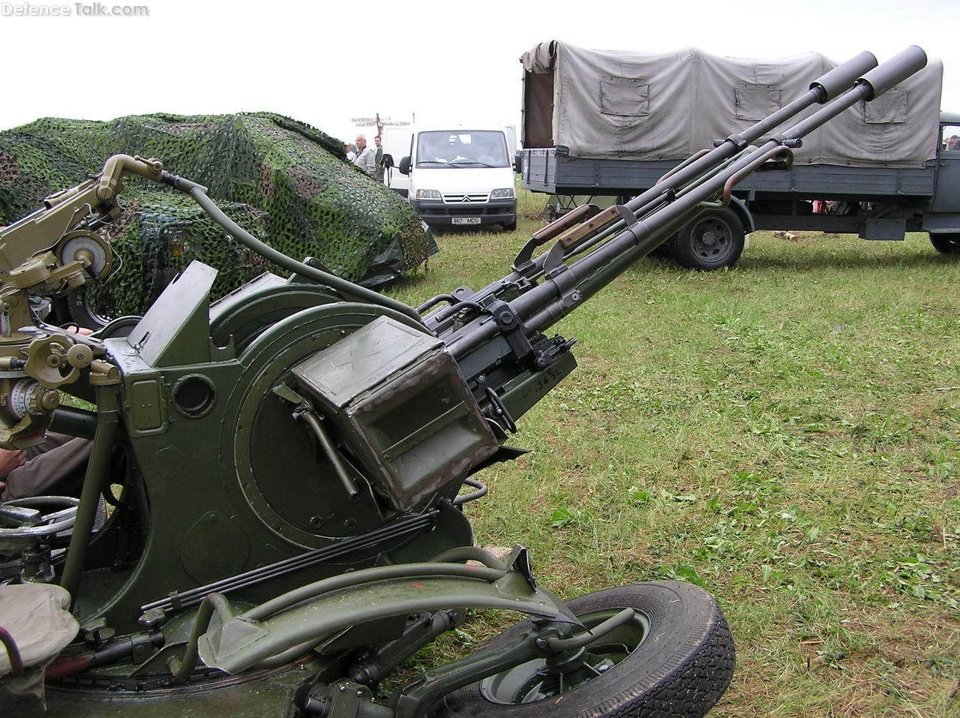
Layout. KBP designed the gun in the late 1950s. In 1955 KBP presented a single-barrel ZU-1 and a twin ZU-14, and the twin was developed into the ZU-23-2. The carriage derives from the 14.5 mm ZPU-2. [DOCUMENTED] (Source 6.) For firing, the wheels are moved aside and the trailer becomes a stationary mount. It goes from march to firing position in about 30 seconds, and in an emergency it can fire from the travelling position. [DOCUMENTED] (Source 6.) Aiming and firing are manual. The ZAP-23 optical-mechanical sight uses manually entered target data to give limited automatic lead, and a T-3 straight telescope is used against ground targets. [DOCUMENTED] (Source 6.) After about 100 rounds a barrel is too hot and is swapped for a spare, and each gun comes with two spare barrels. [DOCUMENTED] (Source 6.) That sets the real limit on sustained fire against drone waves, more than the cyclic rate does. [ESTIMATE]
| Round | Type | Projectile g | Bursting charge g | Notes |
| BZT | API-T | 190 | - | 15 mm RHA at 1,000 m / 30°; tracer 5 s |
| OFZ | HE-I | 184 | 19 | nose fuze with self-destruct |
| OFZT | HE-T | 188 | 13 | reduced charge for tracer; tracer 5 s |
| APDS-T (Polish, 2008) | APDS-T | 103 | - | 1,220 m/s; 30 mm RHA at 1,000 m |
Ammunition table from en.wikipedia, after russianammo.org and Polish sources. [DOCUMENTED] (Source 6.) The self-destruct fuze on the HE rounds is why crews say a near miss can still kill a drone: rounds that miss burst in the air, about 10-15 s after firing according to one crew. [DOCUMENTED] for the fuze (Source 6); [SINGLE-SOURCE] for the timing (Source 4).
SERVICE HISTORY BEFORE 2022
- Vietnam: from 1965 it was, with the 37 mm M1939, the most common AA gun facing US aircraft. Given that most US losses came from ground fire, it probably shot down hundreds of aircraft. [SINGLE-SOURCE] (Source 6, an inference in the source.)
- Afghanistan: Soviet static defence and fire support, and later the Taliban and the Northern Alliance on BMP-1s, BTR-70s, GAZ-66s and ZIL-131s. [DOCUMENTED] (Source 6.)
- Lebanon: mounted on M113s, BTR-152s, pickups and trucks for urban direct fire. In 1983 it was used against US Marine positions. [DOCUMENTED] (Source 6.)
- 1991 Gulf War: used by Iraq mostly against ground targets and of little effect against jets. [DOCUMENTED] (Source 6.)
- Georgia, 4 June 1993: a Su-25 was claimed shot down. [SINGLE-SOURCE] (Source 6.)
- Libya, Syria, Yemen: the standard heavy "technical" weapon. It is credited with several Syrian helicopters and is said to have engaged Saudi tanks. [SINGLE-SOURCE] (Source 6.)
- Somalia, 4 May 2020: Ethiopian AMISOM troops mistakenly shot down an EMB 120 carrying medical supplies, killing six. [DOCUMENTED] (Source 6.)
- India-Pakistan, 2025: the Indian Army used it with L-70 and Shilka guns against drones. [DOCUMENTED] (Source 6, Economic Times.)
VARIANTS AND UPGRADES
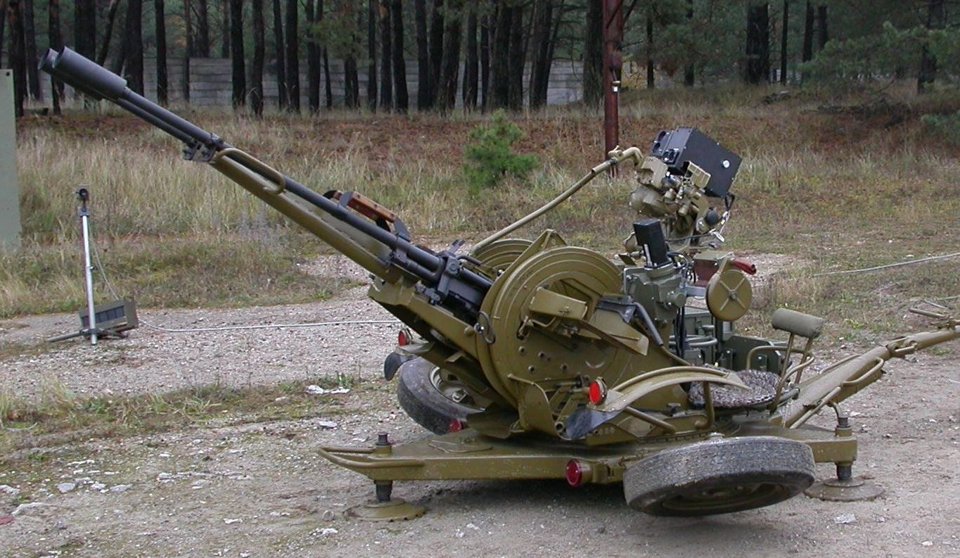
- ZU-23M (KBTochmash): laser rangefinder, TV channel and optional thermal channel, electromechanical drives, and an option for two Strela-2M or Igla missiles. [DOCUMENTED] (Source 6.)
- ZU-23M1 (PEMZ Spetsmash with NTC Elins): the current Russian export model, with upgraded fire control and optional Igla-S launchers. [DOCUMENTED] (Source 6.)
- ZU-23/ZOM1: a complete gun-missile system with a gun module, a four-round 9M333 Strela-10 missile module and remote control. The version without the missile and remote-control modules is carried on the Samum 4×4, first exported in 2019. [DOCUMENTED] (Source 6.)
- ZU-23AE: an automatic version with an electro-optical module, shown at Army-2023. [DOCUMENTED] (Source 1.)
- Poland: licence production at ZM Tarnów from 1972. Variants are the ZUR-23-2S Jod (1988, GP-1R sight, Strela-2M missiles), the ZUR-23-2KG Jodek-G (2002, CKE-2 and later CP-1 sights with laser rangefinder, Grom missiles), the Jodek-SP for the Pilica system, the truck-mounted Hibneryt and the naval Wróbel. [DOCUMENTED] (Source 6.)
- Finland: 23 ItK 61, upgraded to 23 ItK 95 with gyro-stabilisation, an auxiliary power unit and a laser rangefinder. Finland holds about 1,100. [DOCUMENTED] (Source 6.)
- Egypt: licence-built ZU 23-M, plus Nile 23 and Sinai 23 on M113s. [DOCUMENTED] (Source 6.)
- China: Type 85 copy, Giant Bow systems, and the Type 87 at 25 mm. [DOCUMENTED] (Source 6.)
- Iran: Mesbah-1 with four mounts (eight barrels). [DOCUMENTED] (Source 6.)
- Czech and Slovak upgrades: the Vlara kit and the EVPU ZU-23M. [DOCUMENTED] (Source 6.)
PROTECTION: TRUCK VERSUS ARMOURED MOUNTS
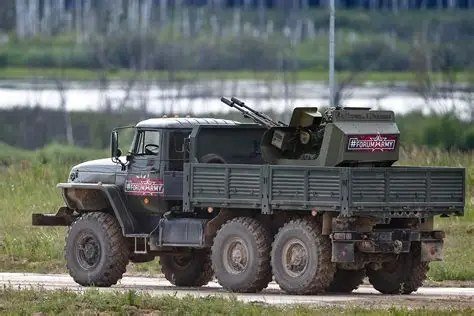
The site owner's point, from the ground, is that a ZU-23-2 crew on a truck has no protection at all. Gunners on an open Ural or KamAZ bed, or in a pickup, are fully exposed to shell fragments, cluster submunitions, FPV drones and small-arms fire, and so is the cab. [FIELD ACCOUNT, site owner] The vehicle record agrees:
- A ZU crew commander described moving from a Ural to an MT-LB because "there is at least some armour". [DOCUMENTED] (Source 4.)
- Russian crews themselves list mortars, FPVs and "Baba Yaga" heavy bomber drones as their main threats. [SINGLE-SOURCE] (Source 4.)
- Oryx (26 Oct 2026) records 15 Ural-4320s with ZU-23-2, 2 Ural-43206s and 7 KamAZ 6×6 trucks with ZUs lost by Russia, against 53 MT-LBs with ZU-23s. Ukraine has lost 14 MT-LBs with ZU-23s, and 6 ZU-23s have been captured. [DOCUMENTED] (Source 7.) Most losses are on the MT-LB because it is the most common mount near the front. Loss counts alone do not show which mount is safer. [ESTIMATE]
- Russian crews have added improvised protection. Lenta.ru (Sep 2025) showed an MT-LB with a ZU-23 covered in logs. [DOCUMENTED] (Source 8.) WarSpotting #41328 records an MT-LB(V) with ZU-23 lost on the Kinburn Spit on 3 Oct 2025. [DOCUMENTED] (Source 9.)
The MT-LB gives its occupants armour of only about 7-14 mm, which stops rifle bullets and light fragments but not heavy machine guns or FPV shaped charges. [BACKGROUND] The gun and its gunner still sit on top, exposed above the hull, so the armour mainly protects the rest of the crew, the ammunition and the vehicle's mobility. [ESTIMATE] A tracked MT-LB can also leave the road and hide in tree lines, which a truck cannot easily do. [ESTIMATE] The trade-off is that MT-LBs are in short supply (see Sosna, chassis section), while trucks and pickups are plentiful and fast on roads, which suits the rear-area Shahed and long-range-drone hunting of the mobile fire groups. [SPECULATION]
WHY A 1960 GUN IS BACK
The ZU-23-2 was obsolete as an anti-aircraft weapon against jets by the 1980s. Its revival is due to the target set: aircraft-type drones flying at 100-300 m and 150-200 km/h, at night, in large numbers. Against those the gun is accurate enough, its ammunition is plentiful in Soviet-era stocks, and each engagement costs a fraction of a missile. [ESTIMATE] The limit is detection. Without a radar or acoustic cue the crew sees the target too late, so both sides pair guns with searchlights, thermal optics, acoustic sensor networks and, for Russia, Pantsir-family radars. [DOCUMENTED] (Sources 3, 5.) For comparison, the self-propelled and radar-directed ZSU-23-4 Shilka uses the same calibre and has its own radar and armour.
PLACE IN THE LAYERED DEFENCE
In Russia's layered air defence this system sits in the lowest tier, under Tor, Pantsir, Buk-M3 and the S-300 / S-400 long-range layer. Beside it are the MANPADS (Verba, Igla), guns and electronic warfare. Its main job in 2024-2026 is to stop Ukrainian reconnaissance, strike and long-range drones, the mirror image of Ukraine's fight against the Geran-2. [ESTIMATE]
SOURCES
- 1. Rossiyskaya Gazeta, «Хранители снов: в Росгвардии модернизировали ЗУ-23», 21 Mar 2025.
- 2. The Defense Post, "Russia to Deploy Mobile Anti-Aircraft Gun Units", 2 Apr 2024 (Izvestia).
- 3. Militarnyi, "Russian Mobile Fire Groups Equipped With Pantsir Radar Systems".
- 4. Uralsky Meridian, «Сотни сбитых дронов», 21 Oct 2025.
- 5. Argumenty i Fakty, «Тысяча выстрелов в минуту. Как блуждающие орудия ПВО уничтожают дроны ВСУ».
- 6. en.wikipedia, "ZU-23-2" (history, variants, characteristics, production).
- 7. Oryx, Russian and Ukrainian equipment losses lists, accessed 26 Oct 2026.
- 8. Lenta.ru, MT-LB with log armour and ZU-23, 30 Sep 2025.
- 9. WarSpotting, entry #41328, MT-LB(V) with ZU-23, Kinburn Spit, 3 Oct 2025.
Project Orlan // Underground Information Database
Related on this site: Shilka, Gibka-S, 1L122 Garmon, MT-LB, Igla, Verba, Tunguska.
Related on this site: Russian Unified Air Defense (how the layers fit together).