WHAT IT IS
Sosna (Сосна, "pine") is a Russian short-range air-defence system developed by KB Tochmash as the successor to the Strela-10. It fires the 9M340 Sosna-R laser beam-riding missile, sometimes designated 9M337 in Western references (Western name SA-X-25 in some sources), from a stabilised turret with TV, thermal and laser-rangefinder sights. The baseline carrier is the MT-LB, with BMP-3 and BTR-82 versions shown. [DOCUMENTED]
Sosna is a case study in a system that exists on paper and at arms shows, but has not been seen in real service. That is why this article is short. [ESTIMATE]
HISTORY
THE 9M340 MISSILE
The 9M340 is a two-stage, supersonic (about Mach 2.6) laser beam rider. The operator keeps the sight on the target and the missile flies up the laser beam, so it cannot be decoyed by flares and gives off no radar emission. Its payload is two warheads totalling about 7 kg: a rod warhead fired by a laser proximity fuze for air targets, and an armour-piercing fragmentation charge fired on impact, so the missile can also hit light armour. [SINGLE-SOURCE] (en.wikipedia summarising manufacturer data.)
| Parameter | Claimed figure |
| Range | up to 10 km |
| Altitude | up to 5 km |
| Speed | about Mach 2.6 |
| Launch weight | about 42 kg in container (about 38 kg missile) |
| Load | 12 missiles in two banks of six; reload in about 12 min |
| Crew | 2 (driver, gunner) |
All figures are manufacturer claims. [SINGLE-SOURCE]
UKRAINE WAR: NOT SEEN
In August 2023 the analyst Rob Lee posted drone-strike video as possibly the first Sosna-R at the front. Ukraine Weapons Tracker replied that the vehicle was a Strela-10 in non-combat position and that Sosna-R "highly likely exists in the form of several prototypes only". [DOCUMENTED] (Focus.ua; ProstoMob, 15 Aug 2023.) No later confirmed sighting is known. [ESTIMATE] The naval relatives, the Palma and Palash gun-missile systems, do use Sosna-R-family missiles. [SINGLE-SOURCE]
NAMES AND DESIGNATIONS: SOSNA, BAGULNIK, STRELA-10ML
The system goes by several names, and they cause confusion.
DEVELOPMENT HISTORY IN DETAIL
In the 1990s Academician A. G. Shipunov of KBP Tula proposed a lighter replacement for the Strela-10. It would use an electro-optical fire-control system and laser beam-riding guidance and cost less. KBTochmash (named after A. E. Nudelman), the designer of the Strela-1 and Strela-10, took on the work. [DOCUMENTED] (Source 5.) Some Russian sources trace work on a "Strela-10ML" successor back to the late 1980s. [SINGLE-SOURCE] (Source 7.) The design principles were [DOCUMENTED] (Source 5):
The system was first shown in June 2013 at the Military Academy of Troop Air Defence in Smolensk, at a conference on Ground Forces air-defence development. [DOCUMENTED] (Source 5.) Preliminary trials led to two design changes. The radio command link was removed, and the former "missile direction-finding" channel was turned into a thermal search channel for target detection. The control console was also redesigned. [DOCUMENTED] (Source 5.) A 2011 Voennyi Parad article by KBTochmash authors (Korotkov, Ukleev, Kopylov) is the main early technical description. [DOCUMENTED] (Source 5bibliography.)
At Army-2018 (Kubinka, August 2018) High-Precision Weapons presented what it called the "first serial" Sosna, on an MT-LB, as having passed state trials and as the intended replacement for the Strela-10M family. [DOCUMENTED] (Source 8.) The Bagulnik trials had been declared complete in 2017. [DOCUMENTED] (Source 6.) By April 2019 the system had passed state trials, during which the field of view of the direction-finding channel was widened so that one vehicle could search its own sector. [DOCUMENTED] (Source 5.) The inter-service trials ended in May 2019, and in June 2019 the MoD decided to accept the system and to place it on supply from 2022. [DOCUMENTED] (Sources 14, 15.) Designer V. Ukleev said the first units would be mixed Sosna and Strela-10M3 formations, with Sosna replacing the Strela-10M3. [DOCUMENTED] (Source 15.) Kommersant reported in February 2025 that troop trials had been completed in 2020 but that the forces had "still not received a single serial vehicle". [DOCUMENTED] (Source 12.)
THE SOSNA COMBAT MODULE: SENSORS AND FIRE CONTROL
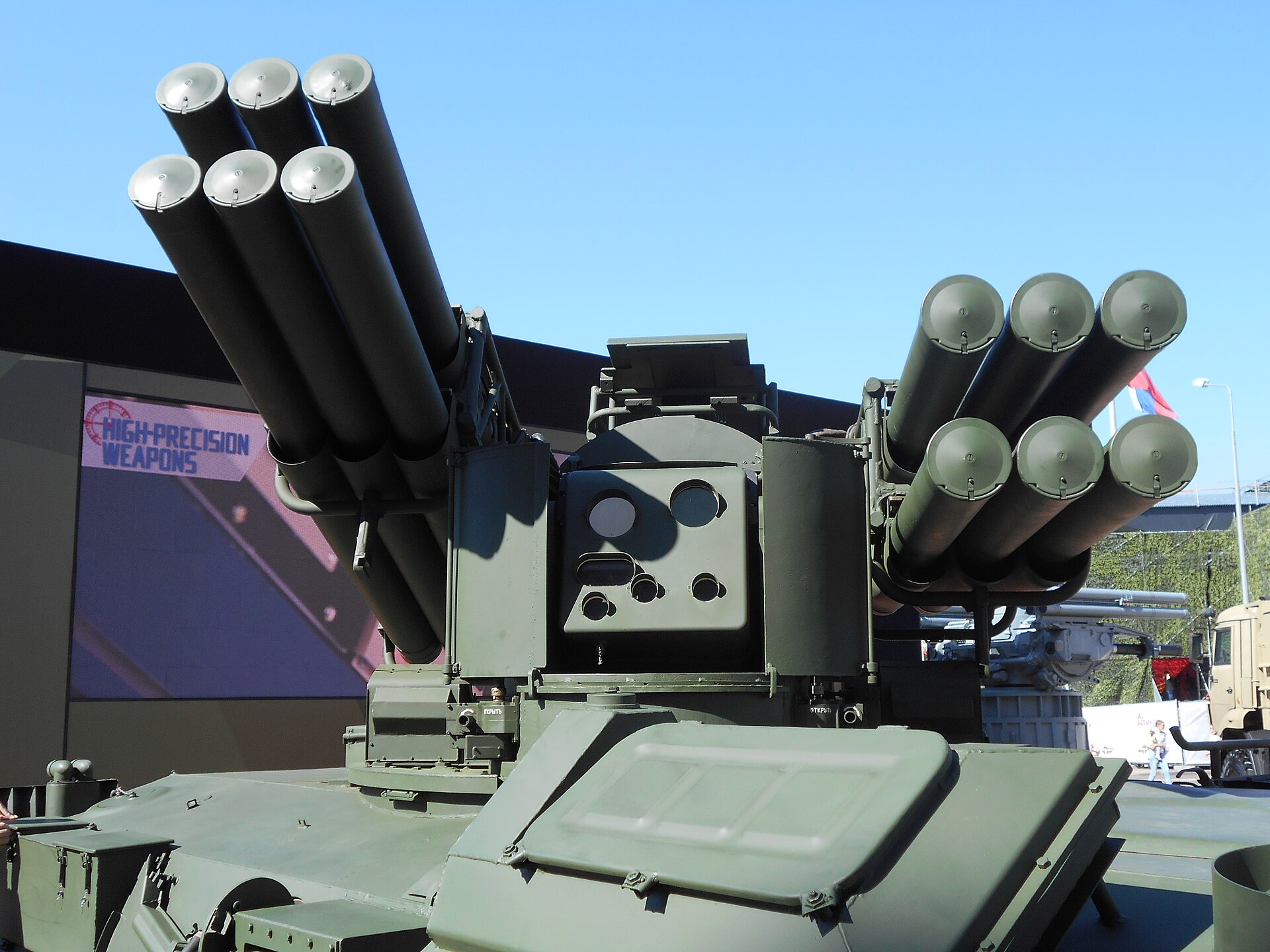
The module is unmanned and sits on top of the carrier. In the centre is the electro-optical system (OES) on a gyro-stabilised platform. It carries thermal and TV sighting channels, a laser rangefinder and the laser beam-riding missile guidance system, and the two six-round missile packs sit on either side. [DOCUMENTED] (Sources 5, 8.) Russian descriptions list the OES components as [DOCUMENTED] (Source 7):
There is no radar. During search and tracking the system emits almost nothing. The exceptions are the IFF interrogator, radio links to higher command and within the battery, and, after launch, the laser beam. [DOCUMENTED] (Source 5.) Without a search radar it is immune to anti-radiation missiles, and an aircraft's radar-warning receiver gives no warning. [DOCUMENTED] (Sources 5, 7.) The beam points at the missile's tail, not at the target, so laser-warning receivers may also fail to detect the guidance. [ESTIMATE] (Source 5lists "the missile flight is not noticeable to the protection systems of the target aircraft".)
| OES parameter (developer data) | Value |
| Modes | automatic, semi-automatic |
| Target acquisition | external designation, or own sector search |
| Slew rate / acceleration | 50°/s / 150°/s² |
| TV fields of view (narrow / wide) | 2.0×3.0° / 6.5×9.0° |
| Thermal fields of view (narrow / wide) | 1.67×2.5° / 8.0×12.0° |
| "Direction-finding" (search) channel | 30×40° |
| Auto-track range, aircraft (15 km visibility, p=0.8) | 16-30 km |
| Helicopters / cruise missiles / armour | 10-14 / 8-12 / 8 km |
| Stabilisation accuracy | 0.07 mrad |
| Coordinate / range accuracy | 0.2 mrad / 5 m |
| Beam-field pointing accuracy | 0.08-0.12 mrad |
All figures above are developer claims. [SINGLE-SOURCE] (Source 5after KBTochmash.) In automatic mode the system processes the target designation, captures and tracks the target, assesses the launch zone and fires, all without the operator. Semi-automatic mode, used mainly in heavy jamming, lets the operator intervene in each step. [DOCUMENTED] (Source 8.) The system can work in a battery under old, current and future battery command posts. The preferred one is the PPRU "Sborka-M1-2" (9S80M1-2), whose radar supplies the cueing that the passive vehicle lacks. [DOCUMENTED] (Source 5.) It can also be networked with portable and fixed radars and stand automated alert duty. [DOCUMENTED] (Source 12.)
THE 9M340 SOSNA-R MISSILE
Layout. The 9M340 is a two-stage, bi-calibre missile: a 130 mm booster and a 72 mm sustainer dart. The booster accelerates the missile to more than 850 m/s (peak about 900 m/s) within a few seconds and then separates. The dart then coasts, with an average speed of more than 550 m/s over the flight. [DOCUMENTED] (Sources 5, 7.) Mass is 30 kg in flight (42 kg in the container) according to ru.wikipedia, or 28/38 kg in other figures. The 42/38 kg split may refer to different versions. [UNVERIFIED] (Source 5.) A missile weighing about half as much in its container as a Strela-10 round lets two crew members reload by hand, so no transporter-loader is needed. [DOCUMENTED] (Source 8.) The reload time is 10-12 min. Ukleev gave 8-9 min for the BMP-3 version. [DOCUMENTED] (Sources 5, 15.)
Guidance. The missile is a laser beam-rider. Its tail receiver reads its position within the coded laser field and steers to the centre, while the OES keeps the field on the target. It has no seeker to decoy, so flares do nothing. [DOCUMENTED] (Sources 2, 5.) Unlike the passive Strela-10 missiles, the vehicle must keep the target in view until impact. That ties the crew to the target for the whole flight, about 10-12 s to 10 km. [ESTIMATE] (from the average speed.) Maximum load factor is 40 g. [SINGLE-SOURCE] (Source 5.)
Warheads. The missile carries two warheads with a combined mass of about 7 kg: a rod warhead detonated by the laser proximity fuze against air targets, and an armour-piercing charge that works on direct impact, so the missile can also kill light armour. [DOCUMENTED] (Sources 2, 5.) The developer says the missile can hit aircraft, helicopters including those using "pop-up" tactics, cruise missiles, aerial bombs, precision munitions and small drones. [SINGLE-SOURCE] (Sources 7, 8.)
| Parameter | Sosna / 9M340 | Strela-10M3 / 9M333 |
| Range | 1.3-10 km | 0.8-5 km |
| Altitude | 0.002-5 km | 0.01-3.5 km |
| Missiles on vehicle | 12 ready | 4 + 4 |
| Guidance | laser beam-riding | passive IR / photocontrast homing |
| Reaction time | 5-8 s | about 7 s |
| Crew | 2 | 3 |
Sources for the table: developer data and the Strela-10 design history. [SINGLE-SOURCE] for the Sosna column (Sources 5, 8); see Strela-10 for the 9M333.
CHASSIS: MT-LB, BMP-3, BTR-82A AND BMD-4M
The combat module is designed to be independent of the chassis. Developers say any wheeled or tracked carrier with at least 3.5-4 t payload can take it, as can ships and fixed coastal mounts. [DOCUMENTED] (Sources 5, 8.)
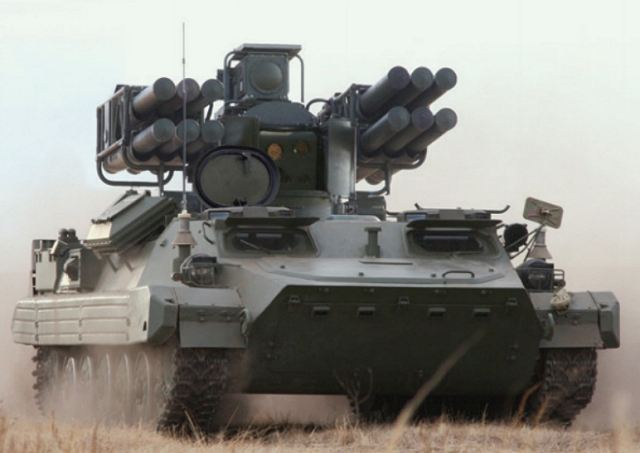
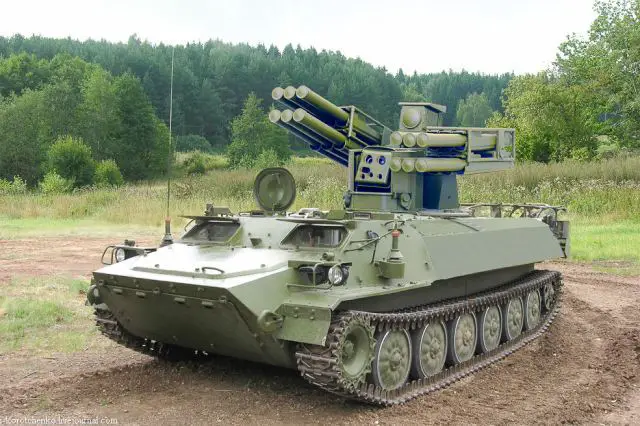
MT-LB. The baseline and the trials vehicles use the MT-LB, the same light armoured tractor as the Strela-10. This keeps maintenance and driver training common with the vehicles it replaces. The crew is two: the commander-operator sits front right with a monitor and console, and the driver sits front left. [DOCUMENTED] (Sources 5, 8.) It was shown on the MT-LB at Army-2018. [DOCUMENTED] (Sources 5, 8.)
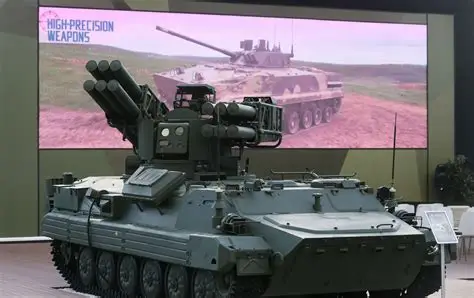
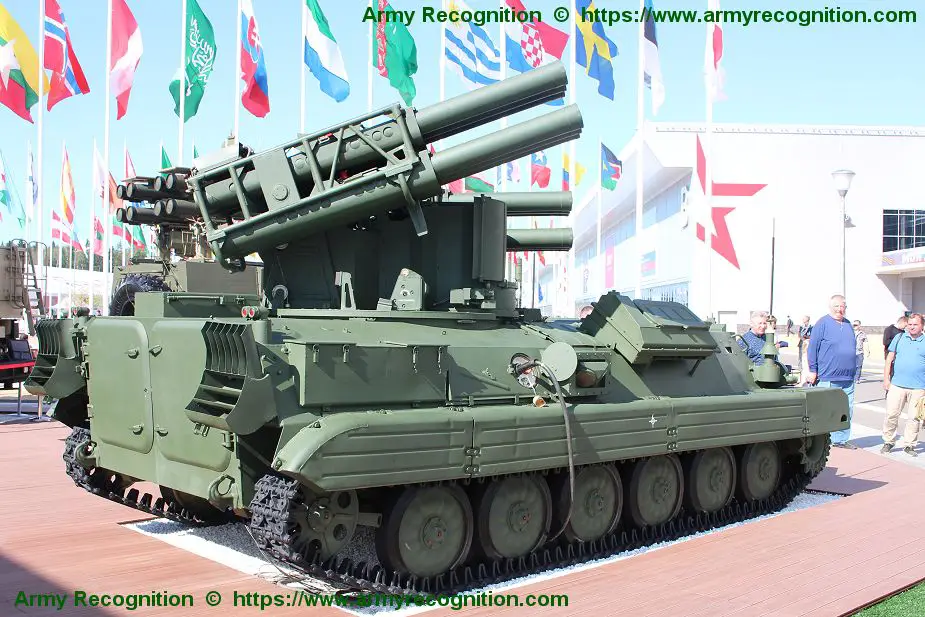
BMP-3. At Army-2019 the module was shown on a BMP-3 chassis. [DOCUMENTED] (Sources 5, 15.) Ukleev said this version carries part of the reload ammunition and can be rearmed by the crew without a special vehicle. [DOCUMENTED] (Source 15.) en.wikipedia states that "the serial production version is based on the BMP-3 IFV". [SINGLE-SOURCE] (Source 2.) No Russian MoD source has confirmed which chassis was chosen for series production, and no series deliveries on either chassis have been confirmed. [UNVERIFIED] The BMP-3 offers more protection and mobility and keeps up with mechanised units. Its weakness is that BMP-3 chassis production at Kurgan is in demand for the IFV itself. [ESTIMATE]
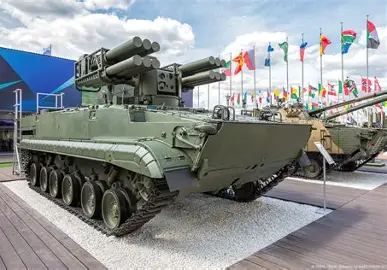
Kurganets-25. No source found shows a Sosna on the Kurganets-25. Developers have said in general terms that the module fits tracked chassis of the BMP-3/BMD-4M class. [UNVERIFIED] Any Kurganets version should be treated as unconfirmed.
BTR-82A. At Army-2021 the module was shown on a BTR-82A 8×8. A remote console was also installed inside a BTR, from which an MT-LB Sosna was operated remotely. [DOCUMENTED] (Source 5.) The BTR-82A is also the carrier for Krona-E. [DOCUMENTED] (Source 12.)
BMD-4M "Ptitselov". The VDV ordered an air-droppable version on the BMD-4M, named Ptitselov ("bird-catcher"). In May 2023 Rostec said development was complete, a year late because of the war, and that evaluation would follow. [DOCUMENTED] (Sources 4, 12.)
Is the MT-LB still being built? The answer bears on how many Sosnas Russia could build. The record is as follows:
New-build or overhauled hulls for Sosna? No source states which hulls the Sosna prototypes and trial vehicles use. Given the record above, the Army-2018 "serial" vehicle and any later MT-LB Sosnas most likely use overhauled Soviet-era hulls, as most current Russian MT-LBs do. [SPECULATION] The BMP-3 and BTR-82A versions would use new-build hulls, since both are in production, but no series Sosna on either has been confirmed. [ESTIMATE]
UKRAINE WAR AND KRONA: STATUS AS OF OCTOBER 2026
Why Sosna has not replaced Strela-10. The likely reasons are the cost and production difficulty of the 9M340, where the 9M333 is a mature line at Kovrov, wartime priority going to proven systems, and the loss of the beam-rider's advantage when the vehicle must stay exposed during the whole flight in an environment saturated with FPV drones. [SPECULATION] The developer's claimed strengths are a passive, jam-proof design, firing on the move, 12 rounds and low cost. Those are exactly what the war has rewarded in the Strela-10, which keeps the concept attractive. [SPECULATION, site owner] See the Strela-10 counter-drone section.
NAVAL AND OTHER DERIVATIVES
WHY IT MATTERS
Sosna was meant to give Russian brigades a cheap, passive, jam-proof short-range layer between MANPADS and Tor. Its absence explains why Russia still relies on Strela-10 and MANPADS against drones, and why gun-based mobile fire groups became so important. [SPECULATION]
SOURCES
Related on this site: Gibka-S, 1L122 Garmon, Strela-10, Tunguska, Pantsir (Palma/Palash relatives), Tor, MT-LB, Igla, Verba.
Related on this site: Russian Unified Air Defense (how the layers fit together).
Project Orlan // Underground Information Database