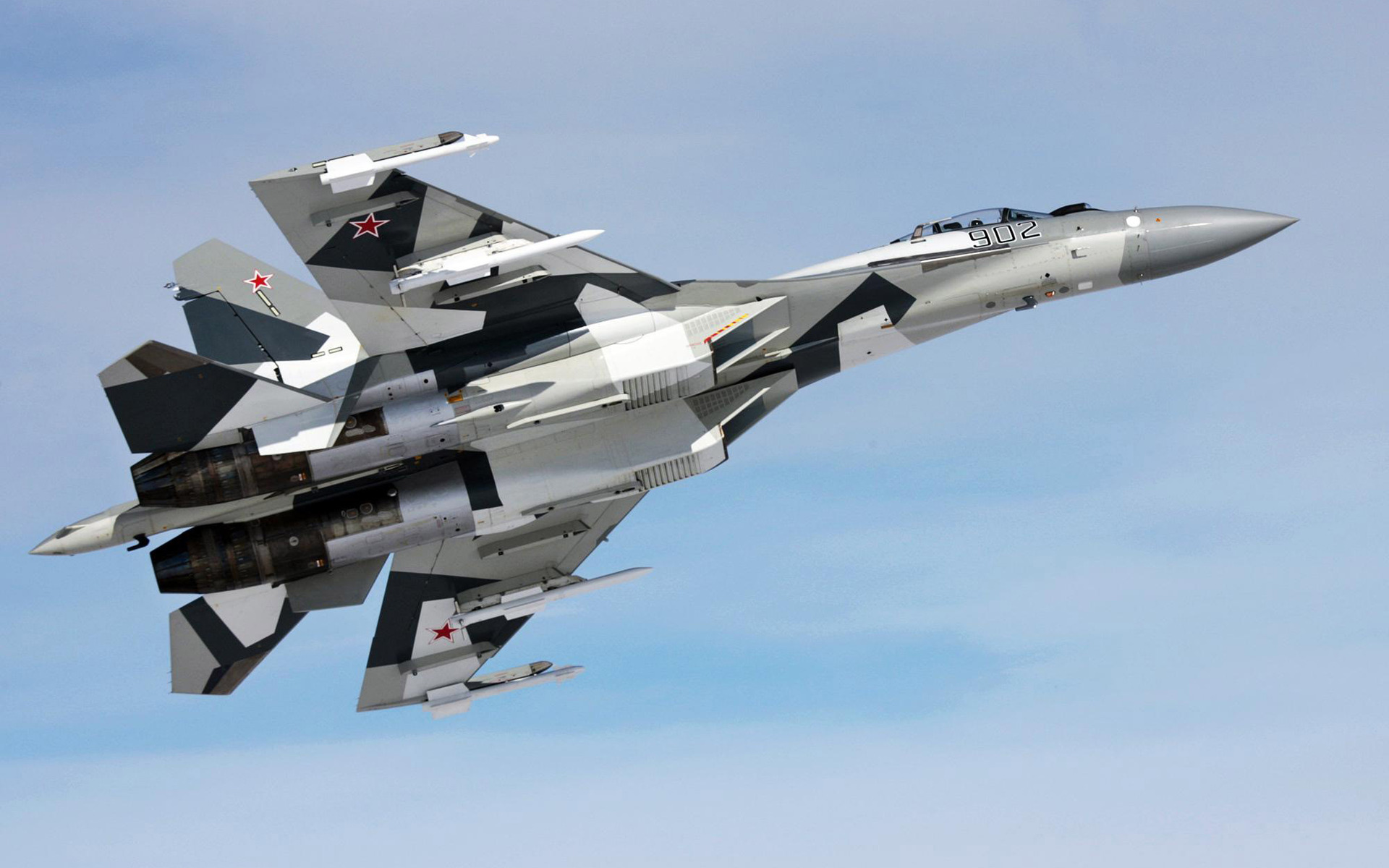
Su-35S prototype bort 902 in flight, in a grey splinter scheme. There are no canards. The tail stinger is visible between the engine nozzles, and electronic-warfare pods and air-to-air missiles are on the wings.
Su-35S prototype bort 902 in flight, in a grey splinter scheme. There are no canards. The tail stinger is visible between the engine nozzles, and electronic-warfare pods and air-to-air missiles are on the wings.
WHAT IT IS
The Sukhoi Su-35 (Су-35; NATO reporting name Flanker-E) is a single-seat, twin-engine, supermanoeuvrable multirole fighter, a deep modernisation of the Su-27, designed by the Sukhoi design bureau and built at the Yuri Gagarin aircraft plant in Komsomolsk-on-Amur (KnAAPO), now part of United Aircraft Corporation (UAC, ОАК). The aircraft in Russian Aerospace Forces (VKS) service, and the one this page is mainly about, is the production Su-35S, developed under the factory code T-10BM and sometimes called Su-35BM ("bolshaya modernizatsiya", major modernisation) during development. UAC markets it as a 4++ generation fighter that uses some fifth-generation technology. [DOCUMENTED]
The name "Su-35" has been used for two different aeroplanes, and that fact is the starting point for any serious reading of the type. In the late 1980s and 1990s, Sukhoi built the canard-equipped Su-27M (T-10M), shown and offered for export as the Su-35, and used one of those airframes, T-10M-11 (bort 711), as the Su-37 thrust-vectoring demonstrator. The current Su-35S is a later, canard-less redesign with new engines (the Saturn / UMPO 117S, also called AL-41F1S), a new digital flight-control system (KSU-35), the Tikhomirov NIIP N035 Irbis-E passive electronically scanned radar, the OLS-35 infrared search-and-track set, and the Khibiny-M electronic-warfare suite. [DOCUMENTED]
A first flight sample of the new aircraft was assembled by August 2007, according to UAC. Flight tests began in February 2008; the date most often given for the first flight is 19 February 2008. RIA Novosti recorded a first demonstration flight on 7 July 2008. A first state contract for 48 Su-35S aircraft for the Russian Ministry of Defence was signed at MAKS in August 2009. TASS says serial production at Komsomolsk-on-Amur began in 2011. The first aircraft was handed to the 929th State Flight Test Centre (GLITS) in August 2011. Air Power Australia, writing in 2012, gave an initial operational capability in 2012. The type has been used in combat in Syria from January 2016 and in the war against Ukraine from 2022. [DOCUMENTED; some dates rest on secondary summaries]
QUICK FACTS
DESIGNATIONS AND NAMES
The factory family is still T-10, the Su-27 series. The original modernised single-seater was T-10M (Su-27M), marketed from the early 1990s as Su-35 and shown as such at Farnborough in 1992. RIA Novosti wrote in 2008 that a 1991 decision put the Su-27M into series production under the Su-35 index, and that the first serial aircraft flew in April 1992. Because of underfunding, only a small pre-production / trial batch was built in 1992-1995: RIA says 12 aircraft were delivered to the Russian Air Force for testing and demonstration; other summaries say about 14. [DOCUMENTED for the renaming and the small batch; the 12 versus 14 count is CONTESTED]
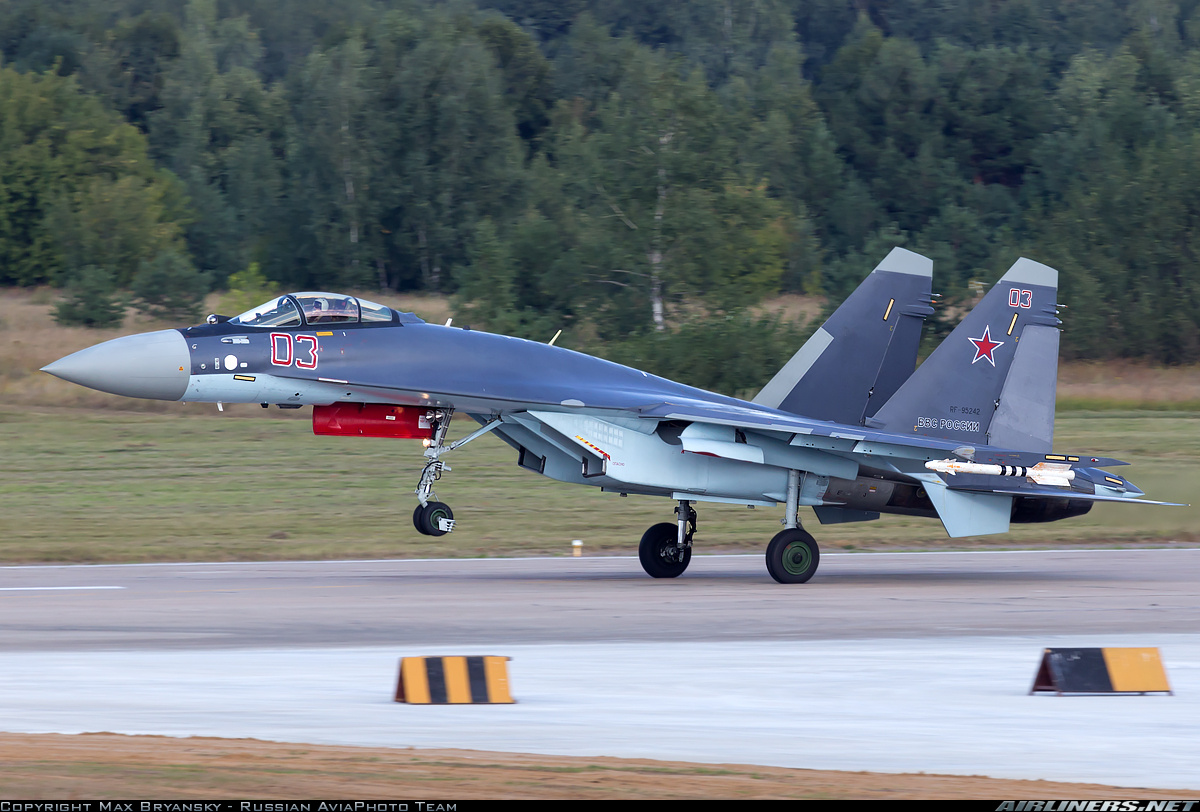
A canard-equipped Su-27M / original Su-35, bort 03, on the runway, in a dark upper and light lower scheme, with a ВВС РОССИИ title on the tail. The canards ahead of the wing distinguish this 1990s aircraft from the later, canard-less Su-35S. This is not a Su-35S.
The Su-37 was not a separate production type. It was the eleventh Su-27M prototype, T-10M-11, bort 711, fitted with thrust-vectoring engines to explore post-stall control. It remained a single demonstrator. [DOCUMENTED]
A two-seat prototype, Su-35UB (associated with T-10UBM), is recorded in specialist sources. RedStar gives a first flight on 7 August 2000; other summaries say a sole trainer was built in the late 1990s and resembled the Su-30MK family. It did not become the production two-seater of the later Su-35S programme. [SINGLE-SOURCE / CONTESTED on the exact date]
When Sukhoi launched the deep modernisation in the mid-2000s, RIA Novosti says the new aircraft was again called Su-35, with the suffix BM for "bolshaya modernizatsiya", precisely to avoid inventing yet another index. The production Russian service aircraft is Su-35S. Export aircraft are generally Su-35SK. NATO has used Flanker-E for the Su-35 family; this page does not treat a distinct public NATO suffix for the Su-35S as established. [DOCUMENTED for BM / S / SK; NATO suffix beyond Flanker-E UNVERIFIED]
DEVELOPMENT AND LINEAGE
The Su-27 gave Sukhoi a large, long-range air-superiority airframe with a wide gap between two widely spaced engines, a big internal fuel fraction, and room at the tail for a boom between the nozzles. The Su-27M / original Su-35 added canards, a new forward fuselage, an updated fly-by-wire system, and a new radar generation (the N011 family on those aircraft, not the later Irbis-E). The Su-37 added thrust-vectoring and a glass-cockpit / digital-control demonstrator set that later migrated, in pieces, into other Flankers (notably the Su-30MKI family) and into the later Su-35S. [DOCUMENTED in outline; radar designations on the 1990s aircraft are from specialist literature, not the current UAC Su-35 product page]
The later T-10BM / Su-35S is better understood as a re-engineering of the Flanker than as a simple avionics upgrade. Notable airframe decisions were to delete the canards and the large dorsal airbrake of the Su-27M, add internal fuel, fit plumbing for in-flight refuelling and external tanks, and hang the new 117S engines and a quadruplex digital flight-control system (KSU-35) on a reinforced structure whose published life is 6,000 hours or 30 years. A fourth Su-35S prototype is widely reported to have been destroyed on 26 April 2009 during a high-speed taxi run after a brake failure. [DOCUMENTED for the configuration change and the life figures; the 2009 taxi loss is from secondary encyclopedic summaries]
A 2008 RIA Novosti article said the 2006-2015 state armament programme envisioned the purchase of 182 Su-35BM aircraft. That is a planning figure, not the number actually contracted. The first firm contract on the public record is the August 2009 order for 48 aircraft. Later contracts followed; official Russian announcements of new batches usually say "a batch" (партия) without giving a headcount. [DOCUMENTED]
AIRFRAME AND FLIGHT CONTROL
The Su-35S keeps the Flanker layout: a blended wing-body, twin tails, and two engines in separated nacelles, with the centre fuselage continuing aft into the tail stinger. It does not have canards. UAC describes a reinforced airframe intended for a 6,000-hour / 30-year life. Composite materials are used, but no official public percentage was found for this page. The type is not a stealth aircraft. Russian-language summaries (including ruwiki) say radar-absorbing coatings are applied at edges and that the canopy has a conductive coating to reduce the cockpit's contribution to radar cross-section. Those measures are not quantified in the official UAC specification block. [DOCUMENTED for layout, life and the absence of canards; RCS treatments secondary and unquantified]
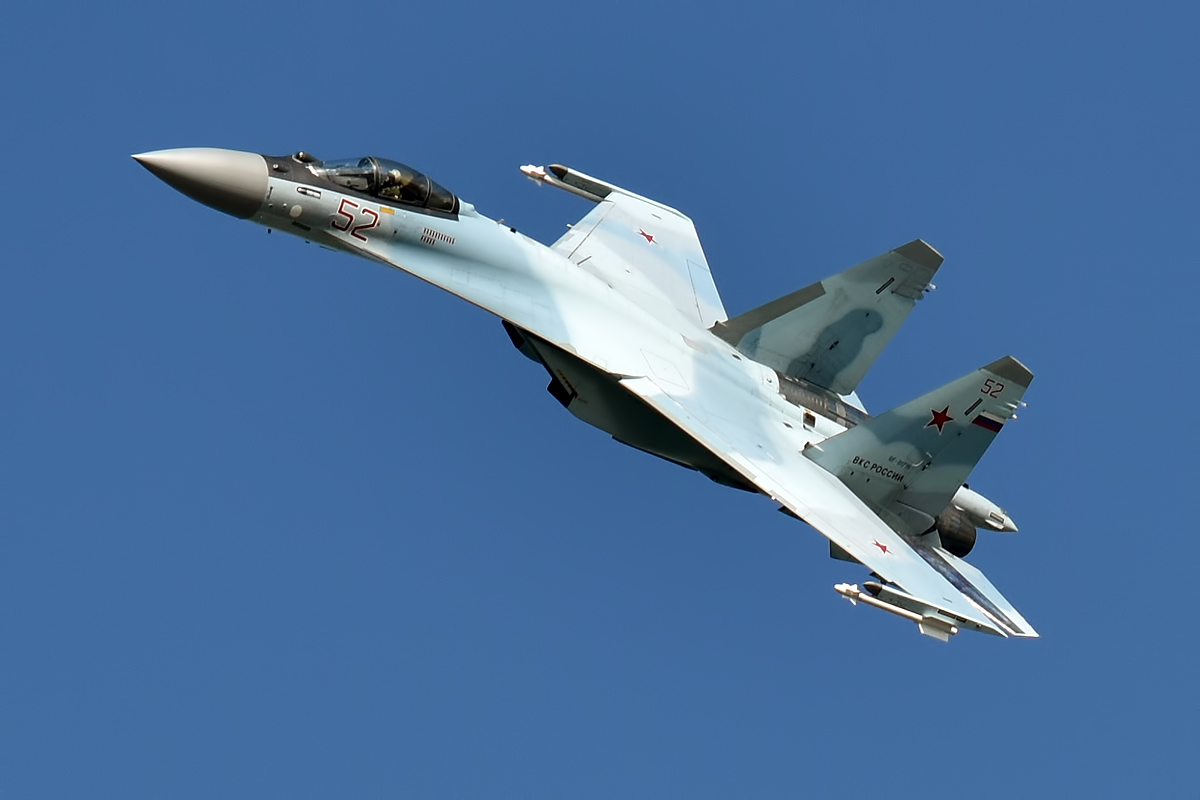
A production Su-35S of the Russian Aerospace Forces, bort 52, in flight. The tail is marked ВКС РОССИИ. There are no canards. The OLS-35 optical-location station is visible as the spherical housing ahead of the windshield, and a short-range missile is on the starboard wingtip.
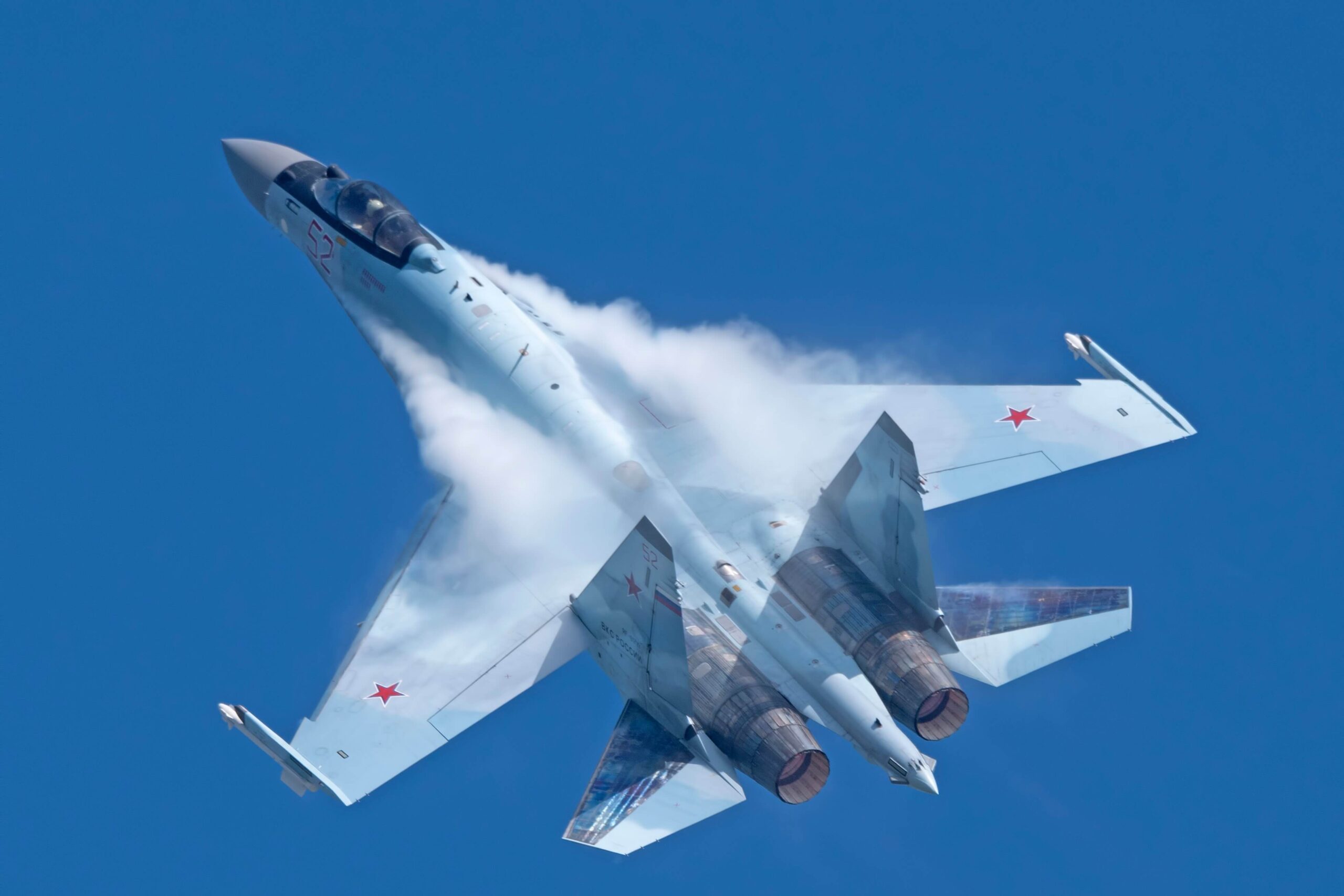
Su-35S bort 52 in a high bank, with wing-vapour over the upper surface. There are no canards. The tail stinger is visible on the centreline between the two nozzles, and short-range missiles are on the wingtips.
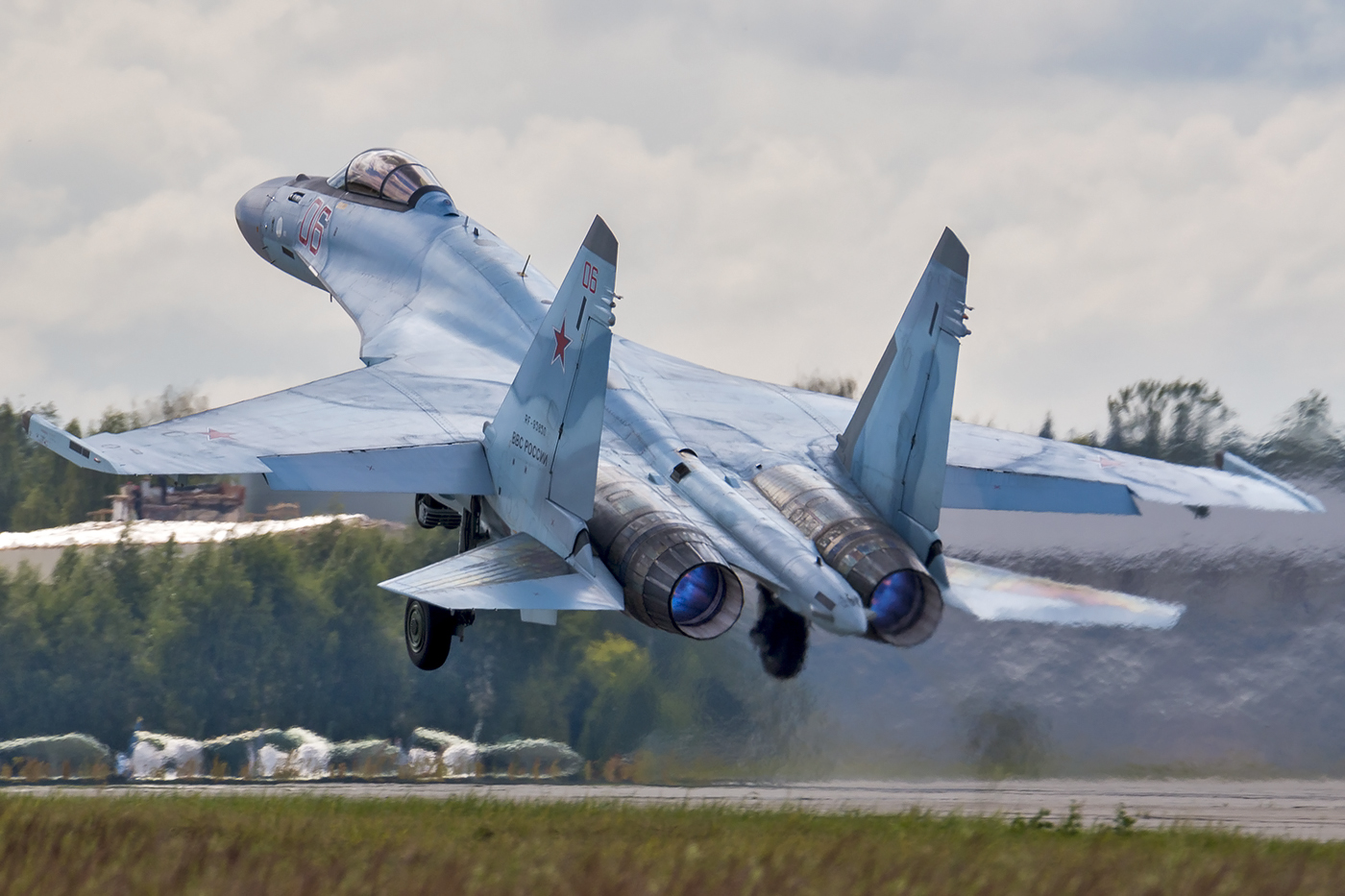
A single-seat Su-35S, bort 06, taking off with afterburners lit. The aircraft has no canards. The tail stinger sits between the two nozzles, and the tail carries a ВВС РОССИИ title used on early in-service aircraft.
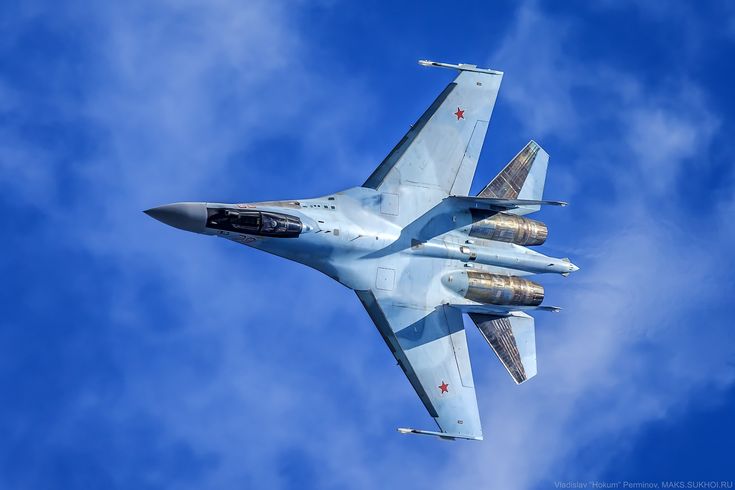
A production Su-35S from below, in the standard light-blue scheme, with no canards. The OLS-35 housing is visible ahead of the windshield, and the tail stinger extends between the two nozzles.
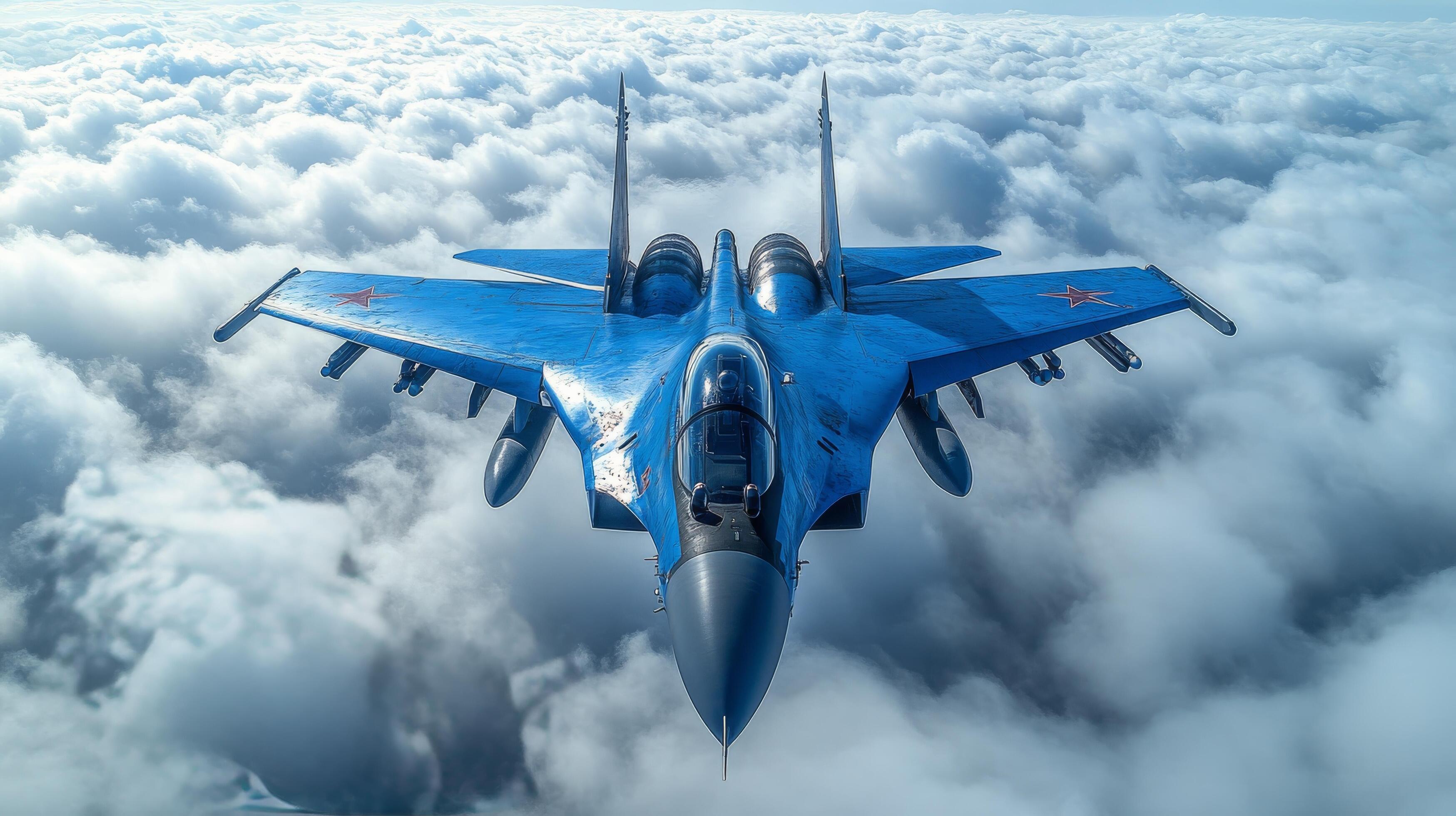
A head-on view of a Su-35S-style Flanker over cloud, in a solid blue finish.
The flight-control system is the KSU-35 (комплексная система управления), a digital, redundant (specialist sources say quadruplex) integrated control system associated with the Avionika design house. Public descriptions say it combines fly-by-wire, automatic flight control, air-data / flight-navigation functions, and landing-gear and wheel-brake control, and that it also commands the swiveling engine nozzles. TASS has written that the thrust-vectoring is not a special mode requiring a separate control path; it is integrated into ordinary control of the aircraft. UAC lists a maximum service overload of 9 g. [DOCUMENTED]
TASS describes the 117S vectoring as controlled in one plane (в одной плоскости). Some Western descriptions call the nozzles all-aspect or two-plane. The physical arrangement on Flanker TVC engines is often explained as single-plane nozzles mounted so that differential deflection can produce yaw as well as pitch, but that geometric reading is not spelled out in the official sources used for the numbers on this page. [CONTESTED as to how the vectoring should be described]
The aircraft is fitted for in-flight refuelling. UAC gives 11,300 kg of fuel in the internal tanks. A widely reprinted KnAAPO table gives 11,500 kg.
ENGINES
The production powerplant is the 117S, also called AL-41F1S, an afterburning turbofan from the AL-31 / AL-41 family, associated with NPO Saturn and UEC-UMPO. It is not the same engine as the AL-41F1 (izdeliye 117) fitted as the first-stage engine of the Su-57, and it is not the later izdeliye 30 / 177 engine. Russian technical commentary describes the 117S as a related but reduced or simplified member of that family, with an electro-mechanical control system rather than the full digital FADEC of the izdeliye 117, and without the same advertised supercruise claim. [DOCUMENTED for the designation and the family relationship; the detailed 117 versus 117S differences are from specialist and secondary Russian sources]
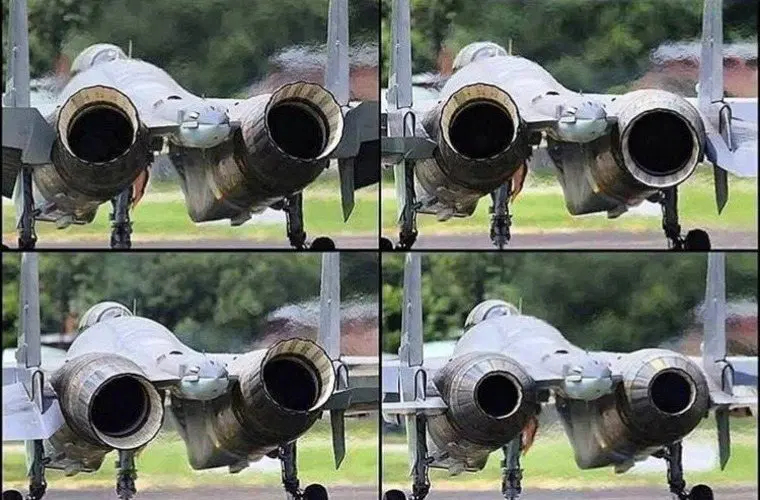
An example of Flanker thrust-vectoring nozzles, with the tail stinger between them, on the ground. The nozzles are deflected at different angles in the lower frames, showing how thrust-vector control works. This crop is not identified as a Su-35S.
UAC's published thrust figures are: maximum dry thrust 2 x 8,800 kgf, and thrust at full afterburner in a special mode 2 x 14,500 kgf. The 14,500 kgf figure is widely reprinted as "the" afterburning thrust; the UAC wording is more precise and should be kept. Aviatransportnoye Obozreniye, writing about a UMPO display of the 117S, contrasted 14.5 tonnes with 12.5 tonnes for the baseline AL-31F (a 16 percent increase) and gave a designated service life of 4,000 hours, described as twice that of the AL-31F in that comparison. UAC's own English specification lists an assigned engine life of 2,000 hours, which is the figure used on this page. A UMPO display report has also used a 4,000-hour designated service life; the two have not been officially reconciled. [DOCUMENTED, UAC]
RADAR AND SENSORS
The main radar is the N035 Irbis-E (Н035 «Ирбис-Э», "snow leopard") from Tikhomirov NIIP. It is a passive electronically scanned array: one high-power transmitter illuminates a phase-shifter network in the antenna, rather than a full active array of transmit/receive modules. See the site's pages on PESA and AESA for the architectural difference. Specialist descriptions, including Air Power Australia, call it a high-power (APA: "20 kilowatt class") steerable hybrid ESA, with the antenna on a hydraulic drive that can slew the array to widen the field of regard beyond a fixed-face PESA. Wikipedia-style technical summaries give a 60-degree electronic field of view in azimuth and elevation on that drive. Rostec has published that the radar can track up to 30 air targets, or track up to four ground targets without dropping the air search. [DOCUMENTED for type, maker and the PESA / hybrid-ESA description; the 20 kW-class wording is APA's]
Detection range is the noisiest number on the type. Brochure-style figures of 350-400 km against a roughly 3 m² fighter-sized target are widely repeated. Other technical commentary says that kind of figure applies only in a narrow, cued search sector, and that a volume-search figure is much lower (one often-cited secondary estimate is about 200 km). A still smaller figure, around 90 km, is sometimes given against a very low-RCS target (on the order of 0.01 m²). None of these is a combat-measured result, and UAC's public English specification table does not list a radar range at all. This page keeps the conflict in view rather than picking a single "the Irbis-E sees to X km" line. [CONTESTED]
The OLS-35 (ОЛС-35) optical-location station sits ahead of the windshield and combines an infrared sensor, a television channel, and a laser rangefinder / designator. It is there so the aircraft can search, track and designate in radio silence, including against aircraft that are hard to see on radar. Published ranges commonly split by aspect: about 50 km head-on and about 90 km from the rear in some secondary sources (AeroCorner and similar reprints); Rossiyskaya Gazeta has used 90 km, and another Russian compilation 80 km. A laser ranging figure of around 20 km appears in secondary descriptions. Mid-infrared (3-5 micrometres) plus visible is the spectrum usually given. [DOCUMENTED as fitted; numerical ranges CONTESTED]
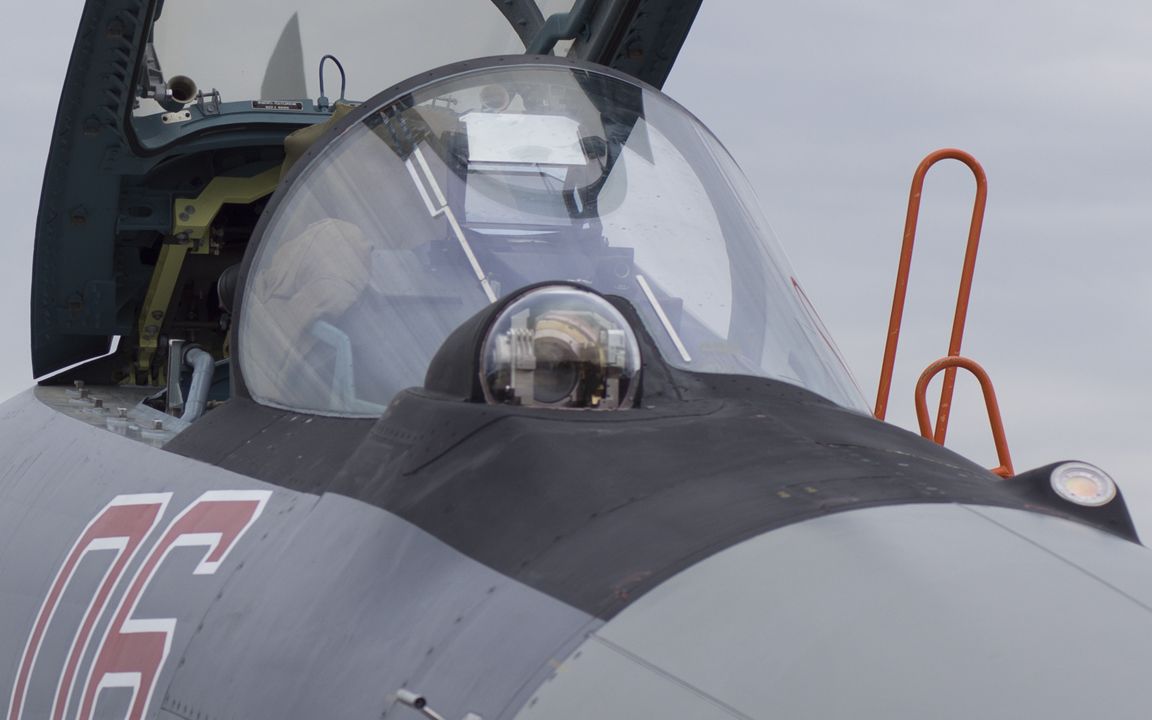
Close-up of the OLS-35 infrared search-and-track ball immediately ahead of the windshield on a Su-35S, bort 06, with the canopy open.
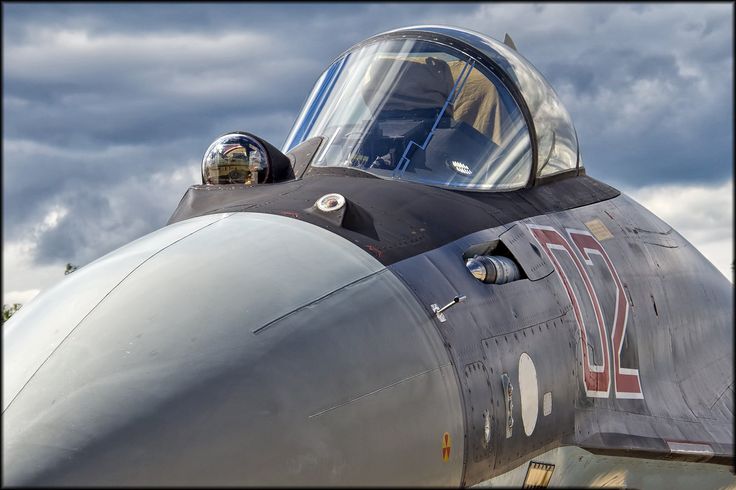
The nose of a Su-35S, bort 02: the OLS-35 optical-location station on the centreline ahead of the windshield, the radome, and the in-flight-refuelling probe on the port side of the nose.
AVIONICS, COCKPIT AND ELECTRONIC WARFARE
The cockpit is a glass cockpit with a wide-angle colour head-up display, two large-format colour multifunction displays, and HOTAS controls. KnAAPO marketing text also mentions provision for night-vision goggles and an auxiliary power unit so that cockpit and equipment can be powered and cooled on the ground without a ground cart. Specific Russian display type numbers (МФИ and so on) were not found in the official public sources reviewed for this page. [DOCUMENTED for the general layout; display designations UNKNOWN]
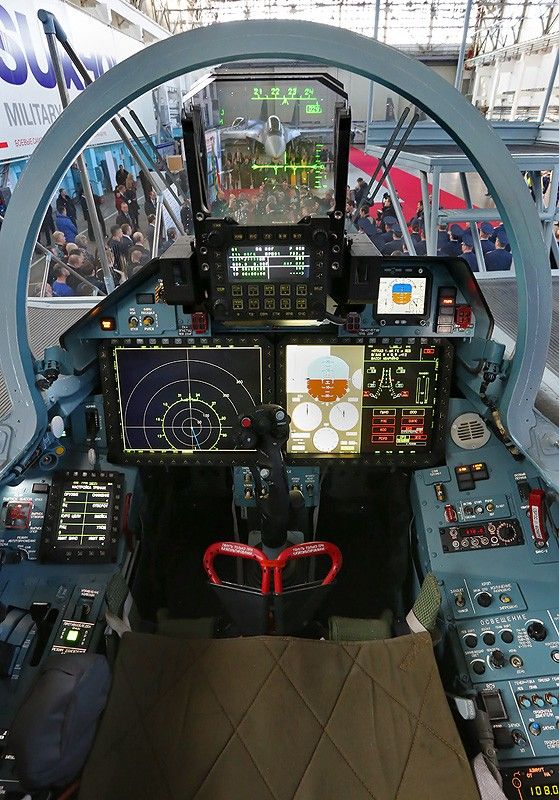
The Su-35S glass cockpit at an indoor exhibition (a Sukhoi banner is visible through the windshield): a head-up display, two large colour multifunction displays, a centre stick, and the red ejection-seat handle.
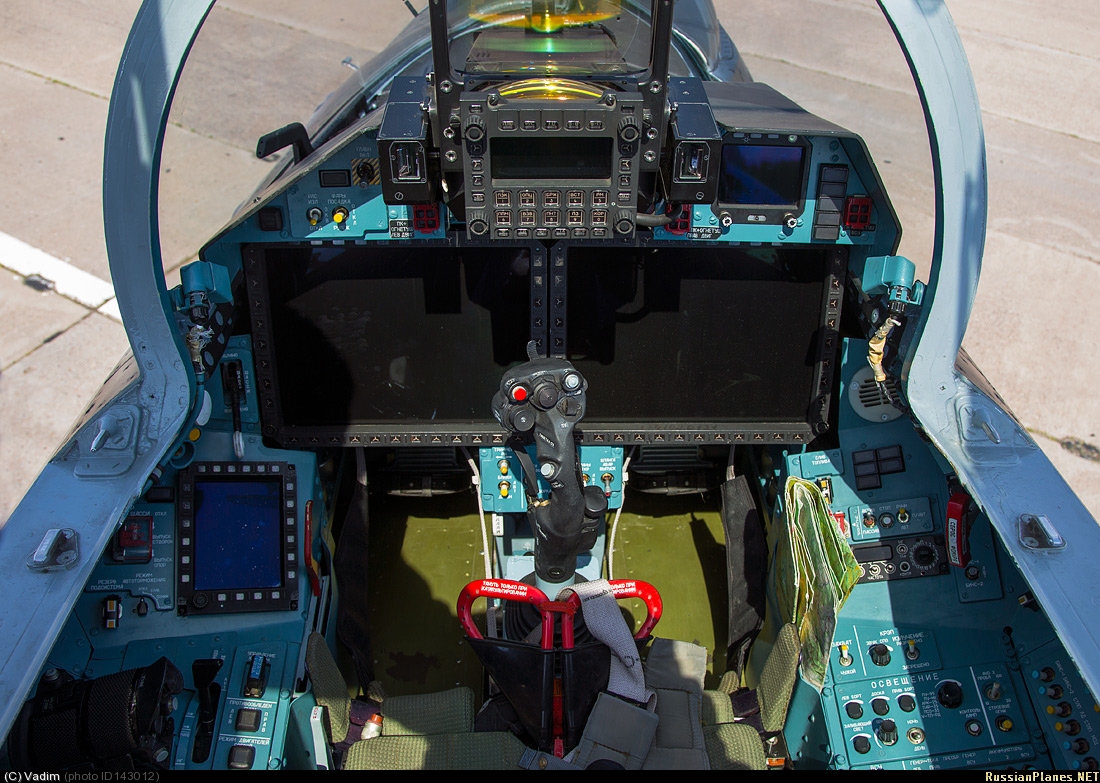
Another Su-35S-style glass cockpit, photographed on the ramp with the two large displays unpowered. The layout matches the exhibition cockpit: HUD, two large multifunction screens, centre stick, and side consoles.
The documented electronic-warfare fit on the Su-35S is the Khibiny-M suite (Хибины-М; also referred to as L-175M, and in some lists L-175V) from KNIRTI. Public descriptions of Khibiny are of a radar-warning and jamming system that finds emitters and distorts the returns they see, carried in wingtip pods on Flanker-family aircraft. Air Power Australia, writing when the Su-35S was new, highlighted new-design wingtip ECM pods, larger than the older KNIRTI Sorbtsiya pods and in the same general class as later DRFM designs. This page does not treat the heavy centreline SAP-14 support-jammer pod, which APA recorded on other Flanker types, as a confirmed standard Su-35S fit. [DOCUMENTED for Khibiny-M on the type; pod sub-variants partly from specialist literature]
The tail stinger: a clear version difference (N012).
Between the two engine nozzles, the Flanker's centre fuselage does not stop at the nozzles. It continues as a long pointed boom — the tail stinger (хвостовая балка, often жало, "sting"). On a layout where the engines sit in separated nacelles, that boom is useful volume at the extreme rear of the aeroplane, and different members of the family use it differently.
On the baseline Su-27, open technical descriptions (MiGFlug, citing the Aircraft Recognition Guide and its own type entry, and general Flanker literature) put the brake parachute in the pointed tip of the boom and APP-50 chaff/flare dispensers in the boom itself. Later production Su-27s can be recognised by box-like extensions on the sides of the stinger; earlier aircraft had only small strakes. UAC's Su-35 specification still quotes a landing roll that assumes the braking parachute as well as the wheel brakes, so a parachute remains part of the current type's landing method even if the exact stinger packing is not shown in official cutaways. [DOCUMENTED for the Su-27 arrangement and for the Su-35S landing-roll assumption]
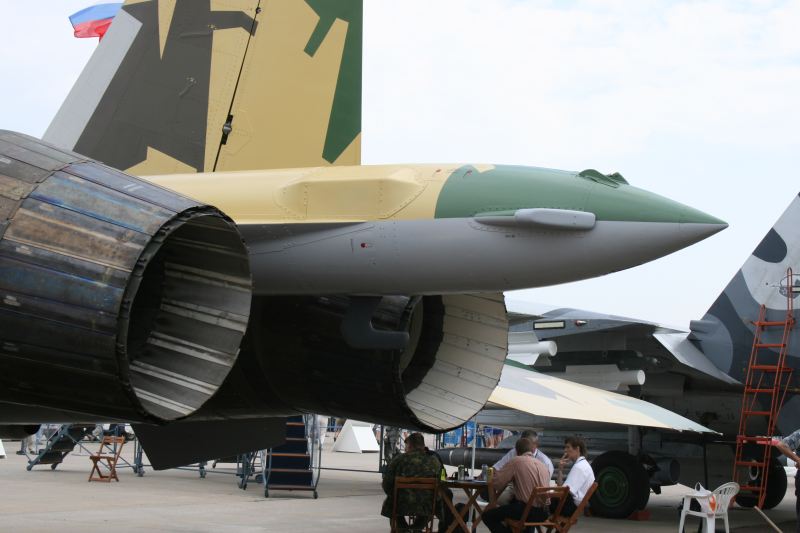
An example of a long Flanker tail stinger between the engine nozzles, on a 1990s demonstrator at a static display. The exact airframe is not identified from this crop. A grey-splinter Flanker stands in the background.
On the Su-27M / original Su-35 — the canard aircraft of the 1990s — and on the Su-37 demonstrator (T-10M-11, bort 711), several secondary sources say that same central tail boom housed a rear-looking radar, the N012 (Н012, РЛС заднего обзора). MiGFlug, citing MILAVIA, places the N012 in the Su-27M's central tailboom. Russian-language material associated with Ildar Bedretdinov (id-bedretdinov.ru) and a technical write-up on avsim.su likewise describe the N012 on the Su-27M / original Su-35 and specifically on the Su-37, and attribute development to the Ryazan research institute "Rassvet" (НИИ «Рассвет»), later associated with Phazotron-NIIR. No official UAC or Sukhoi public manual confirming the installation was found for this page, but the claim is consistent across specialist sources and is treated here as the documented public account of the 1990s aircraft. [DOCUMENTED in secondary literature]
The production Su-35S is different. MiGFlug notes that the Su-35S has a reshaped stinger without the rectangular side boxes of the late Su-27. Public sources checked for this page do not list the N012 as part of the Su-35S fit, and they do not supply an official contents list for the new boom. What occupies that volume on the Su-35S — brake parachute, flare and chaff dispensers, electronic-warfare equipment, some combination of those, or something else — is therefore not established in official public documentation. The specific presence of the UV-26 dispenser family in the Su-35S stinger was not confirmed in the Russian sources reviewed. [UNKNOWN]
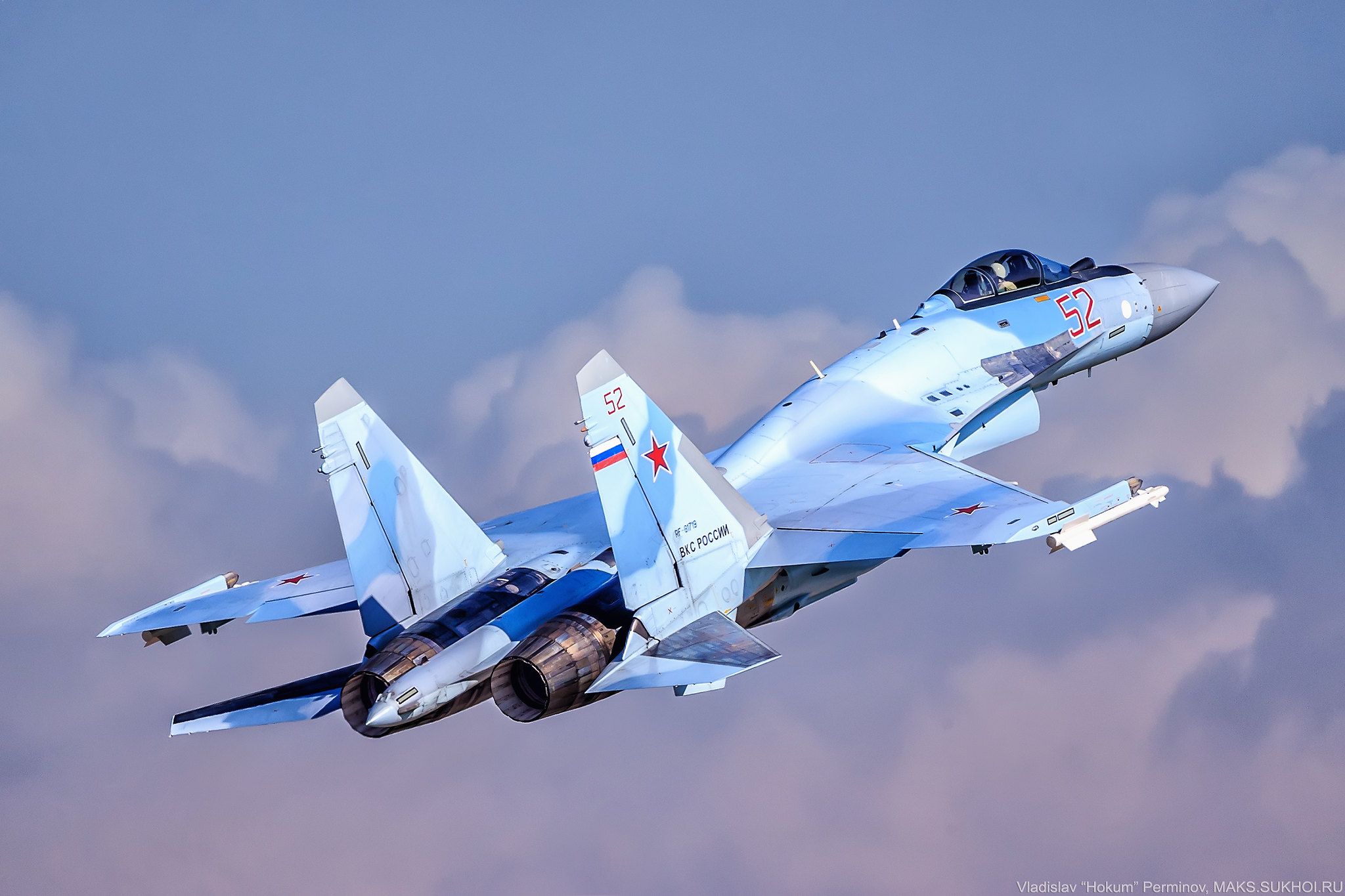
Su-35S bort 52 from the rear. The production tail stinger is the slim, pointed boom between the nozzles, without the rectangular side boxes of late Su-27s. There are no canards.
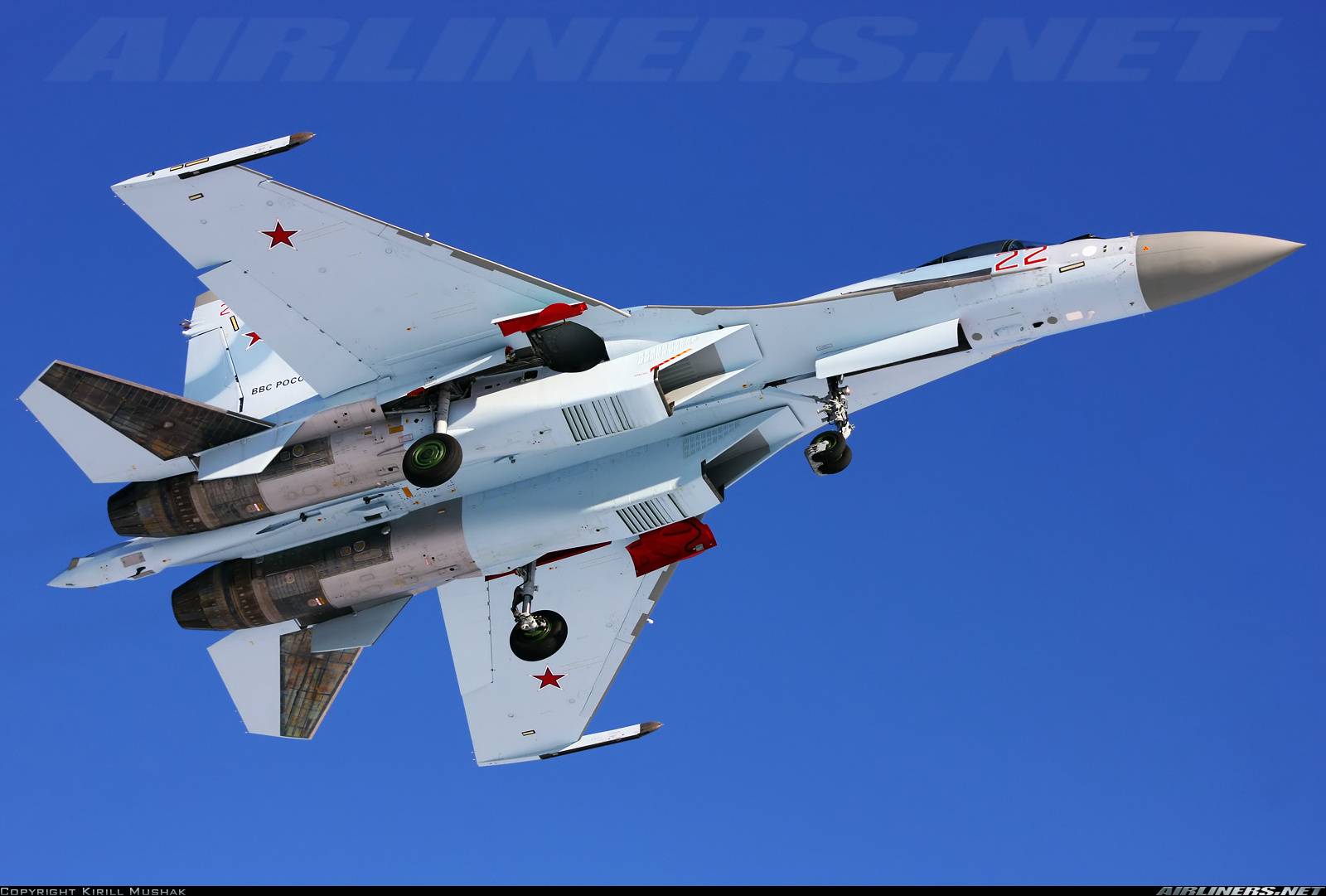
Su-35S bort 22, gear down, seen from below. There are no canards. The tail stinger is clearly visible as the pointed boom on the centreline between the two engine nozzles. The tail carries a ВВС РОССИИ title.
A common inference is that the Su-35S dropped the rear radar and now uses the stinger for self-protection stores and EW gear, with rear-hemisphere warning coming from a missile-approach warning system (MAWS) and from the Khibiny-M suite. That reading is plausible from Flanker-family practice and from the fact that Khibiny-M is the documented EW fit, but the sources checked for this page do not actually say it. MiGFlug, which is solid on the N012-in-the-Su-27M point and on the reshaped Su-35S stinger, does not itself describe a MAWS/Khibiny replacement path. A dedicated, publicly documented MAWS installation for the Su-35S was not found in official sources reviewed here. Forum commentary that calls rear-facing radars on "the Su-35" folk tales appears to blur the 1990s Su-27M and the later Su-35S, and is not used as a technical source. A later social-media claim about a Su-35SM with "circular" EW derived from the Su-57 is weak and is off-type for the production Su-35S. [SPECULATION for the MAWS/Khibiny replacement path; UNKNOWN for the Su-35S stinger contents]
The version difference to keep is therefore this: a rear-facing N012 radar in the tail stinger belongs to the public description of the Su-27M / original Su-35 and the Su-37 demonstrator. It is not part of the documented public fit of the production Su-35S, whose stinger is a different shape and whose rear-hemisphere warning path has not been officially described. [DOCUMENTED as a version difference; the current stinger packing remains UNKNOWN]
RADIOS AND DATALINKS
Official UAC and Rostec public pages do not publish a radio-set list for the Su-35S. A Ukrainian GUR "War & Sanctions" component entry names onboard communications complexes S-107-1 and S-108 on the type. That is a single, useful open-source attribution, not a manufacturer data sheet, and it is tagged as such. Frequency bands and encryption standards were not found in the sources reviewed. [SINGLE-SOURCE]
Russian-language summaries (including ruwiki) say the Su-35 has an optical data-transmission system for communication between aircraft in a group while they are in radio silence. A specific datalink designation for Su-35S cooperation with the A-50 / A-50U was not found. Operational reporting describes Su-35S aircraft working with A-50 aircraft on long-range escort and surveillance sorties, which is expected in the Russian fighter / AWACS relationship and does not by itself identify the terminal. This page does not treat the ground-force radios R-168 or R-187 Azart, or the Sozvezdie ESU TZ system, as documented fits of the Su-35S airframe; they belong to the wider Russian C3 architecture. [DOCUMENTED for the general AWACS relationship and the optical-link claim in secondary sources; terminal designations mostly UNKNOWN]
ARMAMENT
The internal gun is a 30 mm Gryazev-Shipunov GSh-30-1. Secondary references give a magazine of about 150 rounds. External load is given by UAC as a maximum of 8,000 kg on 12 mounting points, which is the figure used on this page. A widely reprinted KnAAPO table lists 14 hardpoints for the same 8,000 kg. The usual physical description is two wingtip rails plus under-wing and fuselage stations. [DOCUMENTED, UAC]
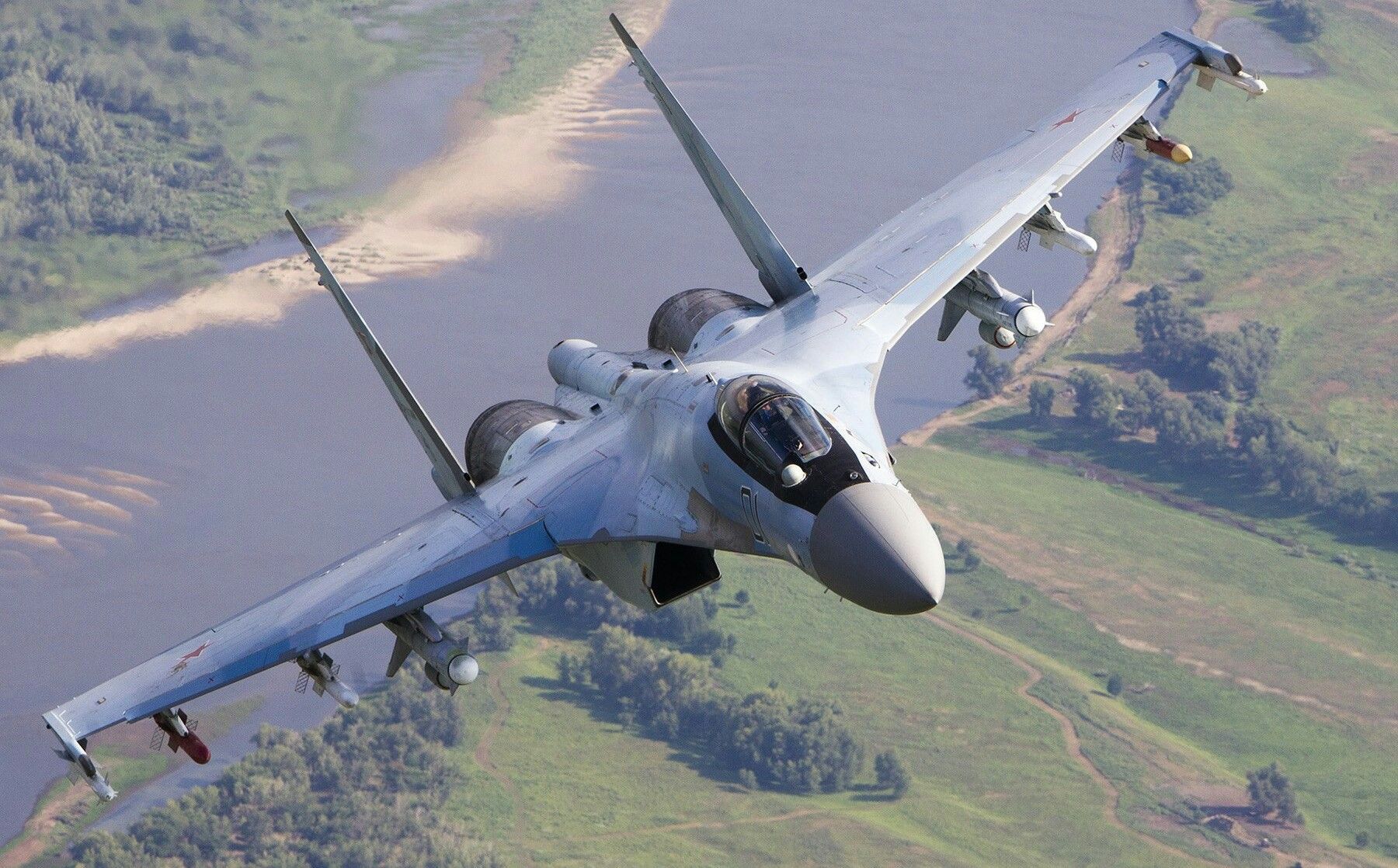
A Su-35S in flight over a river, with no canards. The load includes wingtip infrared missiles (red seeker covers) and underwing air-to-air missiles. The tail stinger is just visible between the nozzles.
Air-to-air weapons associated with the Su-35S in specialist and defence reporting are the R-77 / R-77-1 medium-range active-radar family, the older R-27 family, the R-73 / R-74M short-range infrared family, and the very-long-range R-37M, a missile first and still primarily associated with the MiG-31. The R-37M has been reported in use from Su-35S aircraft in the war against Ukraine from the summer of 2022. Early KnAAPO marketing also emphasised RVV-SD and RVV-MD export/development names in the R-77 and R-73/74 lines, and older studies mentioned a very-long-range Novator missile (R-172 / KS-172 / R-100) as a growth weapon; that last item is not treated here as a confirmed in-service Su-35S store. [DOCUMENTED for the in-service families listed; R-37M combat use from reporting; the Novator long-range missile is historical marketing / SPECULATION as a current store]
Air-to-surface weapons commonly listed for the type are the Kh-31 family (anti-radar and anti-ship), the Kh-59 family including the Kh-59MK2 (see Kh-59), the Kh-29, and KAB-500 / KAB-1500 guided bombs. The Su-35S is not documented in the sources reviewed for this page as a standard carrier of the Kh-47M2 Kinzhal, the Kh-32, or the Kh-69. Those belong to other platforms. Reports that Su-35s have dropped glide bombs in the Ukraine war appear in secondary defence reporting; the Kometa CRPA anti-jam antenna is widely associated with Russian guided bombs, not with a documented installation in the Su-35S airframe itself. [DOCUMENTED for the listed families as compatible in open sources; Kinzhal / Kh-32 / Kh-69 not established on this type; glide-bomb use secondary]
SPECIFICATIONS
The figures in the UAC column are the primary specification for this page. They come from the English-language United Aircraft Corporation product page for the Su-35, fetched on 25 November 2026 (America/Chicago). The site's TLS certificate is not in common public trust stores, so the copy used for the numbers was retrieved without certificate verification and should be checked against the live page. Where another published table differs, that alternate is noted briefly; it is not treated as equal to the manufacturer figure.
| Item | UAC English product page | Also published | Tag |
| Length | 21.9 m | 21.9 m (APA / KnAAPO; TASS) | [DOCUMENTED] |
| Height | 5.9 m | 5.9 m (APA / KnAAPO) | [DOCUMENTED] |
| Wingspan | 14.70 m | 14.75 m in one TASS item; 15.3 m in a KnAAPO-style table | [DOCUMENTED, UAC] |
| Normal takeoff weight | 25,300 kg | 25,300 kg, with 2 x RVV-AE + 2 x R-73E (APA / KnAAPO) | [DOCUMENTED] |
| Maximum takeoff weight | 34,500 kg | APA agrees on 34,500 kg. 34,000 kg appears in some generalist tables | [DOCUMENTED, UAC] |
| Internal fuel | 11,300 kg | 11,500 kg in a KnAAPO-style table | [DOCUMENTED, UAC] |
| Maximum combat load | 8,000 kg on 12 mounting points | 14 hardpoints in a KnAAPO-style table, same 8,000 kg load | [DOCUMENTED, UAC] |
| Engines | 2 x 117S; dry 2 x 8,800 kgf; special full afterburner 2 x 14,500 kgf | 14,500 kgf widely reprinted as afterburning thrust; Wikipedia-style conversions give about 86.3 kN dry and 142.2 kN in the high afterburning figure | [DOCUMENTED, UAC wording preferred] |
| Engine assigned life | 2,000 h | 4,000 h in one UMPO display report | [DOCUMENTED, UAC] |
| Airframe life | 30 years / 6,000 h | Same figures in Russian technical compilations (Airwar.ru) | [DOCUMENTED] |
| Max speed near the ground | 1,400 km/h | 1,400 km/h at H = 200 m (APA / KnAAPO) | [DOCUMENTED] |
| Max Mach at cruising altitude | 2.25 | APA / KnAAPO agree on M 2.25 at 11,000 m. Some TASS items have used 2,500 km/h or Mach 2.35 | [DOCUMENTED, UAC] |
| Practical range, near the ground | 1,580 km | 1,580 km at H = 0, M = 0.7 (APA / KnAAPO) | [DOCUMENTED] |
| Practical range, cruise, no refuelling | 3,600 km | APA and some TASS items agree on 3,600 km. One later TASS item has used 3,400 km | [DOCUMENTED, UAC] |
| Ferry range | Not listed in the extracted UAC English block | 4,500 km with two PTB-2000 tanks, in KnAAPO-style tables and some TASS items | [DOCUMENTED in KnAAPO-style tables; absent from the UAC English table] |
| Practical ceiling | 18,000 m, without mounted items | 18 km (APA / KnAAPO) | [DOCUMENTED] |
| Takeoff distance | 500 m at normal takeoff weight | 400-450 m in a KnAAPO-style table | [DOCUMENTED, UAC] |
| Landing roll | 700 m at normal landing weight, wheel brakes and braking parachute | 650 m in a KnAAPO-style table | [DOCUMENTED, UAC] |
| Maximum service overload | 9 g | 9 g (APA / KnAAPO) | [DOCUMENTED] |
| Crew | 1 | 1 | [DOCUMENTED] |
APA / KnAAPO also publish acceleration times (13.8 seconds from 600 to 1,100 km/h, and 8.0 seconds from 1,100 to 1,300 km/h, at 1,000 m with 50 percent fuel) and a maximum rate of climb of more than 280 m/s at 1,000 m. Those figures are not in the UAC English table. Empty weight is not in the UAC table; some secondary compilations give a figure near 19,000 kg. Combat radius is not a published UAC number in the block used here. [SINGLE-SOURCE / secondary for the acceleration, climb and empty-weight figures]
PRODUCTION AND FLEET
All production of the current type is at the Gagarin plant in Komsomolsk-on-Amur. The first 48-aircraft contract was signed in August 2009, for delivery by 2015. UAC announced the 100th serial Su-35S in December 2018, according to widely repeated industry reporting. Official Russian delivery announcements since the full-scale invasion of Ukraine typically confirm "a batch" without a number: TASS recorded such batches on 23 June 2023 and 8 May 2024, and Russian industry press has claimed further 2026 batches. Independent estimates of recent annual output cluster around 10-12 Su-35S a year; other analyses put combined Su-30 / Su-34 / Su-35 procurement in a similar total band. Those rates are estimates, not UAC figures. [DOCUMENTED for the plant, the 2009 contract and the official "batch" announcements; rates and the 100th-aircraft milestone from industry reporting]
Russia does not publish a current VKS inventory. Secondary 2024 estimates of about 110-120 active Su-35S, after deliveries minus losses, should be treated as rough. Known units include the 929th GLITS for trials and the Russian Knights (Русские Витязи) aerobatic team. A public, complete order-of-battle for operational regiments was not compiled from official sources for this page. [UNKNOWN as an official total; unit examples secondary]
EXPORTS
China. The only completed, widely documented export deal is the sale of 24 Su-35 aircraft to the People's Liberation Army Air Force, with deliveries reported between 2016 and 2018. [DOCUMENTED in open reporting]
Egypt. A contract, generally dated 2018 and often given as 24 aircraft (sometimes Su-35SE), was not completed. Open reporting says Egypt cancelled under outside, including United States, pressure, paid a penalty, and refused aircraft already built. One Russian account says about 20 airframes built for Egypt were stored at airfields in Komsomolsk-on-Amur and Zhukovsky. The built-but-undelivered aircraft are the pool later linked, in reporting, to other customers. [DOCUMENTED as a failed contract; headcount 20 versus 24 CONTESTED]
Algeria. Several defence outlets reported that Algeria began receiving Su-35s in 2025 (March is the month often given), in some accounts using aircraft originally built for Egypt; SIPRI-based secondary estimates of 14 aircraft have been repeated. Other reporting has claimed Algeria walked away because the Irbis radar did not meet its requirements. Both stories were still in circulation when this page was prepared. [CONTESTED]
Indonesia. A contract was signed in the last decade and then stalled under export-control pressure. As of early 2025 a Russian ambassador was still saying the contract had never been cancelled; other Russian and regional reporting has described the purchase as abandoned. [CONTESTED]
Iran. Reports of a finalised Su-35 deal, sometimes dated around a 2023 strategic partnership, conflict with later reporting that the deal collapsed and that Iran turned toward Chinese aircraft. No delivery quantity or date was established in the sources reviewed. [CONTESTED / UNKNOWN]
Ethiopia. In late October 2026, Ethiopian and defence reporting, later echoed by TASS / Rosoboronexport language about a first batch, said Ethiopia had received its first Su-35 aircraft. One widely repeated figure is 12 aircraft; this page treats the delivery itself as reported, and the exact number and the rest of any package (some outlets bundled S-400 talk with the same announcement) as not yet settled. [SINGLE-SOURCE / recent reporting, as of November 2026]
No documented combat use by export operators was found.
COMBAT USE
Syria. The Su-35S made its first overseas operational deployment to Khmeimim in January 2016. Open reporting describes both ground-attack sorties and air-superiority / intercept work, including encounters with Turkish and Israeli aircraft that are poorly documented in official detail. No official Russian record of a Su-35 loss in Syria was found in the TASS Syria-operation material reviewed for this page. [DOCUMENTED for the deployment; intercept stories secondary]
Ukraine, 2022 to 2026. The Su-35S has been used as a long-range air-to-air fighter, including with the R-37M from the summer of 2022, and has also been described in secondary reporting as a glide-bomb and strike aircraft operating from distances intended to stay outside Ukrainian surface-to-air belts. TASS has called it the most successful post-Cold War Russian type by aerial victories in the current war; that is an official claim, not a verified tally. Individual kill stories — including a reported R-37M shot against a Ukrainian MiG-29 at a range of about 190 km, with the Su-35S said to have remained in Russian-controlled airspace — come from defence outlets and should be read as claimed. Ukraine confirmed some of the corresponding losses of its own aircraft in those stories, which is not the same as confirming the range or the firing-position details. [DOCUMENTED for the type's presence and for official Russian claims; individual shot geometry is claimed]
Losses are a conflict. Russia does not publish a Su-35S loss total. The Oryx visually confirmed list, as read for this page on 25 November 2026 (America/Chicago), recorded 12 Su-35S destroyed. That figure is a dated floor: it counts only cases with published visual evidence, it moves as the list is updated, and it does not include unverified claims. Ukrainian and other claims of additional shoot-downs (including by Buk-M1, by F-16s, and at least one report of possible friendly fire, plus a reported mid-air collision of two Su-35S aircraft in the Kursk region) sit above that floor and are not added together here. [DOCUMENTED as a visual-confirmation floor on that date; higher claim totals CONTESTED]
WHAT IT IS NOT
The Su-35S is not the 1990s canard Su-27M that first used the Su-35 name, and it is not the Su-37 demonstrator. It is not a stealth aircraft, even though it uses some signature-reduction measures. It is not an AESA-radar fighter: the Irbis-E is a high-power PESA, which is a different architecture (see PESA). It is not the Su-57, and it does not use the Su-57's izdeliye 117 or izdeliye 30 engines. It is not a documented carrier of Kinzhal, Kh-32 or Kh-69. It is not a published replacement for the A-50 in the AWACS role, even if its radar can cue other fighters. And a rear-facing N012 radar in the tail stinger is not part of the documented public description of the production Su-35S.
IN ONE SENTENCE
The Su-35S is Sukhoi's canard-less, 117S-powered, Irbis-E-equipped deep modernisation of the Su-27 — a different aircraft from the 1990s canard Su-27M that first used the Su-35 name, and one whose tail stinger no longer carries the N012 rear radar of that earlier version in any officially published fit.
SOURCES
Plain-text citations only. No outside hyperlinks. Figures were spot-checked against the UAC product page, the Air Power Australia / KnAAPO table, and the MiGFlug stinger article as described in the specification notes. Other items come from the named outlets as read in November 2026.
Related on this site: PESA radar, the architecture of the N035 Irbis-E.
Related on this site: AESA radar, the architecture the Irbis-E is not.
Related on this site: A-50 / A-50U, the AWACS type that cues Russian fighters, including the Su-35S, in service reporting.
Related on this site: MiG-31, the other in-service Russian carrier of the R-37M very-long-range missile.
Related on this site: Kh-59, including the Kh-59MK2, listed among the Su-35S air-to-surface weapons.
Related on this site: Kh-69, Kh-32 and Kh-47M2 Kinzhal — not documented as standard Su-35S stores.
Related on this site: S-400, Buk-M3, Pantsir and Russian air defence, the ground layer the Su-35S operates with.
Related on this site: Kometa CRPA, the anti-jam antenna used on Russian guided bombs, not a documented airframe fit of the Su-35S.
Related on this site: Russian C3, and the ground radios R-168 and R-187 Azart, which are not documented here as Su-35S installations.