WHAT IT IS
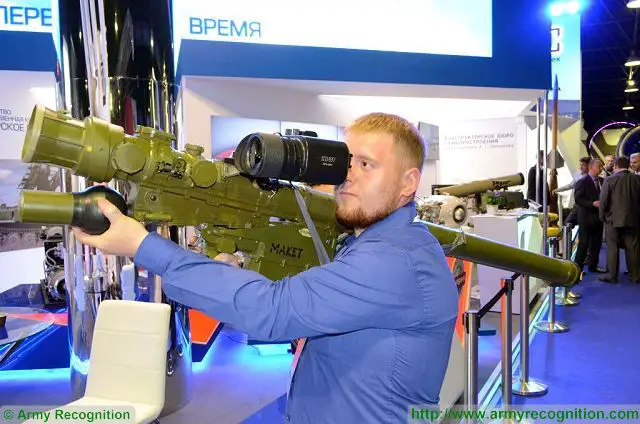
The 9K333 Verba (Верба, "willow"; NATO SA-29 Gizmo) is Russia's newest man-portable air-defence system (MANPADS, ПЗРК). One soldier fires the 9M336 heat- and ultraviolet-seeking missile from the shoulder at aircraft, helicopters, cruise missiles and drones. It was developed by KBM (Конструкторское бюро машиностроения) at Kolomna, now part of the Rostec High-Precision Systems holding, as the successor to the 9K338 Igla-S, and it entered Russian service in 2014. [DOCUMENTED]
Verba is meant to be more than one missile on one shoulder. It was delivered as a set, with a radar IFF interrogator, small radar detectors and the Barnaul-T automation system, which passes target data from radars and higher command down to individual gunners. In the Ukraine war Verba sits at the bottom of Russia's layered air defence, below Tor, Pantsir and Buk-M3, and is used against both manned aircraft and Ukrainian drones. [DOCUMENTED]
DEVELOPMENT
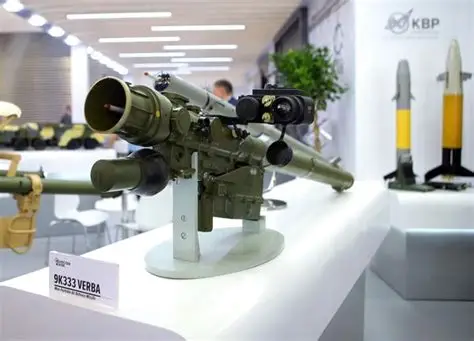
THE 9M336 MISSILE
The main change from the Igla-S is the seeker. The 9M336 has a three-band passive optical seeker working in the ultraviolet, near infrared and mid infrared, where Igla-S has two bands. With three bands the missile can compare a target's signature in each band and reject flares that look right in one band but wrong in the others. KBM says it is also meant to resist the laser directed-infrared countermeasures (DIRCM) now being fitted to Western aircraft. [DOCUMENTED] for the three bands; [SINGLE-SOURCE] for the DIRCM claim (manufacturer).
KBM claimed the seeker is many times more sensitive than Igla-S, giving a 2.5 times larger acquisition and engagement zone against typical targets, roughly ten times better resistance to flares, and the ability to see small, cool targets such as drones and cruise missiles two and a half times farther than two-band Russian MANPADS. [SINGLE-SOURCE] (manufacturer statements in Russian press, 2014-2020.) Russian Wikipedia puts the overall gain at 1.5 to 2 times Igla-S, mostly beyond 3 km. [SINGLE-SOURCE]
The missile also got a new instrument section, modern electronics and a new solid-fuel motor. The warhead is high-explosive fragmentation; figures of 1.5 kg (en.wikipedia) and 2.5 kg (Russian trade press) both appear. [UNVERIFIED] on the exact mass.
| Parameter | Figure | Note |
| Range | 500-6,400 m (6,500 m in some sources) | manufacturer; some marketing gives 6,000 m |
| Altitude | 10-4,500 m | Rosoboronexport marketing gives 3,500 m |
| Target speed | up to 400 m/s head-on, 320 m/s tail-chase | Interfax / VPK also quote up to 500 m/s |
| Combat weight | 17.25 kg | missile in tube with launcher |
| Diameter | 72 mm | |
| Seeker | 3 bands: UV, near IR, mid IR | passive, fire-and-forget |
| Ready to fire | within about 8-12 s | manufacturer / Rosoboronexport |
| Temperature range | -50 to +50 degrees C | manufacturer |
The spread in range and altitude figures probably comes from different target types and conditions (an aircraft head-on versus a small drone), or from the export marketing for Rosoboronexport. All of these are manufacturer figures. [ESTIMATE] for the reason; [SINGLE-SOURCE] for the figures.
PRE-LAUNCH SEQUENCE: POWER, COOLING AND GYRO SPIN-UP
Like the Igla, the Verba is readied by a one-shot ground power and cooling unit attached to the tube. On the Igla this is the 9B238: a 350 kgf/cm² nitrogen bottle plus a thermal battery, rated for at least 30 s. On the Igla it cools the main detector to 77 K within 4.5 s and spins the seeker gyro to 100 rev/s in no more than 5 s. [DOCUMENTED] (Sources 15, 16, for the Igla.) The Verba's three-band seeker likewise has cooled detectors and a gyro-stabilised optical head. [DOCUMENTED] (earlier sources in this article.) The designation and exact figures of the Verba's own unit are not given in open sources. [UNVERIFIED] The rising whine heard before a Verba or Igla launch is the same spin-up-and-cooling cycle described for the vehicle-mounted Strela-10, where it lasts about 5 s. [DOCUMENTED] (Source 17.) The site owner identified this in combat video. [FIELD ACCOUNT, site owner]
SET COMPOSITION AND BARNAUL-T
KBM listed the Verba set in 2014 as follows. [DOCUMENTED] (KBM press release.)
Those modules belong to Barnaul-T, a tactical air-defence automation system. It fuses radar tracks and higher command's air picture, builds target trajectories and hands each target to the unit best placed to engage it, taking into account readiness, position and ammunition. [DOCUMENTED] (manufacturer description via Militarnyi.) The 9S933 is a backpack-sized commander's workstation that can be set up in a couple of minutes and handles fire missions for up to 15 targets at once. The 9S935 puts a display and link on the gunner's helmet and vest, so that he is told where to look before the target appears. [SINGLE-SOURCE] (Russian technical press.)
This matters against drones. A MANPADS gunner who has to find a small, quiet drone by eye usually fails. A gunner cued by a radar through Barnaul-T at least knows the bearing. [ESTIMATE]
COMBAT USE
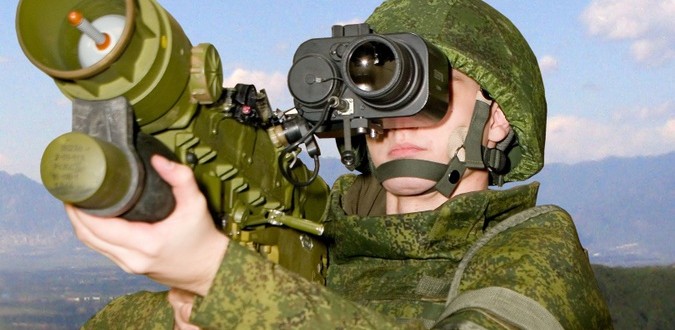
The site owner reports that Gibka-S, Verba and Igla groups cued by the 1L122 Garmon radar have claimed a large number of drones, and that he has seen videos of soldiers firing Verba at drones at point-blank range in large built-up city areas. [FIELD ACCOUNT, site owner] Publicly, the Russian Ministry of Defence released footage on 6 June 2024 of Ivanovo paratroopers shooting down a Ukrainian drone with Verba at Chasiv Yar, Donetsk region, and further Verba-versus-UAV footage was published in November 2023. [DOCUMENTED] (Russian MoD via RT, 2 Nov 2023; Rainews and www1.ru, 6 Jun 2024.) Claimed kill totals have not been independently verified. [UNVERIFIED]
THE ZARNITSA THERMAL SIGHT
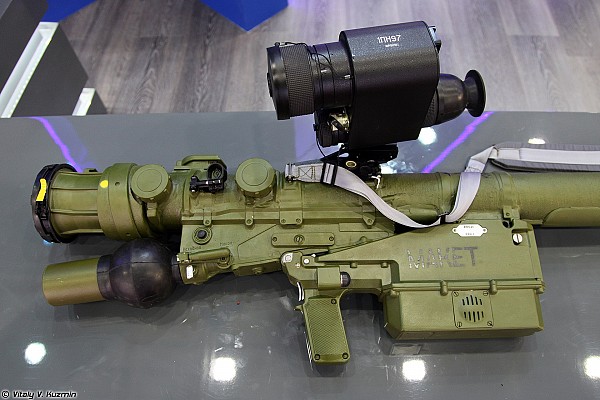
The Verba's three-band seeker is only useful once the gunner has found the target. Small drones at dusk, at night or against cloud are hard to see with the eye. In response Russia has fielded the Zarnitsa (Зарница) thermal sight, which mounts on the Verba launcher and lets the gunner detect and track targets in darkness and poor visibility before cueing the missile. [DOCUMENTED] (Source 18.) On 12 June 2026 Defence Minister Andrei Belousov said production of the Zarnitsa was being expanded so that every Verba launcher would have one. [DOCUMENTED] (Source 18, Interfax.) A related thermal adapter for both Igla and Verba was reported in July 2025. [SINGLE-SOURCE] (Source 19.) This counts as an admission that the eye was the weak link of the system against drones. [SPECULATION]
THE 1L122 RADAR AND THE NETWORKED SQUAD
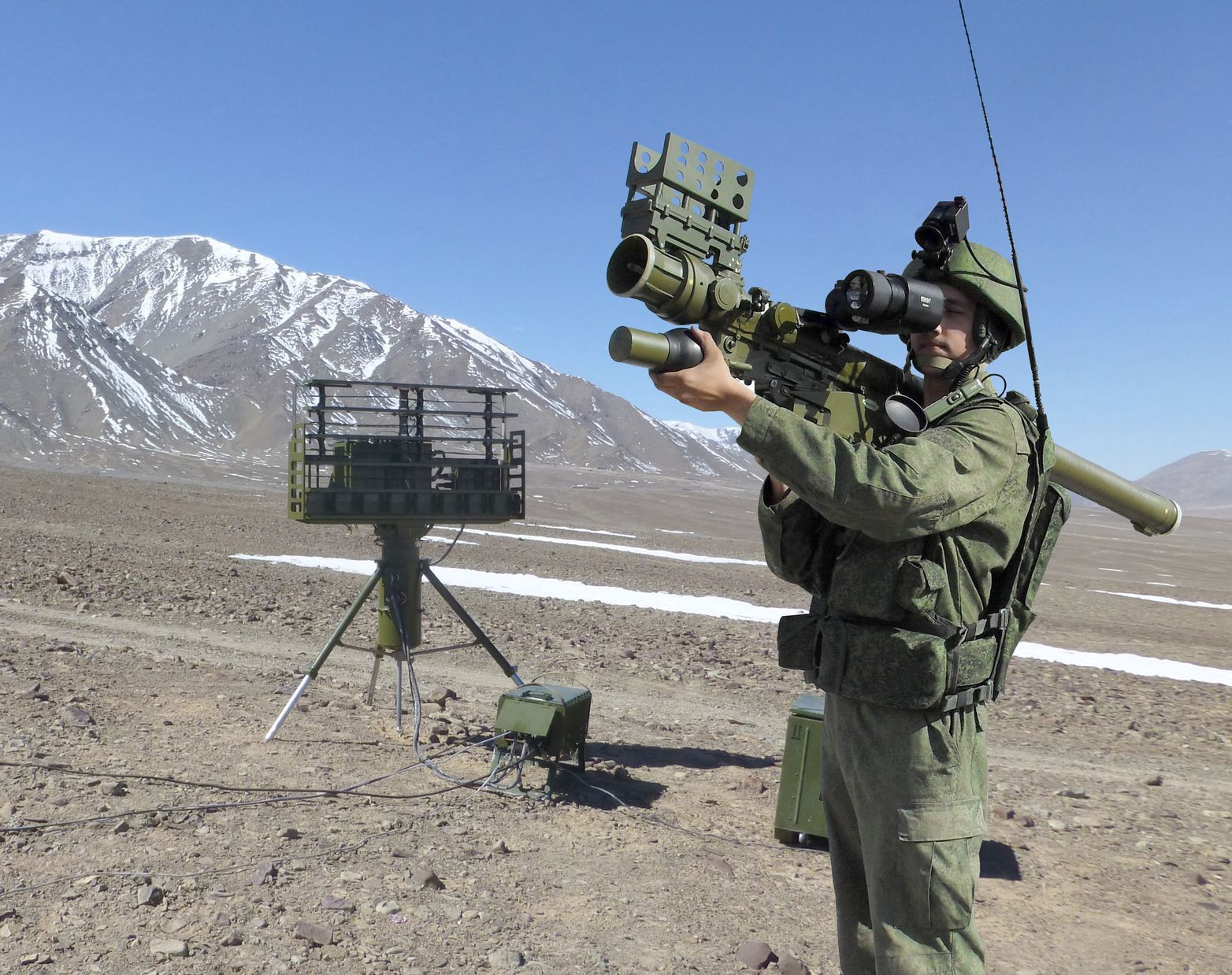
The Verba set is not only a MANPADS. Its 9S935 or 9S936 command-and-control means can tie each team to a 1L122 "Garmon" portable radar. The export 1L122-1E is credited with about 40 km detection range and the 1L122-2E with about 80 km. [DOCUMENTED] (Source 1.) The team then receives target bearings on a tablet before the target is visible, which is how the Barnaul-T battery command system works. [DOCUMENTED] (Source 1.) The Gibka-S applies the same principle with vehicles. [BACKGROUND]
CLAIMED RESULTS AGAINST DRONES
In February 2026 the manufacturer, the High-Precision Systems holding, said Verba crews had shot down "thousands" of Ukrainian drones. [DOCUMENTED] that the claim was made (Source 20, Lenta.ru/TASS). The number cannot be checked and is a manufacturer claim. [UNVERIFIED] Oryx counts eight Barnaul-T 9S932-1 command vehicles destroyed and one 9S932-2 captured as of 26 Oct 2026. [DOCUMENTED] (Source 21.) That shows the Verba's radar and command links are deployed near the front. [ESTIMATE]
VERBA ON SHAHED-TYPE DRONES: THE GERAN-2 "E" SERIES
In January 2026 Ukraine's military intelligence (HUR) published details of a Geran-2 variant fitted with a Verba missile, designated the "E" series. [DOCUMENTED] (Source 22, Ukrainska Pravda.) According to HUR:
All of the above is [DOCUMENTED] as HUR reporting (Source 22). It has not been independently confirmed. [SINGLE-SOURCE] The intended targets were presumably Ukrainian helicopters and light aircraft hunting Shaheds. [SPECULATION] The arrangement repeats the ground pre-launch sequence described below: power and cooling first, then the seeker, then launch. [BACKGROUND]
EXPORT: IRAN AND INDIA
PLACE IN THE LAYERED DEFENCE AGAINST DRONES
Verba is the cheapest missile layer, but it is not cheap against a drone. Transaction documents obtained by the Financial Times in 2026 for a Rosoboronexport sale to Iran showed about EUR 170,000 per 9M336 missile and EUR 40,000 per launcher. [SINGLE-SOURCE] (FT via en.wikipedia.) A missile at that price against a Lyutyi or a Geran-class drone is roughly an even trade. Against a small reconnaissance or FPV drone it is a bad trade, which is why Russian units also use guns, electronic warfare and interceptor drones for low-end targets. [ESTIMATE]
OPERATORS AND EXPORTS
SOURCES
Related on this site: Gibka-S, 1L122 Garmon, Igla, Tunguska, Strela-10, Sosna, Pantsir.
Related on this site: Russian Unified Air Defense (how the layers fit together).
Project Orlan // Underground Information Database