WHAT IT IS
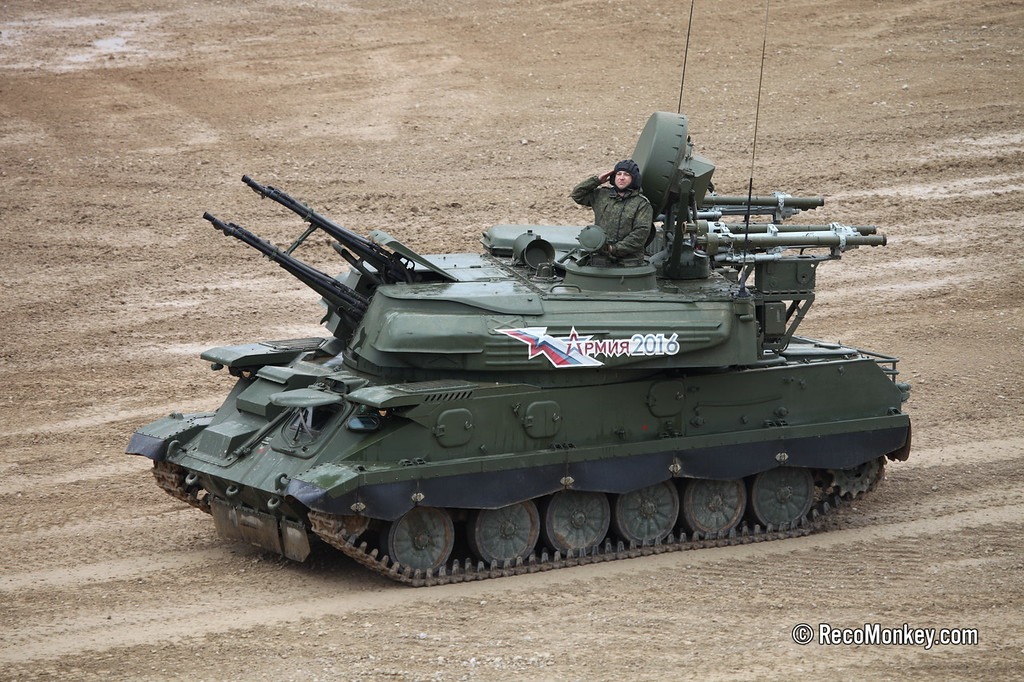
The ZSU-23-4 Shilka (ЗСУ-23-4 «Шилка», named after a river in the Amur basin) is a Soviet tracked self-propelled anti-aircraft gun with four water-cooled 23 mm AZP-23 autocannons and a 1RL33 fire-control radar in one turret. It entered service in 1965 and fires a combined 3,400-4,000 rounds a minute from about 2,000 rounds carried, out to roughly 2.5 km and about 1.5 km altitude. [DOCUMENTED] Serial production ended in 1982. [DOCUMENTED]
It made its name against low-flying jets in the Middle East and Vietnam era. Its successors are the Tunguska and Pantsir. Now it is back in use on both sides of the Ukraine war, mostly against drones. [DOCUMENTED]
MODERNISATIONS
UKRAINE WAR
WHY A 1965 GUN STILL WORKS
A Shahed-type drone flying a predictable course below about 200 km/h at low altitude is an easy target for radar-directed 23 mm fire, and the ammunition costs a tiny fraction of any missile. Against fast jets the Shilka is obsolete; against slow drones it is cost-effective, as long as its radar and computer are modern. [ESTIMATE] (BattlePolicy analysis.)
DEVELOPMENT
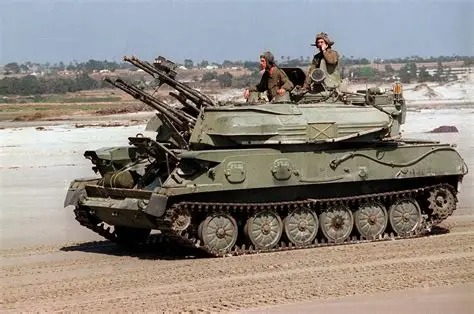
Before the Shilka, Soviet regiments had two kinds of mobile anti-aircraft guns, and both were poor. The ZSU-57-2 had two powerful 57 mm guns, but it carried only about 300 rounds, had no radar and could not fire on the move. The towed ZPU heavy machine guns and the ZU-23-2 had a high rate of fire but had to be set up, and had no fire control beyond an optical sight. [DOCUMENTED] (en.wikipedia.)
Work on a radar-directed self-propelled gun began in 1957, in parallel with a heavier twin-37 mm design, the ZSU-37-2 Yenisei. The Yenisei's bigger guns reached higher and were at first judged better for covering the low "dead zone" under the new Kub (SA-6) missile batteries, but the lighter 23 mm Shilka won on weight and commonality with the ZU-23 ammunition already in service. It was accepted in 1965 and had replaced the ZSU-57-2 in front-line units by the early 1970s. [DOCUMENTED] (en.wikipedia.)
About 6,500 were built in total, of which about 2,500 were exported to 23 countries. Production ended in 1982 when the Tunguska was ready to replace it. [DOCUMENTED] (en.wikipedia; production end date per Russian references.)
DESIGN
GUNS AND AMMUNITION
The AZP-23 "Amur" quad mount (GRAU 2A10 for the turret) carries four water-cooled 2A7 autocannons. Each fires 850-1,000 rounds a minute, 3,400-4,000 combined. The mount elevates from -4 to +85 degrees and is fully stabilised, so the Shilka can fire on the move. About 2,000 rounds are carried: 520 for each upper gun and 480 for each lower gun. That is 30-35 seconds of continuous fire, though in practice crews fire bursts of 3-10 rounds per barrel, with the computer working out lead for each burst. [DOCUMENTED] (en.wikipedia.)
The guns fire the same 23x152B ammunition as the ZU-23-2. A typical belt in the late Soviet period held 40 OFZT high-explosive incendiary tracer rounds and 10 BZT armour-piercing tracer rounds. Slant range is about 2.5 km, effective altitude about 1.5 km, against targets moving at up to about 250 m/s (more with modern fire control). Maximum ballistic reach is about 7 km horizontally and 5.1 km vertically, but that is not an engagement range. The ZSU-23-4M4 introduced a special round with composite projectiles for use against cruise missiles. [DOCUMENTED] (en.wikipedia.)
Early Shilkas had a dangerous fault. After long firing, hot barrels could cook off rounds, and the gun would keep firing by itself until the belt ran out; overheated barrels could even jam or break. Soviet crews learned to keep away from a Shilka that had been firing for a long time. The ZSU-23-4M of 1973 replaced the welded coolant tubes with flexible pipes and largely cured the problem. [DOCUMENTED] (en.wikipedia, citing Perrett 1987.)
RADAR AND FIRE CONTROL
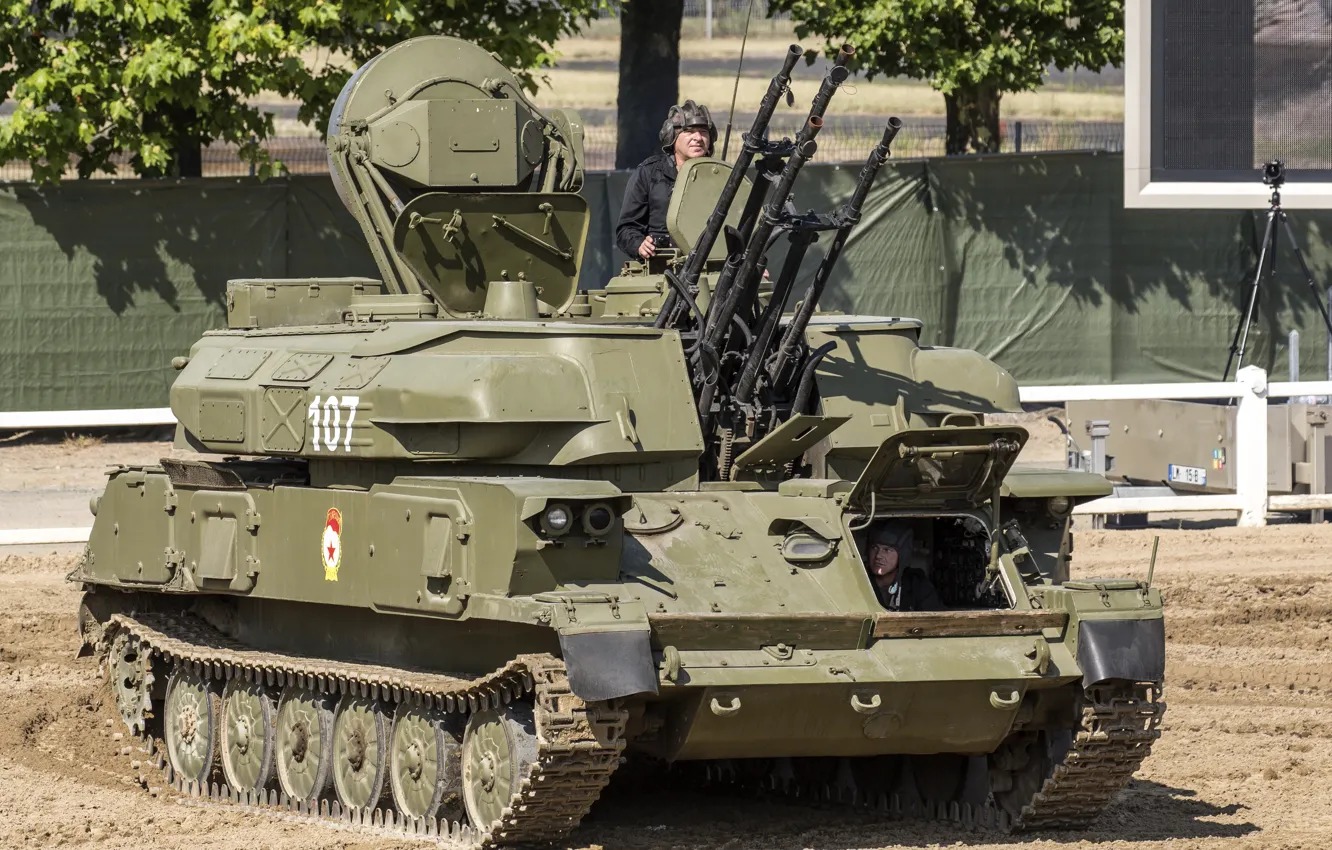
The RPK-2 Tobol fire-control radar (1RL33, NATO "Gun Dish") is a Ku-band set on a folding mount at the rear of the turret. It can detect aircraft at about 20 km, but it was designed mainly as a tracker, and its search range in rain or snow is short. Ground clutter is a serious problem below about 60 m. It is also hard for the radar to keep automatic track of a fast target closer than about 7-8 km because of the high angular rate. [DOCUMENTED] (en.wikipedia.)
The radar feeds a 1A7 electro-mechanical fire-control computer weighing 180 kg. It uses 60 electric motors and 110 shafts, cams and gears to compute flight time, lead in elevation and lead in azimuth, with corrections from a gyroscope. There is no laser rangefinder on the original vehicle, so the commander and gunner need a lot of skill. [DOCUMENTED] (en.wikipedia.)
This is why the unmodernised Shilka struggles with small drones. A small plastic quadcopter or a low, slow reconnaissance drone gives a weak return that is lost in ground clutter, and the analogue computer was tuned for jets. Ukrainian crews before 2025 largely gave up on the radar and aimed optically. [DOCUMENTED] (ArmyInform, 20 Nov 2025.)
ALL VARIANTS
| Variant | Year | Changes |
| ZSU-23-4 | 1964-65 | pre-production and initial production |
| ZSU-23-4V | 1968 | reliability improvements, ventilation housing moved, commander's sight added |
| ZSU-23-4V1 | 1970 | more reliable radar, better computer (accurate fire on the move at 40 km/h), V-6R-1 diesel |
| ZSU-23-4M1 | 1973 | 2A7M guns; pyrotechnic instead of pneumatic charging; flexible coolant pipes; barrel life 3,500 to 4,500 rounds |
| ZSU-23-4M3 Biryusa | 1977 | Luk IFF; all M versions brought up to M3 during overhaul |
| ZSU-23-4M2 "Afghan" | 1978 | radar removed, night sight added, ammunition doubled to 4,000 rounds for mountain ground fire |
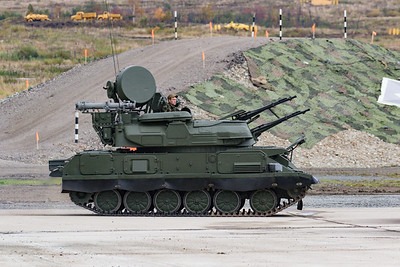
| ZSU-23-4M4 / M5 | 1999 (MAKS-99) | digital fire control, solid-state radar, Igla/Strelets missiles, smoke launchers, laser warning, hydrostatic transmission; M5 adds an optical channel |
| Donets (Ukraine) | 1999 | modified Shilka turret on a T-80UD hull, plus Strela-10 missiles, doubled ammunition (Malyshev plant, Kharkiv) |
| ZSU-23-4M-A1 Rokach (Ukraine) | 2017; mass upgrade 2024-25 | Rokach-AS radar, laser rangefinder, digital ballistic computer, Igla missiles (Arsenal, Kyiv) |
| ZSU-23-4MP Biala (Poland) | 2000 | radar removed; passive digital optics and four Grom missiles |
| India (BEL / IAI) | 2004 contract | 3D phased-array radar, electro-optics, Caterpillar engine; 48 vehicles for about USD 104 M |
| Signaal / Thales demonstrator | 1998 | ASADS Ka-band tracker and PAGE I-band search radar on ex-East German vehicles |
| Soheil (Iran) | 2010s | four Misagh-2 missiles; few details known |
Years and details from en.wikipedia and the Russian upgrade literature. The M4 upgrade was developed by the Minotor-Service and Peleng companies in Belarus with the Ulyanovsk Mechanical Plant; the Ulyanovsk plant also offers its own packages. [DOCUMENTED]
ORGANISATION AND DOCTRINE
From 1965 a Soviet tank or motor-rifle regiment had an anti-aircraft battery of two platoons of four Shilkas; at first one of the platoons still had ZSU-57-2s. In the 1970s the battery became mixed: one platoon of four Shilkas and one of four Strela-1 or Strela-10 missile vehicles, covering the dead zones of the divisional Kub regiment. From the 1980s the regiment had a battalion of three batteries: guns (Shilka or Tunguska), Strela-10, and an Igla MANPADS battery on IFVs or APCs. [DOCUMENTED] (en.wikipedia.)
Shilkas were placed about 600-1,000 m behind the front on the defensive and 400-600 m behind the leading tanks in an attack, and were spread evenly along columns on the march. At first each fought on its own. In 1978 the PPRU-1 "Ovod-M-SV" mobile reconnaissance and control post on the MT-LBu entered service, with a Luk-23 radar, so the battery could be cued from the divisional air picture. [DOCUMENTED] (en.wikipedia.)
COMBAT HISTORY
UKRAINE WAR: LOSSES (ORYX)
As checked on 26 October 2026, Oryx lists 9 ZSU-23-4 Shilka among visually confirmed Russian losses, and 5 among Ukrainian losses (of which 2 were captured by Russia). These are the same totals ArmyInform gave in November 2025, which suggests few Shilkas have been lost since: most of the losses came in the first year. [DOCUMENTED] (Oryx; ArmyInform, 20 Nov 2025.) In June 2025 drone operators of Ukraine's 3rd Assault Brigade published video of an FPV strike on what they called a rare Russian Shilka. [DOCUMENTED] that the video was published (Rubryka, 29 Jun 2025).
UKRAINE WAR: SHILKAS AGAINST DRONES
Russian use of Shilkas against drones is reported less often than for Tunguska or Pantsir. Russian regional media mentioned "Shilka" crews among the means used during the large Ukrainian drone raid on the Moscow region on 11 March 2025, but without a specific confirmed kill. [SINGLE-SOURCE] (regions.ru; news.ru.) Russian Naval Infantry still holds about 60 Shilkas (IISS, 2024), and Russian commentators proposed in July 2026 that stored vehicles be given digital radars to defend rear areas against Lyutyi-class drones. [SINGLE-SOURCE]
On the Ukrainian side, the Rokach upgrade has made the Shilka a real Shahed hunter. The programme was funded by the Come Back Alive foundation and carried out over about a year and a half. Sixteen vehicles went to the National Guard for the defence of critical infrastructure, and the first Shahed kills were reported in December 2025. The combination of a new radar, digital ballistic computer and four 23 mm barrels is well matched to a target flying a steady course at under 200 km/h and a few hundred metres up. [DOCUMENTED] (Militarnyi.) [ESTIMATE] for the matching.
TWO VIEWS
The site owner's view is that the Shilka is limited by its age and range, and that although it has seen some use against drones, it is used only in small numbers, not as a mainstay of drone defence. [SPECULATION, site owner]
The sourced record on each side of that view:
EXPORTS AND OPERATORS
IISS figures for 2024 include Algeria about 225, Egypt about 350 (120 Army, 230 Air Defence Command), Iran about 100, India about 75, Jordan 48, Turkmenistan 48, Peru 35, Kyrgyzstan 24, Poland 20 Biala plus 2 originals, and Russia about 60 with the Naval Infantry plus an unknown number with the Army. Other current users include Angola, Armenia, Azerbaijan, Bulgaria, Cuba, Eritrea, Ethiopia, Laos, Nigeria, Syria, Ukraine, Vietnam and Zambia. Former users include East Germany (150), Czechoslovakia (about 100, licence-built), Iraq, Israel (captured vehicles), Libya, North Korea and Yemen. [DOCUMENTED] (en.wikipedia citing The Military Balance.)
PLACE IN THE LAYERED DEFENCE
In Russia's layered air defence this system sits in the lowest tier, under Tor, Pantsir, Buk-M3 and the S-300 / S-400 long-range layer. Beside it are the MANPADS (Verba, Igla), guns and electronic warfare. Its main job in 2024-2026 is to stop Ukrainian reconnaissance, strike and long-range drones, the mirror image of Ukraine's fight against the Geran-2. [ESTIMATE]
SOURCES
Related on this site: ZU-23-2, Tunguska, 1L122 Garmon, Gibka-S, Igla, Strela-10, Pantsir.
Related on this site: Russian Unified Air Defense (how the layers fit together).